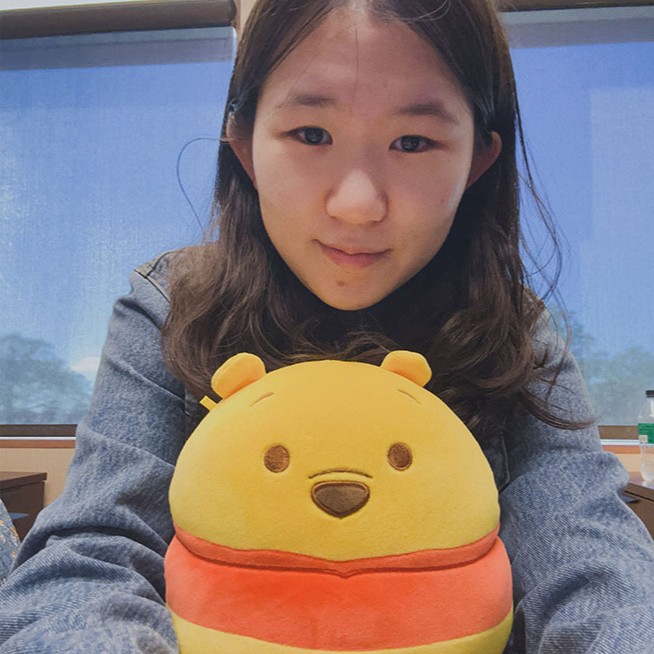
About Erin Yoo
Hi, I'm in the Columbia College Class of 2029, interested in exploring the intersections of neurobiology and storytelling, particularly the stories behind the science. My Laidlaw research project delves into the molecular and behavioral signatures of pain and stress in dorsal root ganglion (DRG) neurons in mice.
I am a/an:
University
Laidlaw Cohort Year
Research Topic
Area of Expertise
I am from:
I speak:
Followers











Recent Comments
Tomás, your project sounds very interesting! I also ended up changing the scope of my project from behavioral assays to morphological assays for corticosterone-treated dorsal root ganglion neurons. I'd be excited to hear more about your experiences using GitHub code repositories for your project on transnational bioethics funders. I'd be curious which variables you've coded to analyze differences in the quantitative baseline of bioethics funders across nations.
Hey Erin!
Thanks for sharing the IHCs from your project. I've heard so much about your project just verbally, but it's so amazing to see some of the fruits of your labor and the physical manifestations of your research! I am currently in a Dry lab, right now but your project seems super cool and has inspired me to branch out a little and maybe try doing more wet lab-related stuff in the future.
Thank you, Karthik! I'm very excited to see how the morphological, biochemical, and molecular correlates connect with one another within the broader context of stress-modulated nociception. I am looking forward to hearing more about your experience working in a dry lab and the algorithms you employ in your project!
Karthik, it's super interesting to hear more about your project on SLPs in cosmeceuticals! I remember having read The Poisoner's Handbook and learning about toxic chemicals in consumer products that have now been removed due to concerns about their effects on human health. I would be curious to learn more about the algorithms you use in analyzing the harmful chemicals and whether it's a particular dosage of SLPs or the presence of SLPs at all. Looking forward to hearing more as your project progresses!
This sounds like a super interesting project! I realize just how many variables are involved in a student's retention of information, from visual patterns to page transitions and other stimuli, and I'd be curious to learn more about what kind of algorithm your team is utilizing for this endeavor. I'm looking forward to hearing more about how your project progresses. Wishing you luck with your R-script writing and your presentation with the RevChem team in July!
Wishing you luck on your IHC assays! For a FroSci research project last semester, I investigated the effects of chronic stress on the hippocampus and human habits that contribute most to the growth or shrinking of memory capacity. I am super fascinated learning about your work diving deeper to conduct a neuron-level analysis of stress's effects and the control the peripheral sensory neurons have in our perception of pain. I'm curious to hear about your findings and understand if chronic stress not only decreases our grey matter volume but also contributes to physical pain that we perceive to experience.
Thank you, Claire! It's very interesting to hear about your project on chronic stress on the hippocampus with regards to memory and habits! In the literature, the hippocampus was actually thought to be the most excitable type of neuron in relation to stress exposure, until relatively recently, within the past 30 years, when dorsal root ganglion neurons, which are pseudounipolar neurons, were found to be more excitable to the effect of stress.
Rinaz,
This sounds very interesting! I'm also going to be using confocal microscopy, particularly to image my immunohistochemical assays of corticosterone-treated and control dorsal root ganglion neurons. Looking forward to hearing more about how your project progresses!
Leo,
I also agree that communication is an integral aspect of leadership, and I, too, have learned a lot from the case study. I'd be excited to hear more later in the program about how you've implemented this kind of leadership in your research team!
Leo,
It's interesting how these other viewpoints and perspectives from the '60s and the '70s help provide a multi-dimensional lens, like in the spheres of advocacy and politics that you mentioned. Excited to hear how your project progresses!