- While all Laidlaw Scholars will be presenting their research at the Columbia Undergraduate Research Symposium in the fall, what are the more immediate expectations that you have for your research? Are you writing a paper? Will your research be part of a larger scientific study? Do you hope to produce an annotated bibliography that you reflect on down the line? Is your research now the first phase of a project you’ll continue to work on throughout the year, and/or next summer? Now that we are nearing the one month mark of the program, please write about your expectations for your research.
As a Laidlaw Scholar, I am currently writing a paper outlining my project for the six weeks of the program. Overall, my research is part of a larger lab paper that explores the many facets of activity-dependent transcription in dorsal root ganglion neurons. Through meetings with the lab PI, I am creating an annotated bibliography by presenting relevant literature in my field and connecting it back to my own project, noting the future directions or questions it raises.
- Why does your research matter? Explain the significance of the question you are investigating, and why you are interested in it.
Chronic stress influences nociceptive processing and how sensory neurons detect and transmit painful stimuli. The somatosensory system is responsible for detecting touch, temperature, proprioception, and pain. Within this system, dorsal root ganglion (DRG) neurons serve as peripheral sensory neurons connecting the spinal cord to the skin and other tissues. Understanding how stress affects DRG neurons is therefore essential for explaining the stress-associated modulation of pain sensitivity.
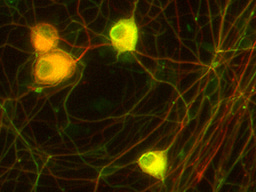
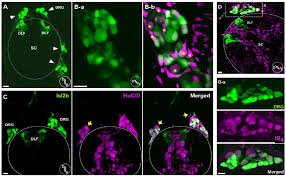
P.S. In the header of this blog post, there's an example of immunohistochemistry (IHC) from dorsal root ganglion neurons. I will be conducting my IHC assays next week and analyzing them via the confocal microscope and ImageJ/Fiji.
Hi, I'm in the Columbia College Class of 2029, interested in exploring the intersections of neurobiology and storytelling, particularly the stories behind the science. My Laidlaw research project delves into the molecular and behavioral signatures of pain and stress in dorsal root ganglion (DRG) neurons in mice.