Courage Wrapped in Fear
Courage Wrapped in Fear
Note: This piece was written before the recent tragic events at Brown University. My thoughts are with the Brown community.
Three months into my first job as Community Ambassador at the Laidlaw Foundation, @Susanna Kempe, the Foundation’s CEO, complimented my writing and suggested I should hone it further by attempting a Thought Leadership piece. Having only just graduated three months prior, I did not particularly identify with the title of ‘Thought Leader’. The idea felt daunting, and in the whirl of life's bustle and chaos, the piece was quietly buried.
A year into my role, I realised I still hadn’t touched it. I felt unqualified: as a 22-year-old finding my footing in the world, what could I possibly teach others about leadership?
What I have come to realise is this: for young people today, bravery rarely looks heroic. It seems ordinary, imperfect, and ongoing. It is saying yes before you feel ready; acting while afraid. It is choosing growth over comfort in a world that constantly urges you to be a perfect, flawless, finished product.
This question led me into deep reflection. One idea kept circling my mind - ‘Brave’, the theme of the 2025 Laidlaw Scholars Conferences. What does it mean for a young person to be brave in a world that feels huge and terrifying in so many ways? Bravery often appears large-scale and out of reach, reserved for extraordinary people or dramatic moments. Sometimes, I think that simply existing as a young person today is a brave feat. Yet, I have never really thought of myself as particularly brave.
Despite this, through the conferences and all the conversations I observed, I discovered that I do possess brave qualities. More importantly, I realised that many others do as well, often without recognising these qualities in themselves.
As someone who has spent months working towards conferences centred on ‘brave’, constantly collecting crumbs and golden nuggets of insight like a magpie and stitching them into a patchwork of ideas, I feel privileged. I am also uniquely positioned as a former Laidlaw Scholar now working on the other side – an observer of new generations of Scholars, and a learner within a truly extraordinary global community.
At the 2025 Conference hosted by Brown University, Dr Prudence Carter, Professor of Sociology, said something that genuinely altered my brain chemistry:
“We need your courage, even when it’s wrapped up in fear”.
What monumental words. Courage, I realised, does not mean the absence of fear but acting despite it. To be brave is not necessarily to move forward confidently, but to move forward while trembling.
Through reflection over this year, I have come to think of bravery not as a single moment, but as a collection of microscopic instances, which can be summarised as:
- Bravery as saying yes – even when you don’t feel ready.
- Bravery as imperfection – allowing yourself to be seen learning.
- Bravery as vulnerability – admitting uncertainty and asking questions.
A month before the Laidlaw Conference at Durham University, I was asked to step into a more significant role in events. In all honesty, I felt unprepared. Up until then, my involvement had been more behind the scenes. I felt excitement, but pressure. On top of that, a familiar companion crept in: imposter syndrome. Despite this, I said yes.
I would not previously have considered saying yes as a brave action. But now I see that it was. I could have said no and remained comfortable. Instead, I stepped into something unfamiliar, stressful at times, and shadowed by a constant fear of making a Big Mistake. That moment never came, or if it did, never on the catastrophic scale I envisaged. Organising these events became one of the most enriching experiences I have ever had, and the small act of saying ‘yes’ was the catalyst.
This is a pattern I now recognise across young leaders: we underestimate the bravery of participation and showing up, because we are often taught that leadership should arrive in a perfect, fully formed package.
To echo the title of Dr Carter’s Keynote speech, “Falling into Leadership”, I learned that part of being brave is allowing yourself to fall into responsibility, into uncertainty, into something you know will be difficult.
Once I accepted that role, more small acts of bravery followed. Refusing to take “no” for an answer when advocating for something important. Scanning emails obsessively to ensure I hadn’t made a mistake and sitting in one-to-one meetings with Important People. Meanwhile, a voice inside me whispered that I would be exposed as underqualified and inexperienced.
Perhaps this is generational. Many of us are perfectionists, shaped by an era of polished LinkedIn posts, flawless ChatGPT prose, and constant comparison. The fear of a grammatical error, a spelling mistake or – worst of all – sounding like an actual human being can feel paralysing.
Much of the way leadership is implicitly presented to young people, on LinkedIn, in classrooms, and even at conferences, privileges confidence over courage. But confidence is often the result of bravery, rather than the prerequisite.
Lately, I have been trying to embrace the sound of my own voice, occasional mistakes and all. To me, just embracing imperfection is an act of bravery. Perfectionism has stunted my growth for years, and now I am actively looking for opportunities to fail, again and again, even when it feels excruciatingly awkward.
Enough about me.
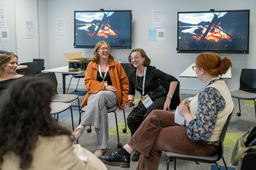
At the conferences, bravery was ubiquitous. Scholars presented research to large groups of peers. They stood and showcased their posters to editors from the Taylor & Francis Group. They led Leadership in Action Campfires, telling authentic stories to others they barely knew. Some travelled alone to a new country, arriving among 250+ unfamiliar faces.
Scholars asked questions, even in a vast ballroom that held space for vulnerability. Dr Carter herself acknowledged this as a key tenet of leadership: the ability to show vulnerability. In a personal branding masterclass, one Scholar admitted they struggled to answer questions about themselves. The honesty of that moment struck me. As Dr Carter noted, one of the bravest things a leader can say is, “I don’t know”.
And to those who didn’t speak publicly or raise their hand: that does not mean you weren’t brave. Bravery isn’t hierarchical, and no fear is too small. Asking someone a question one-to-one, approaching a poster presentation, making the effort to connect. These quiet actions are equally important.
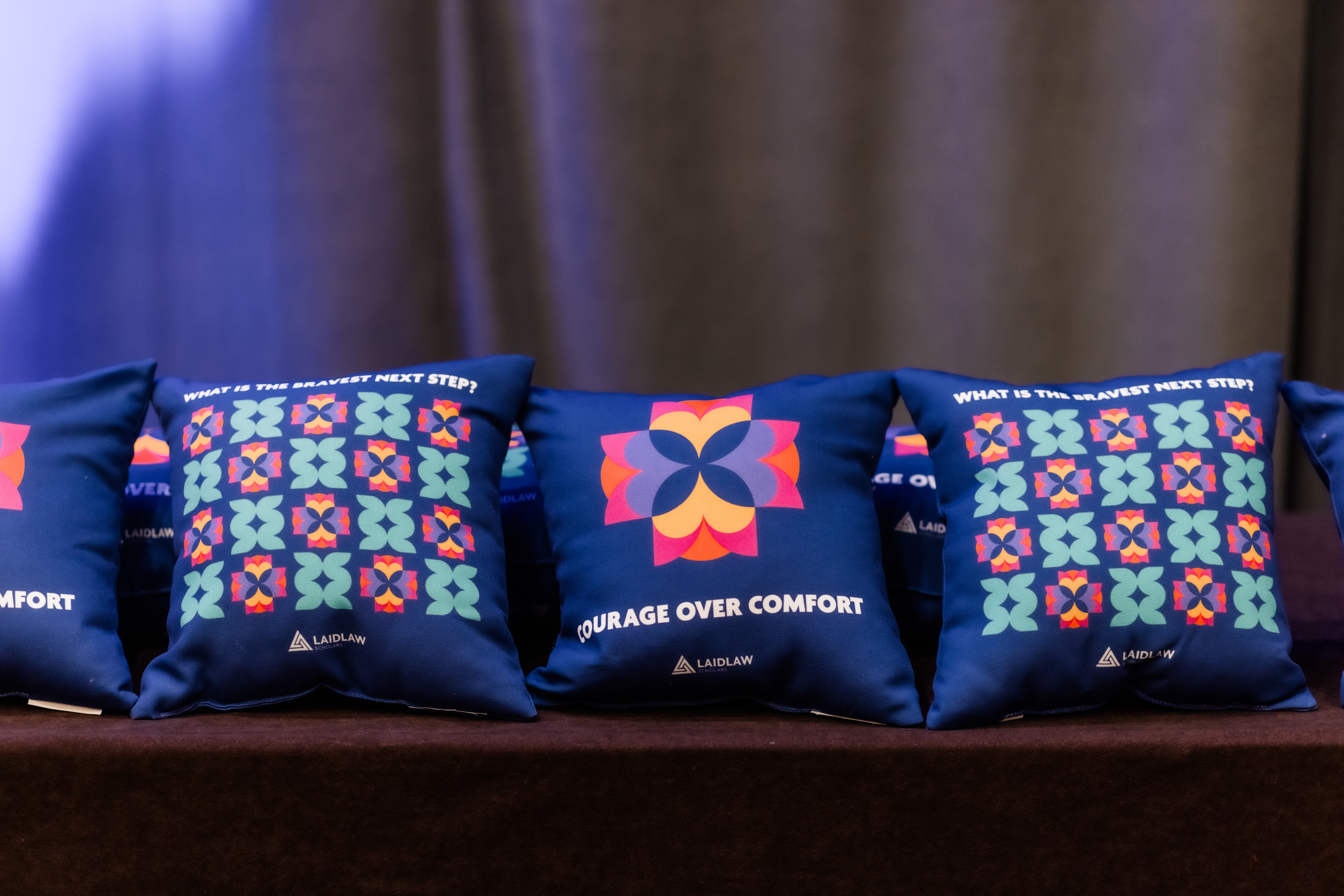
What I’ve learned is this: bravery is not always loud, polished, or visible. It is often deeply mundane. It is choosing growth over comfort when there is no blueprint. It is asking how you can do something better. It is curiosity and self-reflection. It can be saying yes, even when you’re afraid.
As Alex Staniforth, adventurer and keynote speaker at the Laidlaw Conference in Durham, said:
“Bravery is not the absence of fear but the refusal to be ruled by it.”
If we want to develop brave young leaders, we must stop only rewarding confidence and begin to recognise courage in its quieter, more ordinary forms. Bravery might look like asking a question, admitting uncertainty, or simply showing up. And perhaps the most important thing we can teach young people is this: you do not have to feel ready to begin.
Hi everyone! My name is Hannah and I’m the Marketing Manager at the Laidlaw Foundation.
I was previously a UCL Laidlaw Scholar in the 2022 cohort, where I studied English Language and Literature. It’s a real privilege to now work with the community as part of the Foundation team.
My role focuses on building and nurturing an engaged global Scholars network, creating events that strengthen connection, and shaping how we share the Foundation’s work and impact.
In my spare time, I love cooking new dishes, reading, going to the theatre, and café hopping around London.
Please don’t hesitate to reach out or connect with me on LinkedIn. I’m always happy to chat!