Summer 1 Blog - Lessons Learnt
My summer 1 research project has been one of the most rewarding, challenging, and inspiring experiences of my time in university so far. There were ups and downs, copious tears, and plenty of missteps, but I would not change it for the world. I am immensely proud of the work conducted over the course of this research, which was only made possible through the help and guidance given by my family, my wonderful academic supervisor Dr Phil Mullen, the amazing Joel and Orla from the Trinity Laidlaw team, all of those who participated in the study, and last but definitely not least, the incredible fantastic brilliant people at Sport Against Racism Ireland (SARI) – my greatest thanks to Kerrie, Perry, Fayaaz, and the rest of the team for allowing me the privilege of collaborating with you during my research on the Football for Unity project.
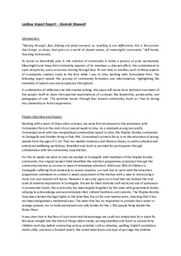
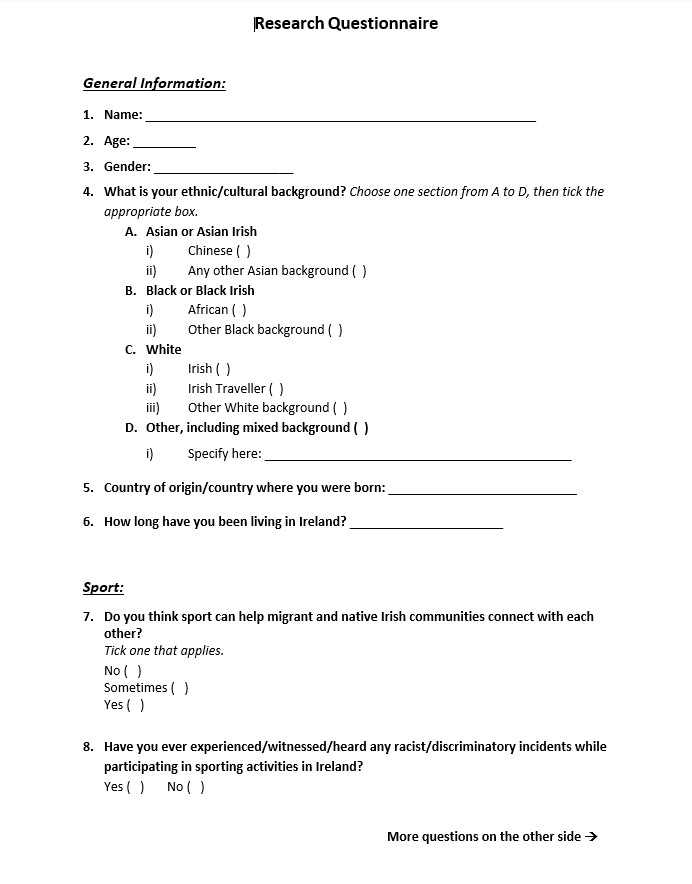
Setting out, I had a very clear idea of how I wanted to structure my project. Each stage was scheduled to last 7-9 days, and there would be very little overlap between the different stages. I pencilled in a week for a full literature review (mistake number 1), a week to make and distribute a survey to over 200 people (mistake number 2), two weeks to conduct twelve semi-structured interviews (mistake number 3 – are you starting to see a pattern here?), with the last two weeks put aside for thematic analysis and tying up any loose ends. Needless to say I learnt some harsh lessons about the reality of conducting research:
- Research is Collaborative
Going into this project I subconsciously planned and structured the research as if it were an essay or individual college assignment. I went into the project as if I was studying for an exam, firmly placing the responsibility of information-finding on my own shoulders. This INDIVIDUALISTIC APPROACH WAS NOT A GOOD IDEA. As a second-year undergraduate student, it turns out I did not have much prior knowledge about my area of research. Even using software like Google Scholar and Connected Papers, I found myself stuck reading through articles that were no longer accurate, relevant, or useful.
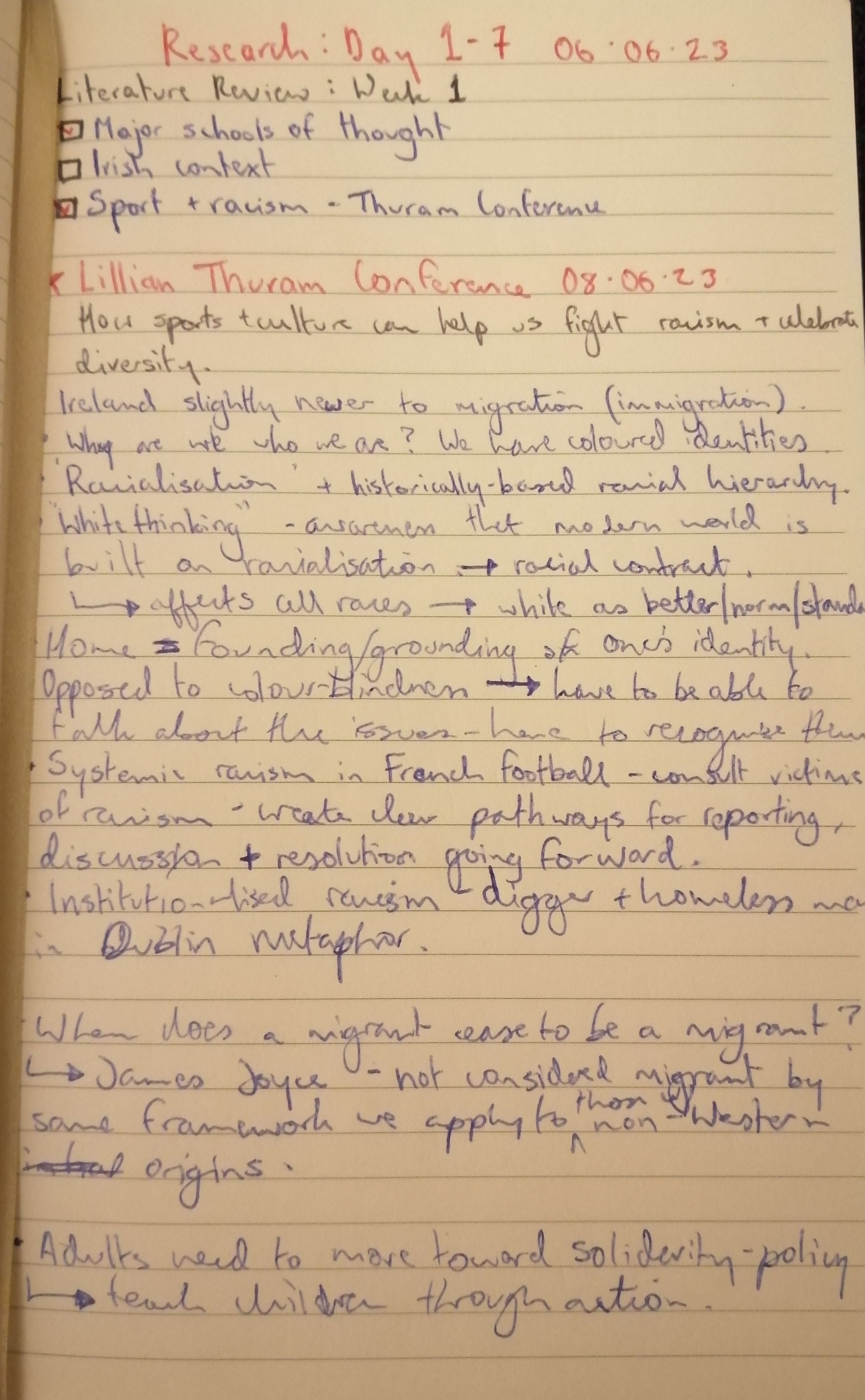
As I was getting more and more bogged down in the seemingly never-ending cycle of find article, download article as PDF, read article, realise article was not what I needed, look for new article, I became more and more stressed. It took meeting with my Action Learning Set group to realise that I was in fact not meant to be conducting this project entirely by myself. They encouraged me to get in more regular contact with my supervisor, to not be afraid to ask questions, and most importantly, to be able to recognise when I needed some external guidance. Allowing other people to help you and work with you on your project is the key to good research, a realisation that made all the difference to the amount of pressure I put on myself to be productive.
- Perspective is Important
Repeat after me – YOU ARE NOT YET AN EXPERT OR PROFESSIONAL IN YOUR CHOSEN AREA OF RESEARCH. Over the course of my project, and even now, I was plagued with fears and anxieties about whether my research mattered, whether it was making any kind of meaningful contribution to the field, and whether the sky would fall down Chicken Little-style if I did not complete my project within the six-week timeframe. It took a lot of reflection and active attempts at mentally stepping out of my own perspective to realise that these worries were largely redundant. For the majority of Laidlaw scholars, this project is our first taste of self-directed research, and it seems no one but ourselves expect ground-breaking and entirely world-changing discoveries.
While such discoveries would be amazing, they are not required to make your research project and Laidlaw experience a good one. I wanted to complete my project to the highest standard, as we all do, but somewhere along the course of the six-weeks I (thankfully) realised that I can fulfil that aim without beating myself up for doing an hour less of work than I had planned. If your Laidlaw research project has indeed saved the world, I tip my hat to you, but I think that one of my greatest takeaways from this experience is the realisation that we should put as much stock in celebrating the ‘small’ wins as we do the big ones.
- There is No Perfect Way to Research
Research is a continuous, flexible, and an often entirely unpredictable process. IT WILL NOT GO AS PLANNED. The initial six-week period is finished, yet I still have a lot of work to do before I would consider my project completed. Unforeseen delays emerged as a result of having to rely on other peoples’ schedules, not having access to certain software, and organisational mix-ups. Not all of these delays were immediately solvable, nor were they all ultimately overcome. Life happens, even when you have a research project to do. As a self-anointed planning freak, I struggled greatly with the unpredictability of primary data gathering. I was constantly fretting that I would not be able to do exactly what I had planned to do and that other researchers would have dealt with these problems better than I was. Comparison is indeed the thief of joy, as I found out when obsessively reading over the research reports of other Laidlaw scholars who had seemingly completed their projects flawlessly.
In reality, everyone who has ever conducted research has encountered setbacks, making my own project no different. Everyone researches differently, and a 9-5 schedule (the very thought of which had me spiralling prior to starting my research) is often not sustainable or suitable for most people. Planning and organising your work is important, but so is being flexible with that work. You are not always going to have the same energy and motivation levels every day. Some weeks may be the most productive you have ever been, while others may leave you feeling like nothing has or will ever be done. Ups and downs are natural and inevitable. Research is messy and I have come to recognise that there is definitely no perfect way to do it.
Overall, I have really enjoyed challenging myself to come up with creative solutions to the problems I encountered and I have learnt a lot about my capacities as a researcher. I handed out surveys, conducted semi-structured interviews, and reviewed the existing literature on my topic. I have figured out how to ask for help, and do not struggle as much anymore when faced with a flexible schedule. Alongside my own personal development, my experience researching the Football for Unity tournament run by the amazing team at SARI was an honour and privilege that I will cherish for a very long time. To witness a group of people who really care about inclusion and the celebration of diversity in Ireland was really heartening, especially in a time of overwhelming negative media coverage toward refugee and immigrant populations in Europe.
Life permitting, I am planning to finish my thematic analysis as soon as I can. Once that is done I hope to write an academic article detailing the study and any implications its findings may have on the provision of community-led sports programmes aimed at integrating immigrants in Ireland. My Laidlaw experience thus far has been overwhelmingly positive, and I am very much looking forward to experiencing what the rest of the programme has to offer.
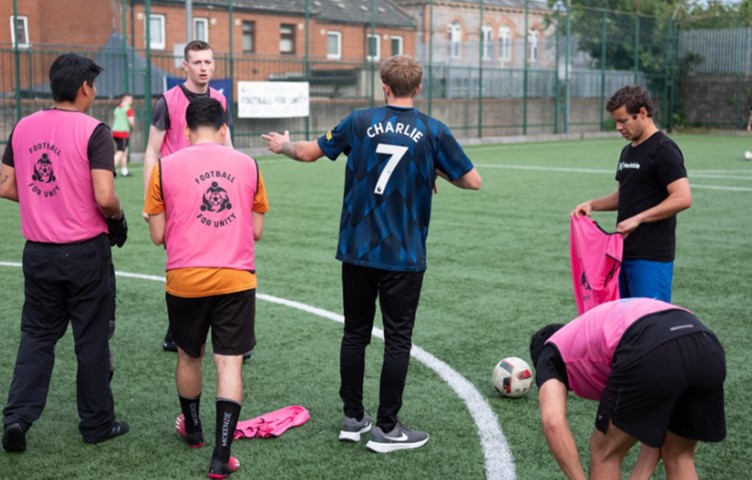
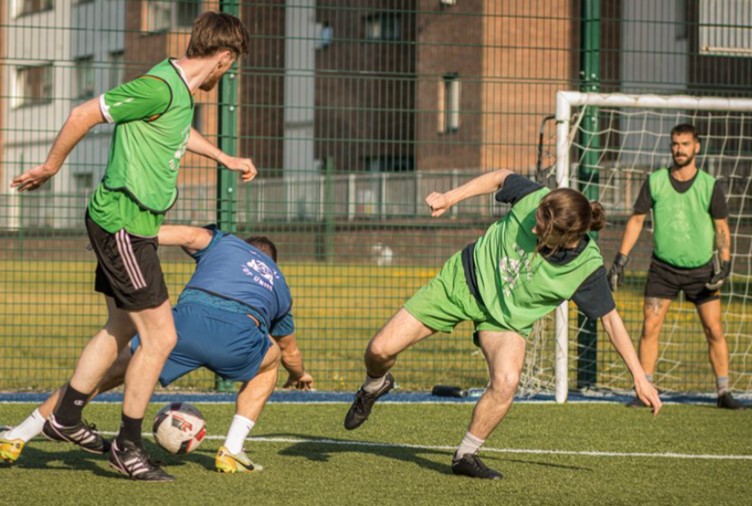
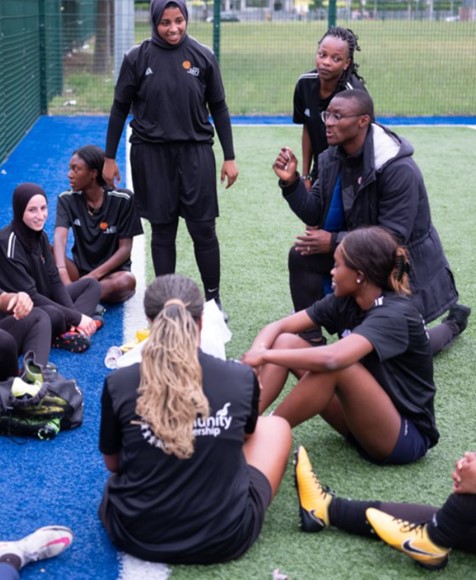
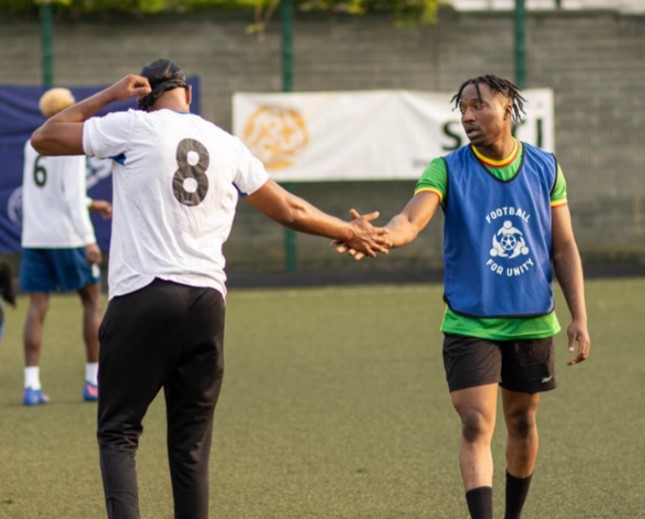
All photos from Football for Unity2023 included below are used with the express permission of Sport Against Racism Ireland.

I am currently an undergraduate PPES student at Trinity College Dublin. I have chosen the Joint Honours Pathway, specialising in Political Science and Sociology.
My research project for summer one, titled "Sporting Bonds: Can sporting programmes properly facilitate the meaningful integration of migrant and host communities in Ireland?", concerns the efficacy of community-led integrative programmes that use sport as a means of blurring inter-cultural barriers and bringing together diverse communities. I will be working with Sport Against Racism Ireland, an established Irish NGO that delivers various sporting programmes aimed at facilitating and implementing anti-discrimination practices in Irish communities.
In my spare time I enjoy playing football and basketball, reading, and wandering around taking photos of things I see.