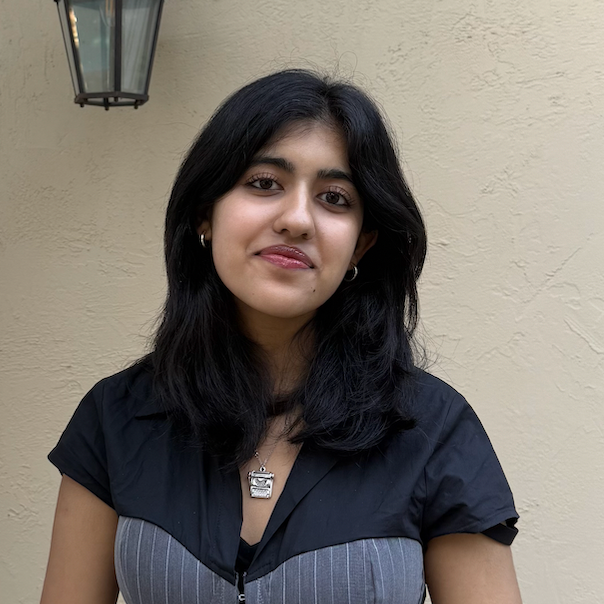
About Ruchi Mangtani
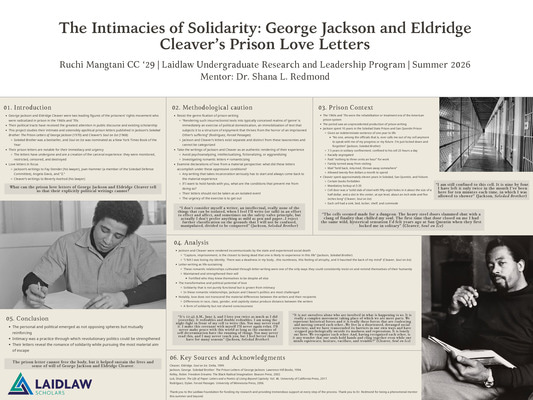
I am interested in the 1960s-70s prisoners' rights movement. In the past, I spent significant time researching the Attica Prison Uprising, the deadliest prison rebellion in the United States. Prison writing was a defining mobilizing force for the incarcerated people at Attica, and I am eager to delve into prison autobiographies in particular this summer as a progressive art form that has challenged literary expectations and engendered a collective voice of incarceration.
Outside of research, I am heavily involved in advocacy and volunteering related to criminal justice.
I am a/an:
University
Laidlaw Cohort Year
Research Topic
Area of Expertise
I am from:
I speak:
My hobbies/interests are:
Followers






Popular Content
Field Journal, 2026 Scholars, Week 2
Reflecting on reading prison writing and resisting subconscious biases I may have.
Field Journal, 2026 Scholars, Week 5
Navigating new challenges with a more narrow research topic and how to conduct my research responsibly.
Recent Comments
Really interesting project! I'm curious about the non-traditional sources you explored, and if a certain song or social media post stood out to you.
Hi Celine! I'm inspired by how you reached out to people beyond your Laidlaw bubble to gain guidance. I think it's easy to become stuck in your own thoughts or within the same set of perspectives, so your strategy to seek an extra pair of eyes seems very helpful. As I am writing my paper, I am also considering who I might want to share my writing with beyond my current mentors for new insights.
Hi Tomás! It's interesting to read about how you've been working on a larger team effort that goes far beyond you and is only just beginning. As someone working on an independent project, it has been difficult for me to trace the outlines of my project, since it feels like I could research forever and still only scratch the surface. I am curious if working in a multi-university project has made you feel alienated in any way from the research goals, or if you feel like you can clearly see how your work is contributing. I also wonder if you work closely with your teammates or mostly alone.
Hi Christian! I think you pointed out an important factor of leadership - to be both aware of the tangible stakes at hand and the individual needs of each member. The case example we were given during the Leadership Retreat was a perfect example of this; the group very well may have run the event successfully, but if relationships were broken in the process, or if they wouldn't be able to run another event in the future together, that leadership dynamic is not sustainable or commendable. I also appreciate you recognizing how being a leader means uplifting those around you, rather than fearing how other people's successes may threaten yours. It's about seeing how everyone's successes will contribute to a greater whole.
Hi! It was really interesting to read how you are considering balancing the participants' agency and the need for unbiased data, which may require withholding some information. I am curious what the norms are regarding these somewhat conflicting interests in scientific studies. I participated in a psychology study last semester, and I remember not being told what the experiment was specifically for, but I was allowed to withdraw at any time if I was uncomfortable. Afterward, they gave me an in-depth explanation of what my data was used for. This may be a way to respect the participant's autonomy while ensuring the validity of the data.
Hi! I really resonate with not knowing what the start-to-finish will look like and struggling to fit everything you want to study in just 6 weeks. I imagine there will be many different turns and misdirections, and the final product will be somewhat unexpected, but I think that is also the fun of research — letting the "mistakes" lead to discoveries. I am curious how you might integrate your interest in policy in the second summer. I am also studying many historical and autobiographical accounts, so it will be interesting to see how these findings can be applied to the contemporary moment.