What are some of the ethical issues that you are grappling with in your research? What are some of the ways in which you are responding to these questions?
On my first day of research last Tuesday, I completed a human subject protection course to prepare for conducting participant trials independently in future weeks, and the most crucial document I read during this training was the Belmont Report. While three key principles define the report, Respect for Persons stood out to me, which emphasizes giving complete agency to participants in their decision to involve themselves in the study. The entire goal of RevChem's research this summer is to restore agency in chemistry problem solvers, yet in order to restore agency in the long run, must we restrict it temporarily to collect unbiased data?
This dilemma reemerged this week as I was crafting the researcher's script that will ultimately be read to a participant over the course of a trial. What is included in the script to inform the individual about the experiment they will undergo imminently, and what is withheld to preserve the integrity of the data? For instance, from an ethical standpoint, participants need to know their vision is being tracked, yet my current work involves crafting language that provides enough information without causing participants to fabricate their visual behavior or alter their technique before being prompted. It is easy for participant's behavior to stray from how they would interact naturally with a chemistry problem, so I must prioritize both authenticity and ethics in the control test.
As you continue your research, have you considered alternative viewpoints in your investigation? If so, how have these alternative viewpoints enriched or changed your project?
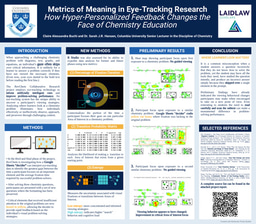
This week, I have been focusing on different ways to analyze eye-tracking data efficiently in the middle of a study. At around the halfway point of a trial, participants will receive a 5-10 minute break while the researcher analyzes the data obtained so far about where a participant focused v. skimmed, for how long their gaze fixated on certain areas of the screen, the pathway of their eye movement, and a combination of other variables. Therefore, there are multiple methods to break down this data and different variables to single out in determining the type of feedback the researcher can provide. However, all of this analysis must happen extremely quickly to respect the participant's time.
While I had some ideas coming into this week about how to break down these data, I was recently exposed to entropy as a quantifying tool. In short, higher entropy can indicate a higher cognitive load, or that more mental work is required for an individual, and calculating entropy is an easy jumping off point for data analysis. This unexpected approach has redefined the work I have done and continue to do this week in developing analysis protocols.
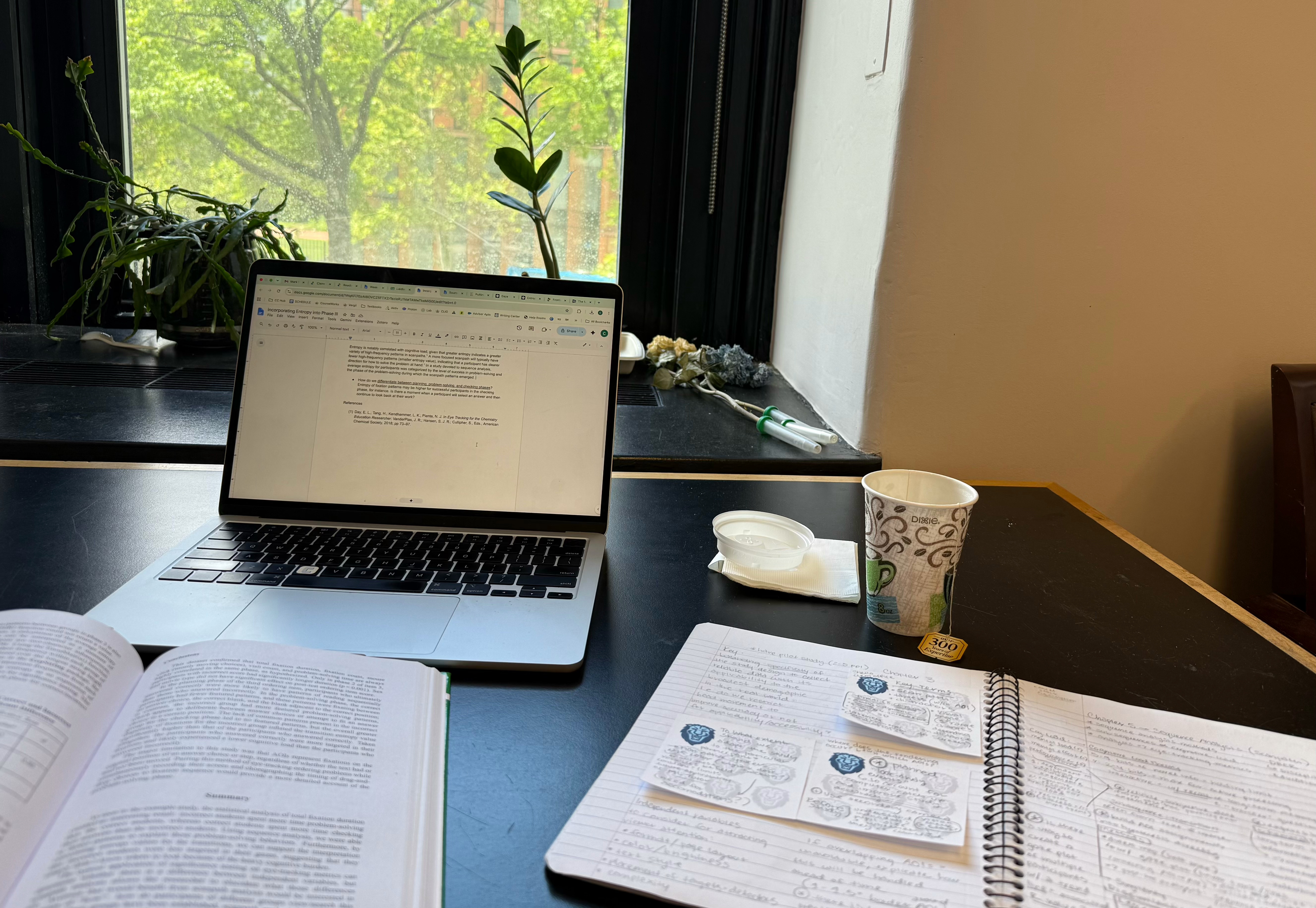
Where does your research take place? Take a photo of the place where your ideas and investigations are taking place, and post it to the Network!
I'm very grateful to be able to work at a desk in the Chemistry department office with a window that looks out to Broadway (as photographed above). I've met some awesome administrators in the department and am really enjoying this new space for research.

Hello! My name is Claire Buchi, and I am a sophomore at Columbia University from Los Angeles, California studying Medical Humanities and Public Health on the pre-med track. Some of my academic interests include metacognition, writing, and health equity from an educational and technical perspective.
This summer, I conducted eye-tracking research in chemistry education, analyzing how learners approach challenging questions and developing an AI tutor that can encourage more effective problem-solving strategies across a broad demographic.
In my free time, I love dancing, running, reading and trying new places to eat around New York. Feel free to reach out to talk research or to just say hello!