The following allows you to customize your consent preferences for any tracking technology used
to help us achieve the features and activities described below. To learn more about how these trackers help us
and how they work, refer to the cookie policy. You may review and change your preferences at any time.







Recent Comments
Nike, I'm really interested in the personalized nature of your research, especially through social media! Since my project covers so much about digital life and how it has eliminated but also preserved several forms of personal media/records/ and archives. I'd love to talk more about what it means to catalog one's life on a platform like Instagram compared to more material forms like physical photo albums or letters and cards!
I found your focus on prison letters really interesting, especially because letters represent such a different mode of communication than what most of us are used to today. The physicality of a handwritten letter creates a level of intimacy that can be hard to replicate through digital communication. Every aspect of the letter- the handwriting, edits, spacing, and even signs of wear, carries traces of the writer's presence in a way that typed text often does not.
Your discussion of letters as both fragile and urgent made me think about how much technology has changed our expectations around communication. Today we expect messages to be delivered instantly, but prison letters depend on time, distance, and uncertainty. The fact that writers often did not know whether their words would reach their intended audience makes the act of writing feel even more powerful. I'm curious whether you've thought about how the material form of the handwritten letter itself contributes to the political and emotional significance of these texts.
I really appreciated your point that some of the qualities we often associate with weakness, especially vulnerability and admitting mistakes, can actually be signs of strong leadership. Columbia doesn't always feel like the safest environment to admit to not knowing it all, but your observation about creating an environment where failure is accepted as part of learning really resonated with me. Being willing to acknowledge confusion and ask for help takes a great deal of humility!
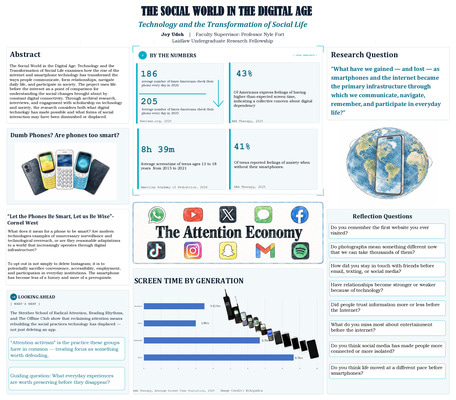
Evalina, your ethical dilemma on the use of AI in your project really intrigues me, especially because my project is on the role of technology in our society! When does a tool go from powerful to dangerous or unethical? Is it when the creator of the tool makes it too powerful, or when users overuse it?
I definitely relate to the struggle of narrowing down the scope! My project explores pre-internet Black life in comparison to modern Black life, and there is so much time between those points, so it's hard to know where to narrow in. Breadth vs depth is such a great way to frame this, and I'm sure that with more work with our librarians, it'll be easier to find converging ideas to make deeper points with a variety of sources.