It's hard to believe that we are well past the mid-way point of your Laidlaw research summer!
- What new ideas, challenges, or other issues have you encountered with regard to your project (this might include data collection, information that contradicts your assumptions or the assertions of others, materials that have enriched your understanding of the topic or led you to change your project, etc.)?
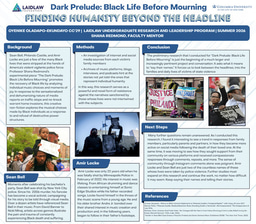
- My research heavily depends on digging through social media postings and personal interviews with family and friends of victims of violent police brutality. However, I have had difficulties with finding consistencies and creating stories out of such general resources. With social media, there is no standardization, which means that a lot of the work can be speculative. However, the very complexity of the nature of this work has enhanced my understanding, because now I see the importance of including these narratives. The stories told on social media are still important stories to be heard.
- How have these ideas or challenges shaped the bigger picture of your research? Has the scope or focus of your topic changed since you began this project? If so, how?
-
It has, in fact, changed the bigger picture of my research. when analyzing individual case studies of those murdered by police force, I start to see similarities in both the public response, and private responses of families. I see how they handle their grief, and how they never fully move on from their loved one, especially when justice was never shown. My scope has changed to include cases like Sean Bell.
-
- Now that you’ve engaged in Part II of the Leadership Retreat, reflect on a learning point that remains with you as a new way to understand leadership, and to incorporate into your own engagement, in the future.
-
Part II of the leadership retreat taught me that there are different forms of showing up as a leader. Leadership does not require co-opting a project or taking over. Instead, it can look like the drive to enact change, no matter what role you play. People can be leaders from behind and within, just as much as they can lead from the front. I want to incorporate using criticism as a means of understanding the other person criticizing.
-