The pursuit of peace and progress cannot end in a few years in either victory or defeat. With its trials and its errors, its successes and its setbacks, [it] can never be relaxed and never abandoned.
![The pursuit of peace and progress cannot end in a few years in either victory or defeat. With its trials and its errors, its successes and its setbacks, [it] can never be relaxed and never abandoned.](/cdn-cgi/image/metadata=copyright,fit=scale-down,format=auto,quality=95/https://public-storage.zapnito.com/aPqCUNBk9oxTbWwkB7o0yLfTsbe14iUXxumXgnvodBU)

Beyond victory or defeat: determined leadership in practice
As the 21st of September approaches and the International Day of Peace issues a universal call for nonviolence and collective ceasefire, we return to the enduring wisdom of Dag Hammarskjöld. His leadership, forged amid the major global crises of the twentieth century, offers a deeper insight into meaningful progress: lasting transformation rests on persistent commitment that reaches far beyond isolated moments or singular initiatives.
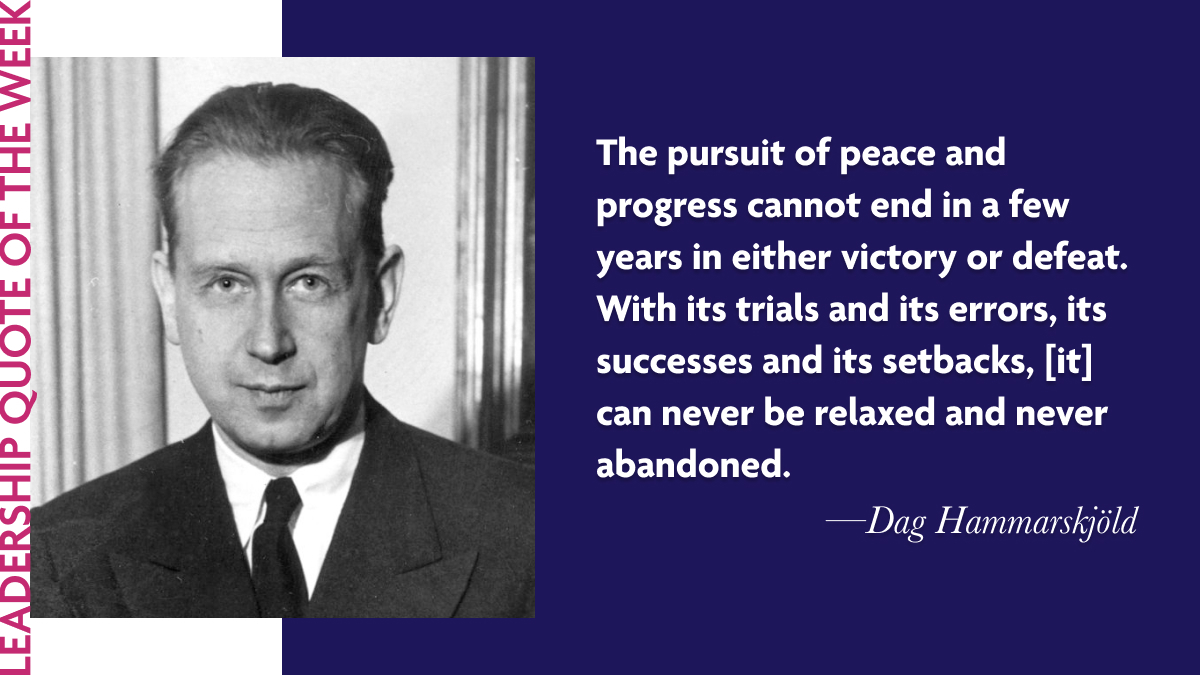
Dag Hammarskjöld: The pursuit of peace and progress cannot end in a few years in either victory or defeat. With its trials and its errors, its successes and its setbacks, [it] can never be relaxed and never abandoned.
Dag Hammarskjöld served as the second Secretary-General of the United Nations from 1953 until his death in 1961, transforming the role from administrative figurehead to moral authority on the global stage. A Swedish economist and diplomat, he incorporated philosophical depth with international governance, viewing his position not merely as political but as profoundly ethical. Hammarskjöld's tenure was marked by his innovative approach to peacekeeping, establishing the first UN Emergency Force and developing the concept of "preventive diplomacy." His perspective transcended the conventional binary thinking that reduces leadership outcomes to simple victories or defeats. Instead, Hammarskjöld understood that meaningful leadership operates in the space beyond such immediate classifications, where true progress unfolds through sustained commitment regardless of temporary triumphs or setbacks. His words, drawn from the United Nations Bulletin, speak to a fundamental truth about meaningful leadership: that true progress requires an unwavering commitment that transcends immediate outcomes and temporal boundaries.
Leadership Through Persistent Vision
Hammarskjöld's reflection sees past immediate political contexts to address a fundamental challenge in contemporary leadership: the tension between urgency and sustainability. His words acknowledge that meaningful progress operates on a timeline that extends far beyond individual careers, electoral cycles, or quarterly reports. This perspective demands leaders who can maintain vision and commitment despite setbacks whilst simultaneously recognising that each failure contains essential learning for eventual success.
Hammarskjöld's approach aligns with the Laidlaw value of being #Determined and the Oxford Character Project virtue of #Temperance. Determination commits leaders to sustained, purposeful effort even when early signals are ambiguous; temperance provides the composure to absorb setbacks without losing direction.
A Call to Reflect
We invite you to reflect on Dag Hammarskjöld's leadership insights as we approach the International Day of Peace. In your own leadership experience, how do you maintain commitment to long-term goals when immediate results are disappointing? Share your reflections on sustaining vision across the inevitable cycles of progress and setback.

Hi! I'm Amanda, a third year Neuroscience student and Laidlaw alum from UCL. I'm Swedish-Persian and grew up in Sweden before moving to London for uni. These days, alongside my studies, I work for the Foundation as a Marketing Assistant.
For my first year research project, I worked on optimising alginate hydrogels for 3D astrocyte culture systems. In simpler terms, I was figuring out the best way to prepare a jelly-like scaffolds so that star-shaped brain cells called astrocytes could grow in three dimensions rather than flat on a dish. This matters because 3D environments mimic the brain more realistically, which could help researchers develop better treatments for neurological disorders!
For my Leadership-in-Action project, I co-created Beyond the Books, a resource designed to help students from underrepresented backgrounds navigate the unwritten rules of university life, from internships and networking to professional opportunities that aren't always obvious if you're the first in your family to go to uni.
Always happy to connect, whether you want to chat about neuroscience, widening access, the Laidlaw experience, or just say hello! One of my favourite things about this community is getting to meet people from different universities and backgrounds, so please do reach out! 🌟