Celia Irving, a Laidlaw Scholar at the University of St Andrews, delves into the impact of the performing arts in shaping and sustaining the Esperanto language movement.
Celia Irving, a Laidlaw Scholar at the University of St Andrews, explores how performing arts have propelled the Esperanto movement as a tool for unity and cultural diversity.
Research Title:
Acting for a Universal Language: The Role of the Performing Arts in the Development of the Esperanto Movement
My research explores how the performing arts have played a pivotal role in advancing Esperanto to become the most successful planned language in history. Esperanto is an ‘artificial’ or ‘international auxiliary’ language created by Polish doctor Ludwig L. Zamenhof in the late nineteenth century. Zamenhof designedEsperanto intentionally for easy language acquisition, with only 12 grammar rules (no exceptions) and a vocabulary rooted in an amalgamation of Latin and Romance languages. Although the number of Esperanto speakers and the enthusiasm for the movement has fluctuated over the last century, today, estimates indicate that betweena couple hundred thousand to 2 million people speak Esperanto today. As a theatre history enthusiast, I was curious as to how the performing arts were potentially used to grow and validate the movement, particularly given that both the Esperanto movement and the performing arts have been historically used to advocate for similar causes.
I focused on three crucial eras in the Esperanto movement’s development and how the performing arts were used as a tool in each of these periods. These periods are: The Inception of the Esperanto Movement (1887-1914), The Recovery of the Esperanto Movement (1945-1980), and The Survival of the Esperanto Movement (1980–present). My research inherently rejects longstanding criticism that planned languages lack quality culture by demonstrating the long history of high literature and performing arts. Furthermore, it exemplifies the significance of the performing arts in promoting an international community and maintaining linguistic diversity.
Where did your passion for this research originate?
I’ve always loved theatre, and I’ve always loved history – but my passion for theatre history only emerged when I began the IB Diploma program in high school. Taking both IB History and Theatre at the Higher Level, I soon realized that the courses were inextricably linked. While I was studying the theatre theories of practitioner Bertolt Brecht, I was simultaneously learning about the rise of the Third Reich under which he was persecuted. As I studied the foreign policy of Imperial Japan, I was simultaneously practising the Noh Theatre of that period. I had to understand the historical context of the AIDS epidemic under Reagan to fully immerse myself in Tony Kushner’s Angels in America. The examples are endless. In my view, theatre cannot be fully digested without understanding its context and its stimuli, and in many cases, that context and stimuli are political history.
As for Esperanto, I knew of the language but had almost no exposure or interest in it prior to Laidlaw. Dr Bernhard Struck, a professor in the School of History at St Andrews, was advertising a separate pre-defined Laidlaw project on Esperantujo that I was interested in. But after speaking to him for the first time, I realized how many different directions work on Esperantujo could go: it’s an area of history that is largely unresearched. As soon as I raised the idea of doing the performing arts and the Esperanto movement, Dr. Struck was on board.
What is the most memorable moment from your Laidlaw scholarship experience so far?
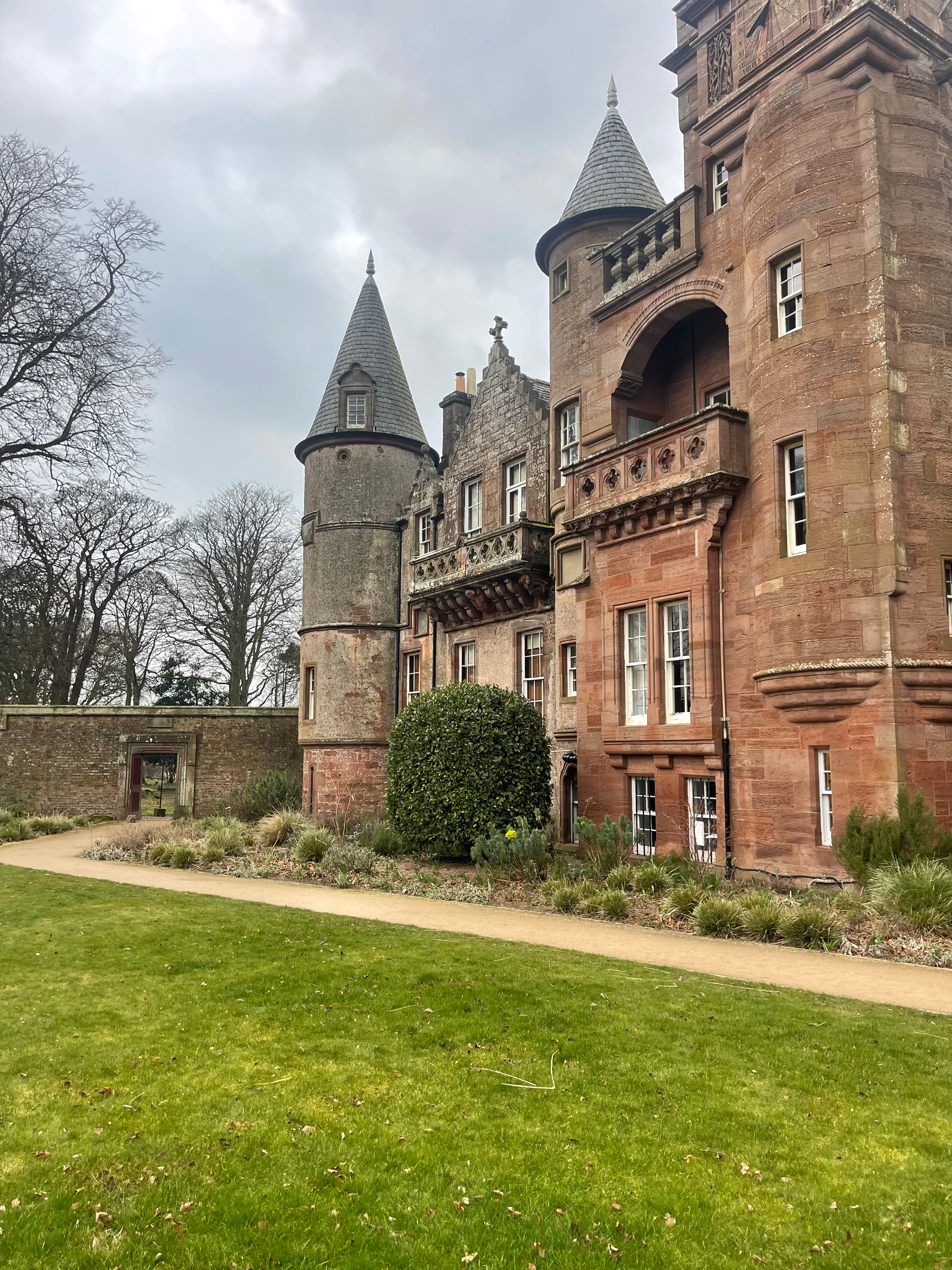
One of the most memorable experiences thus far has been our retreat to Hospitalfield. In March, the St Andrews Laidlaw cohort was taken on a lovely weekend retreat in Arbroath, an hour or so north of St Andrews. The venue, an arts centre and historic house was stunning and provided the perfect first opportunity to get to know the others in my cohort and a detailed understanding of what our Laidlaw journey will look like. I went into the program knowing only two of the 25 scholars, and I am happy to say that after Hospitalfield and Summer 1, I know them all! I still have another year left in Laidlaw, so I’m sure my answer to this question will be different in a year’s time. So far, Hospitalfield remains a standout highlight.
Hospitalfield, an arts centre and historic house in Arbroath. .
What is the biggest challenge you came across in your research and leadership journeys so far, and what did you learn from it?
In my research, the largest challenge was source accessibility. The history of Esperanto is already relatively niche, so narrowing my project even further to the performing arts made the list of available sources shrink. Many of the documents and play texts referenced in the works I consulted were either unpublished or inaccessible. I learned to get creative with the sources I could use. For example, I looked at contemporary blog posts on Esperanto forums to glean how engaged the movement was today – non-scholarly sources provided productive insights when used in the right way. The works I was able to use were so informative, but wide-ranging, from the first Esperanto films to puppet festivals to songs published in their old pamphlets. Thus, the subsequent challenge was piecing everything together in a way that was organized, engaging, and understandable. Shaping your project into something succinct is hard when you have such a breadth of information. I learned to be creative both in utilizing unconventional sources and in carving out the final version of my project.
What does it mean for you to be a Laidlaw Scholar?
To me, being a Laidlaw Scholar is not only an honour but an opportunity to challenge myself. Alongside my cohort, I am provided with the opportunity to challenge my own conceptions of leadership, to pursue answers to questions that may seem impractical or unanswerable, and to be a real changemaker in my university community and beyond. To be a Laidlaw Scholar is to be a member of a dynamic, supportive community that strives for self-improvement and the improvement of the world around us.
Which particular leaders inspire you the most and why?
The leaders that come to mind are those who have made a concerted effort to empower and connect with my generation via social media. One standout example is Ilona Maher, a member of the US rugby sevens team who became a breakout influencer at the Paris Olympics. Although I know very little about rugby, I found Ilona’s content to not only be fun and engaging, but incredibly important in promoting female athletes, the mental and physical well-being of women in sports, and positive body image. In the political sphere, Jack Schlossberg, JFK’s grandson, also comes to mind. He’s been using TikTok to get young people enthusiastic about the upcoming US election and the Harris-Walz campaign. His methods are a little unorthodox, but they’re effective. Leaders like Ilona and Jack are developing a new mould for leadership by recognizing the power of Gen Z and leveraging it to inspire positive change.
Briefly describe a scene from the future you are striving to create.
I envision a future in which justified calls for reform are not disregarded or scorned as ‘unrealistic’ or ‘naive’, and instead are seriously considered and weighed with an open mindset. A future in which academic, political, and community settings are not hindered from progress by those who feel threatened by dismantling conditions and systems that privilege them at the expense of others. A collective commitment towards diversity, equity, inclusion, and justice fosters meaningful dialogue and comprehensive steps towards change!
If you want to learn more about Celia's work, explore her research here and follow her on LinkedIn. Celia Irvingis a Laidlaw Undergraduate Leadership and Research Scholar at the@University of St Andrews. Become a Laidlaw Scholar to conduct a research project of your choice, develop your leadership skills, and join a global community of changemakers from world-leading universities.