Change happens by listening and then starting a dialogue with the people who are doing something you don’t believe is right.
Listening Before Change: Honouring the Legacy of Jane Goodall
On October 1st, the world bid farewell to a distinguished figure of scientific discovery and moral courage, Dame Jane Goodall. In honour of her extraordinary life and enduring legacy, we reflect on her words that continue to illuminate the meaning of transformative leadership:
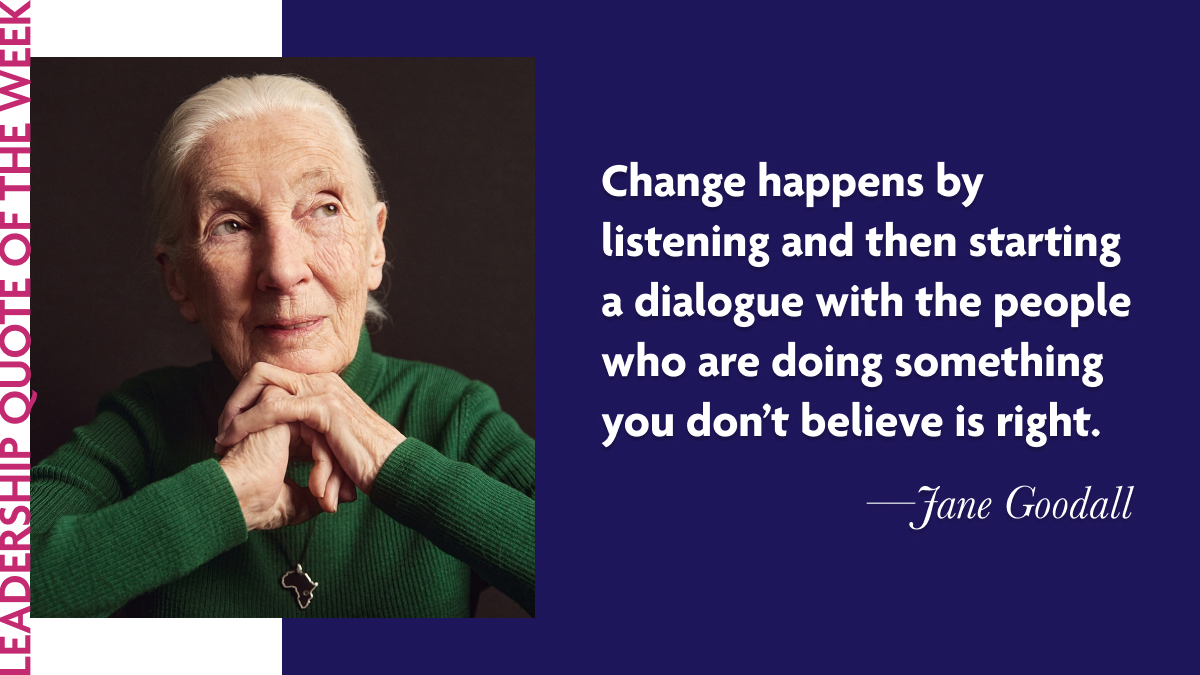
Jane Goodall: “Change happens by listening and then starting a dialogue with the people who are doing something you don’t believe is right.”
A Life Devoted to Understanding
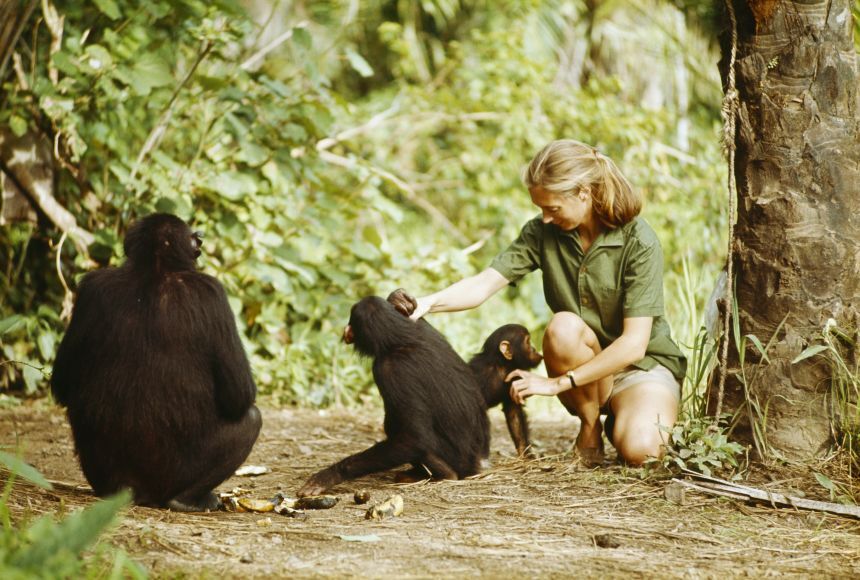
Jane Goodall was more than a primatologist; she was a visionary who fundamentally transformed our understanding of humanity’s place in the natural world. In 1960, at the age of twenty six, she arrived in Tanzania’s Gombe Stream National Park without formal scientific training. Through careful and patient observation, Goodall revealed the depth and complexity of chimpanzee social and emotional lives. She documented behaviours including tool use, hunting, cooperation, and expressions of empathy and grief. These discoveries challenged longstanding beliefs about human uniqueness in intelligence, emotion, and culture. Her approach, which involved naming individual chimpanzees and observing their relationships closely, broke scientific conventions and opened new avenues for studying animal behaviour, ethics, and conservation.
Her work extended well beyond her early discoveries. Jane Goodall founded the Jane Goodall Institute, which supports conservation projects and community-led initiatives that benefit wildlife and people alike. She also launched Roots & Shoots, a global youth programme that encourages young people to engage in environmental, humanitarian, and animal welfare efforts across more than seventy countries. Over decades, Goodall became a respected advocate for animal welfare, habitat preservation, and climate action. Her dedication earned wide recognition from scientists, world leaders, and environmentalists who highlighted her curiosity, compassion, and commitment to protecting the natural world.
Turning Division into Understanding
Goodall’s words reveal that listening is not a passive gesture but a courageous act. It demands humility to confront beliefs different from our own and the strength to seek understanding where instinct might urge rejection. For Goodall, dialogue was never weakness; it was strength used wisely. It bridged boundaries and softened hostility, allowing truth and empathy to find common ground.
Her words align with the Laidlaw value of being #Good and the Oxford Character Project virtue of #Courage. Goodness calls leaders to act with moral clarity and fairness. Courage asks them to engage even when disagreement feels uncomfortable. Together, they remind us that leadership is not proven by volume or victory, but by the steady choice to listen, reflect, and respond with integrity.
A Call to Reflect
As we remember Jane Goodall’s extraordinary life, we invite you to reflect on her enduring insight. When confronted with conflict, how do you listen to voices that challenge your beliefs? And how can courage guide you to begin a dialogue that transforms division into understanding?
Poster image credit: Hugo Van Lawick/National Geographic Creative
Quote image credit: Katherine Holland
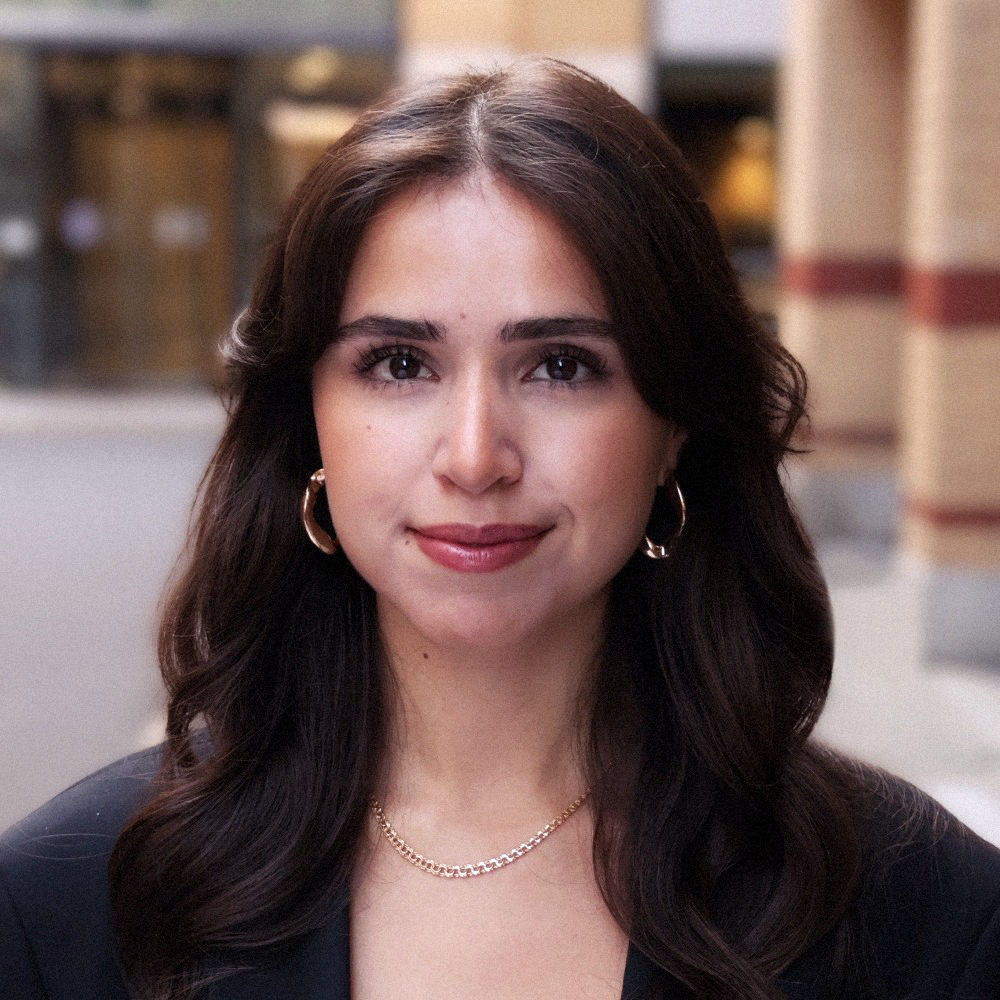
Hi! I'm Amanda, a third year Neuroscience student and Laidlaw alum from UCL. I'm Swedish-Persian and grew up in Sweden before moving to London for uni. These days, alongside my studies, I work for the Foundation as a Marketing Assistant.
For my first year research project, I worked on optimising alginate hydrogels for 3D astrocyte culture systems. In simpler terms, I was figuring out the best way to prepare a jelly-like scaffolds so that star-shaped brain cells called astrocytes could grow in three dimensions rather than flat on a dish. This matters because 3D environments mimic the brain more realistically, which could help researchers develop better treatments for neurological disorders!
For my Leadership-in-Action project, I co-created Beyond the Books, a resource designed to help students from underrepresented backgrounds navigate the unwritten rules of university life, from internships and networking to professional opportunities that aren't always obvious if you're the first in your family to go to uni.
Always happy to connect, whether you want to chat about neuroscience, widening access, the Laidlaw experience, or just say hello! One of my favourite things about this community is getting to meet people from different universities and backgrounds, so please do reach out! 🌟