Scholarly edition of letter exchanges and revised typescripts between Rabindranath Tagore (1861-1941) and Thomas Sturge Moore (1870-1944).
By Hannah Watton
Supervisor: Ulrich Tiedau
Email: hannah.watton.21@ucl.ac.uk
Within the duration of my six week research project, I was able to learn more about the process of digital editing, collaboration and edition building. The majority of my work consisted of looking at manuscripts edited by the Nobel prize winning poet Rabindranath Tagore and transcribing the pages into HTML. Through workshops with other students and academics, we were able to participate in a ‘social editing model’ in which editing becomes an ongoing, collaborative process. I learnt how to use the programmes Dillinger and Github, as well as how to use Markdown editors. Furthermore, I was able to discover more about Tagore as well as his editor, Thomas Sturge Moore, and the nuances of the editing process. In addition to these, I believe I was able to learn many important lessons throughout the six weeks. For example, I became aware of the fact that being perfectionist is not always a good thing: sometimes it is necessary to take a look at the bigger pictures rather than the details. Moreover, the academics in charge of the project were often busy with their own separate research, meaning that I often had to be independent. However, due to my supervisor’s reassurance that the first transcriptions were drafts, I was able to work without agonising over the details too much, and noted down my queries. Despite the barriers I encountered, I believe that I have become much more resilient through these experiences.
My project, titled ‘Scholarly edition of letter exchanges and revised typescripts between Rabindranath Tagore (1861-1941) and Thomas Sturge Moore (1870-1944)’, aimed to take unused Tagore manuscripts from the Senate House Library and create a series of typescripts to be published in a digital scholarly edition. Rabindranath Tagore was the first non-European to receive the Nobel Prize in Literature. The manuscripts housed in the Senate House library show his work as well as his and others’ edits. These manuscripts bring up questions to do with revision due to the misconception that Tagore’s success stemmed from help from the well-known poet W.B. Yeats and Tagore’s editor Thomas Sturge Moore. Through the six weeks, I took part in an editorial project which looked at manuscripts from some of Tagore’s most famous works ‘The Crescent Moon’ and ‘The Fugitive’, transcribing them with notations and edits. The project aimed to develop a novel publication model, or a ‘social editing’ model which allows students and non-academics to contribute to the editing process. My project primarily looked at the possibilities of digital publication as well as collaborative editing: student workshops allowed anyone from the general public to contribute and create a more fluid, ongoing editing process.
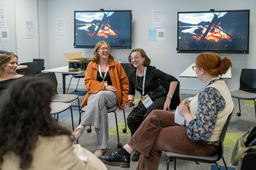
Preceding the six weeks, I got in contact with my supervisor about the details of the project and did some research about Tagore and Sturge-Moore to give me some context about the material I would be working with during the next few weeks. The next step was to attend a public editing workshop for students and academics at the Senate House Library, which was where the project would be based and where the manuscripts were housed. The workshop was led by academics in literature as well as the digital humanities, and we were given a brief talk about the histories of Tagore and Sturge Moore. We were also taught about Markdown editors, specifically Dillinger, which I would be using in the next six weeks. These editors, we learnt, are used to convert text to HTML in order to be processed and published in a digital scholarly edition. The rest of the workshop was spent transcribing pages of manuscripts from Tagore’s work ‘The Crescent Moon,’ as these had been previously disused at the library. Our goal was to create scholarly editions of papers from the works ‘The Crescent Moon’ and ‘The Fugitive,’ noting in any edits and variations to be published in a digital document. We uploaded the transcriptions to a platform called Github so we could all collaborate and add to the final publication. This platform would allow us to keep track of who was working on which page, and was also a way of storing the pages and organising them for future publication.
Much of my work was independent and online, as after the initial workshop, I spent most of my time transcribing the manuscript pages on Dillinger and uploading them onto Github to be stored for later use. I annotated and marked in edits to Tagore’s work, differentiating who the editor was as well as what the notations meant, and how I could portray them visibly in HTML format to be processed. Even within the workshop there were uncertainties, as we learnt that in Markdown there are many different ways to show a certain edit. The editor I was using, Dillinger, was also a very basic Markdown software, which meant that some edits couldn’t be accurately represented, or there was little information to be found on which Markup language to use. Despite these issues, I was reassured by the advice given to me by my supervisor. He assured me that as the initial transcriptions were drafts, it would be adequate to work as much as possible on the initial pages and then go back to address any issues I had at the end of the project prior to publishing. I ended up making a separate document with all the queries and uncertainties I had, so I could sufficiently address these near the end of the project.
In addition to the digital and aspects of publication in the project, my project also focused on the historical implications of translation and editing. Despite the fact that Tagore was the first non-European to win the Nobel prize in literature, many believed that his success stemmed from edits made by W.B. Yeats and Thomas Sturge Moore, well-known British poets. However, from the manuscripts it is evident that Sturge Moore made very few edits, and that the majority of the edits were made by Tagore. Furthermore, I gained knowledge about the political implications of these edits, and the possibility of these becoming intrusive with certain expectations of what a Bengali poet’s writing should look like. Such nuances bring up the question of whether it is appropriate for a Western editor to shape this work.
At first, I was nervous as it was my first time using digital Markdown software. However, I managed to get used to the software I was using relatively quickly. This unfamiliarity with the software was greatly helped by an editing workshop which took place at the beginning of the project, which was extremely helpful for learning about Markdown and gaining confidence. I had lots of help from my supervisor, the academics in charge of the project, and the other students participating in the workshop. Despite the fact that we were all beginners, we helped each other by asking questions and sharing information about our research, which helped us to be much more efficient. We were able to fill gaps in each others’ knowledge and create more accurate transcriptions.
One of the main things I learnt from participating in the six weeks of research was not to be so perfectionistic. During the project, I was often unsure about which notations to use for certain markings in the manuscripts, as there are a number of different ways of representing markings in different Markdown software. As the academics in charge of the project were extremely busy with their own research, I was often unable to ask questions. However, when I consulted my supervisor about my worries, he assured me that the initial transcriptions didn’t have to be perfect, as they were drafts and could be altered later. Instead, I noted down all the things I didn’t know or was confused about, or unknown markings to consult later. This improved the speed at which I worked, as I wasn’t constantly agonising over all the small things I was confused about.
On the other hand, one of the main challenges I encountered throughout my project was keeping up my motivation. At the beginning of the project, I split my time into days and weeks, allocating a certain number of pages to transcribe each day. This worked well for the first few weeks, until the pages often became longer or more complicated, often taking much longer to transcribe than previous pages. This led to a loss of motivation, as what took me a couple of hours before could take up to a day to complete, meaning that I became behind on my schedule. However, I managed to overcome this by scanning over my tasks as a whole and allocating more time to harder pages. Despite this, the project still managed to take longer than the allocated six weeks. In the future, if I could re-do the project, I would take a more detailed look at all the work I had to do at the beginning of the project and plan more thoroughly, overestimating my tasks and giving myself more time.
Another issue I ran into was working from home. Due to the fact that my project was almost completely independent and online, I was largely working by myself. My project centres around questions of revision, which meant that some of my work consisted of transcribing the same work a number of times, with minimal edits. This often led to an inability to look at the project as a whole, and getting bogged down in minute details. However, I managed to improve this by trying to change my place of work, for example I went to coffee shops or the library, which improved my work flow.
Furthermore, when I was struggling with my project, or had concerns, I was able to talk to other Laidlaw scholars about myself and others’ projects, which helped me to gain confidence in my work. Talking to other scholars made me realise the similarities in our difficulties, and talking them out allowed me to reflect on how I could improve and work more efficiently. In addition to this, the Laidlaw scholars organised a variety of fun activities, trips and socials which were a nice break, and helped me to feel refreshed.
Finally, I struggled with the fact that the research took place in the summer. Due to the time in which the research took place, the academics in charge of the project were often extremely busy with their other projects, with their time not matching up with the time of my project. This meant that I often had to solve problems by myself, or put off asking questions. However, I was helped by my supervisor, who assisted me when I had uncertainties. However, through this experience I have learned to be more independent.
Whilst the transcriptions were completed, the documents are yet to be published due to hold-ups. However, as the editing process is ongoing, I hope to see the transcriptions published as a scholarly edition in the near future.
To conclude, I have had an amazing opportunity these past six weeks to learn more about myself as well as the academic world, getting a taste of the editing process as well as getting to know Tagore’s work and editing process. It has been a great experience to participate in a social editing model and work with other students. I have been able to learn practical skills such as being able to navigate my way around softwares such as Dillinger and Github, as well as general life skills, such as planning and organisation skills, independence, and the ability to ask for help when needed. I have been able to practise looking at an independent project as a whole rather than just its details, and ways in which I can work more efficiently especially when working online and from home, for example changing workspace and talking to my peers. I hope that the transcriptions we have worked on can be published in the near future.
Hi everyone! My name is Hannah and I’m the Marketing Manager at the Laidlaw Foundation.
I was previously a UCL Laidlaw Scholar in the 2022 cohort, where I studied English Language and Literature. It’s a real privilege to now work with the community as part of the Foundation team.
My role focuses on building and nurturing an engaged global Scholars network, creating events that strengthen connection, and shaping how we share the Foundation’s work and impact.
In my spare time, I love cooking new dishes, reading, going to the theatre, and café hopping around London.
Please don’t hesitate to reach out or connect with me on LinkedIn. I’m always happy to chat!