LiA Journal Entry 1
This week- Monday the 22nd of June, to be precise -marked the beginning of my Leadership-in-Action project this summer. I knew going in that my plan was to work with the Arunodhaya Centre for Street and Working Children (a local nonprofit in Chennai, whose activities span such disparate categories from anti-abuse outreach to political advocacy). And I knew that my role specifically would be primarily focused on education: using my proficiency in English and science in combination to foster the education of the children and youths with which Arunodhaya works. This was not the beginning of my time in Chennai this summer; I arrived from Boston a week and a half earlier, taking the time to settle into the environment and shake off the jet lag. This was not even my first time in Chennai, period- a band trip in middle school offered me a sort of sneak preview of the whole experience. Yet despite the extra time I'd been afforded to settle in, I was immediately caught off guard upon my first foray into the culture of Chennai. This was not much of a surprise. I already knew going in that there would be aspects of the culture I'd be fundamentally unable to prepare for without seeing it firsthand: these are "known unknowns," as some have called them, concepts which I'm fully aware I am not cognizant of. A clear example of this is the pervasive culture of hospitality. I was offered tea and coffee, snacks and desserts, in all sorts of places- from temples, to art galleries, to the very learning centres where I'd soon be working (alongside other members of Arunodhaya). In America I would not think twice of refusing a host's offer- but in India, such a refusal could be interrupted as insulting, rude, or downright ungrateful. This is only one of a myriad of cultural philosophies which I've had to devote immense effort into rapidly memorizing, lest they induce awkwardness and discord that detract from my educational mission. To borrow language from other concepts we've covered in our Laidlaw sessions, this period has demanded from me serious quantities of drive and determination. Culture shock is already a formidable foe even during mere vacations and excursions, let alone a 2-month-long campaign of pedagogy. To call this an intimidating obstacle would be a severe understatement. 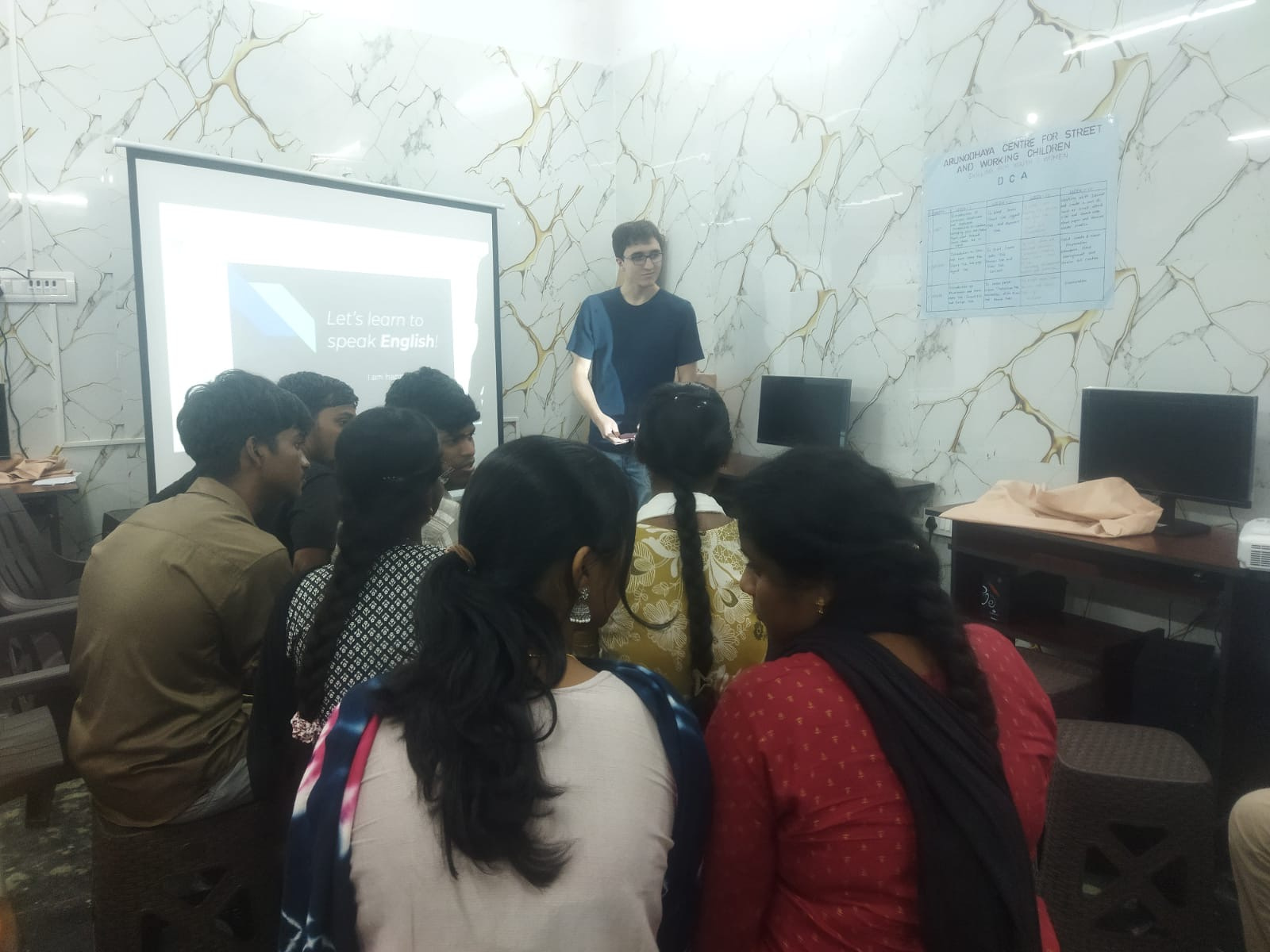
And yet, as you can gather from the above image of me at one of Arunodhaya's Guided Learning Centres in the northern region of Tiruvottiyur, the aforementioned culture shock did not scare me off. And as you can gather from my smile in the above image, I'm very grateful that I did indeed follow through. The students I've worked with so far showcase a clear and obvious passion for learning, and I in turn have felt an immense gratitude that I am able to teach them. There are two main classes I've met with so far. One class (not pictured) is a group of about nine or ten students of late high school age, mostly female. These classes are in the nearby region of Tiruvottiyur. The classes focus on a number of topics, from saree design to Excel spreadsheet operation, but the field in which I've been selected to teach them is basic spoken English. We started off simple this week- nouns, verbs, adjectives, and basic introductions. These students have undergone their schooling exclusively in Tamil, after all; their past experiences with English are virtually nonexistent. The other class consists of a younger cohort, between roughly eight and thirteen years of age; this is the cohort pictured above and below. I've been tasked with teaching them English as well, but in addition to that I'll be teaching them science. My goal is to develop a bespoke curriculum which Arunodhaya can continue using well into the future- based on the Indian government's guidelines, Arunodhaya's advice, and my own personal experience, to help these girls develop basic scientific skills. I'll note that these classes are entirely extracurricular, organized entirely by Arunodhaya outside of the jurisdiction of the Indian government. This, in fact, is why the student body of Arunodhaya is so overwhelmingly female. Gender discrimination in India is still a pervasive problem; many women and girls must undergo experiences like child marriage or forced labor in the garment industry instead of experiencing a proper childhood and education, and Arunodhaya is one of the chief organizations devoted to combating this trend. So it is immensely gratifying to know that these students are receiving a second chance at the education they should've already been afforded (and would've been, had they grown up in such a privileged environment as me). And it is deeply humbling to know I am playing a serious part in the procurement of said education. It was up to pure luck that I was born into a well-off, English-speaking family, or that I was given opportunities to hone and practice my innate talents for science (talents which I'm sure countless students here possess, with far less opportunity to showcase them). And just by virtue of this privilege I was born into, my innate sense of Humanity leads in turn to a sense of Accountability (to steal a phrase from the Oxford Character Project). I feel it's my duty to share my skills with the students I've met in the past week: to teach them English, to teach them science, and ultimately to help them earn back the opportunities they were at risk of losing through no fault of their own. I already am so grateful for the opportunity to embark on this journey, and it's only been a week of teaching so far. I'm truly excited to see what the rest of this experience has to offer.
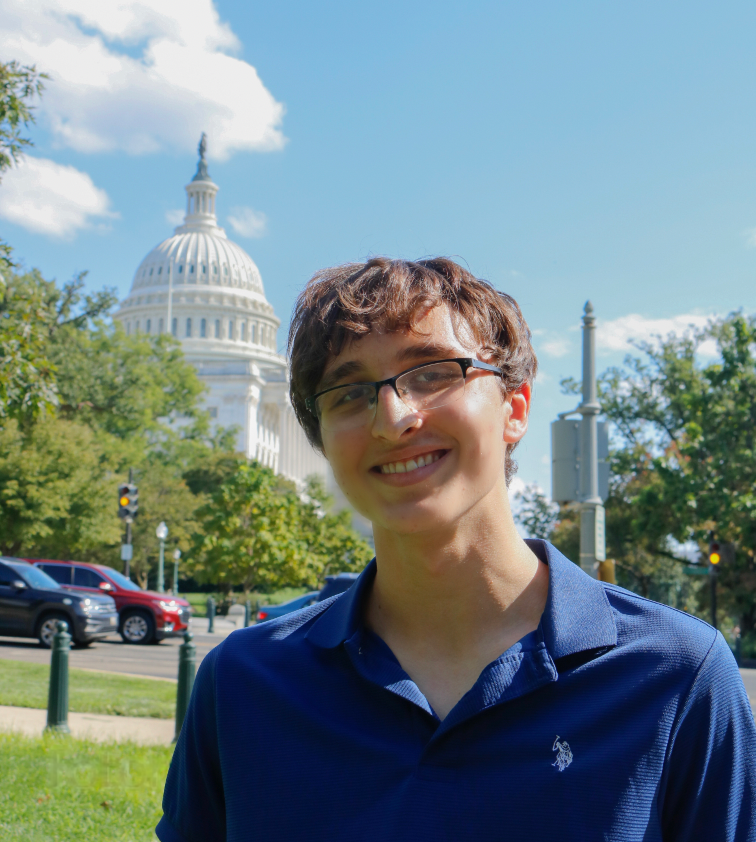
Hi, everyone! I'm Martin. I'm a third-year student at Georgetown majoring in Biology (with a concentration in Molecular Bio), and I'm planning to minor in Japanese. My focus has always been on cancer biology; so many people I've known have been affected by it, and my life's goal is to contribute to a cure. I'm half-American, half-Bulgarian, the child of two diplomats; I speak English fluently, and intermediate Bulgarian, Japanese, and Spanish. I have a lot of different interests outside of science: basketball and baseball, chess, politics, music, literature, and a whole list of other things that's way too long for this blurb. Here's a random fact about me which I think is kinda cool: I once saw the tallest manmade thing on Earth (the Burj Khalifa) and the tallest thing on Earth, period (Mt. Everest) from the window of the same flight!