LiA Journal Entry 4
I've emphasized time and time again, over the course of these reflections, that I am learning as much as I am teaching (and quite often even more). Teaching of any kind is a relatively alien experience to me, let alone teaching English to non-native speakers, in a city whose geography and culture I have virtually no experience with. What serves to complicate this arrangement even further is the fact that I've been called upon to improvise entirely new educational material a number of times. In some cases, this is just an unavoidable fact of the teaching experience. Every new slide comes with the possibility that students will suddenly hit a wall and lose the path of understanding they were previously following; the responsibility lies on me, at that point, to bring everyone back to the path via whatever communicational and pedagogical strategies are necessary. The need to do this in real-time, without interrupting the flow of class or losing the focus of the students, adds a whole new dimension of difficulty. In other cases, the need to improvise is conferred to me by my other colleagues. Just this past week, my colleague at the science classes in Korukkupet suggested that I design a lesson on digital literacy. This represented a significant detour from the educational arc I had initially planned, but Arunodhaya's needs take precedence over whatever my own ideas are on how best to design each curriculum. This sort of improvisational ability draws largely from the character value of judgment, and it's no wonder that this value is the most central of all. No other character value can really operate effectively without judgment guiding the way, not only pragmatically but also ethically.
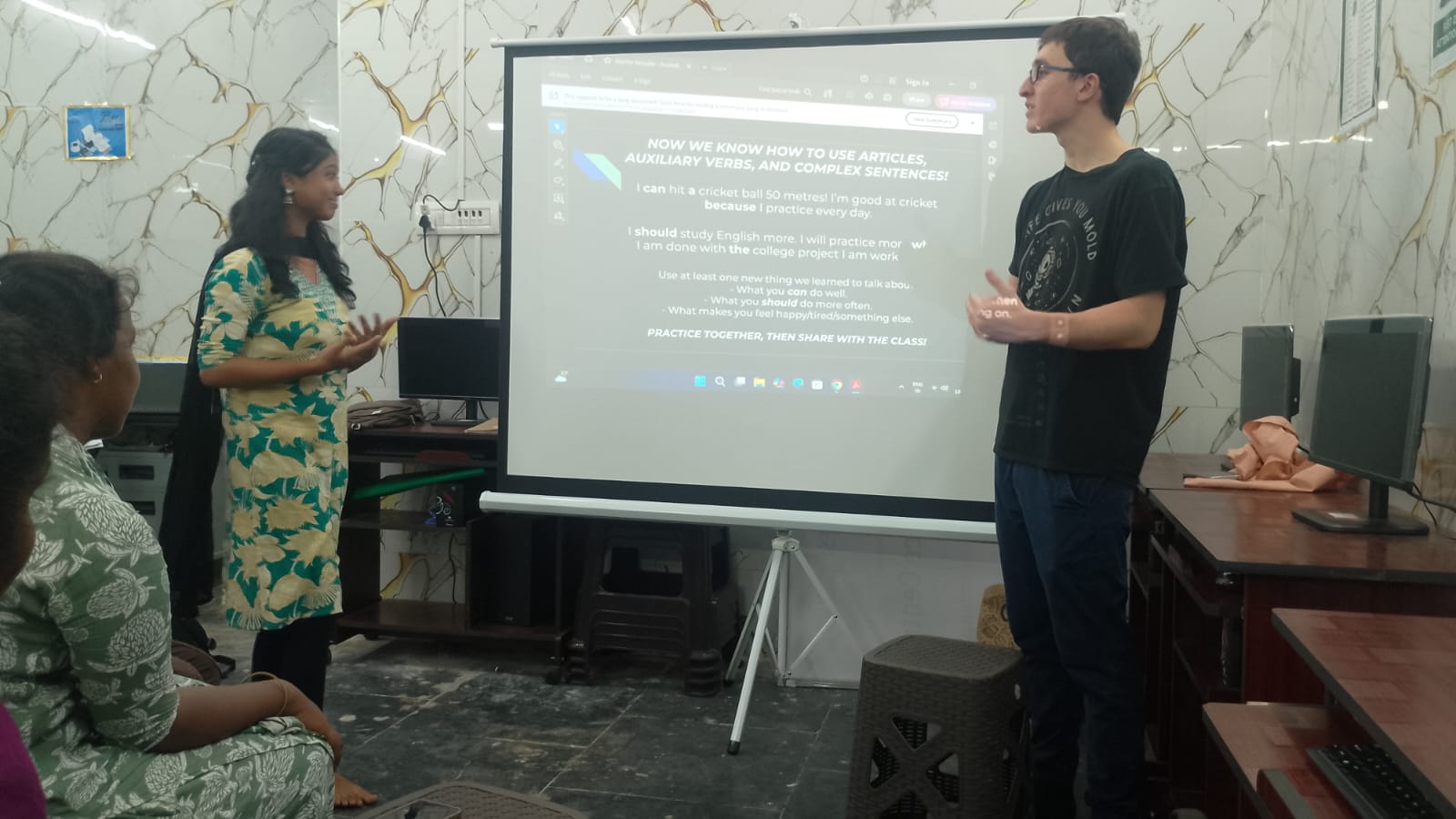
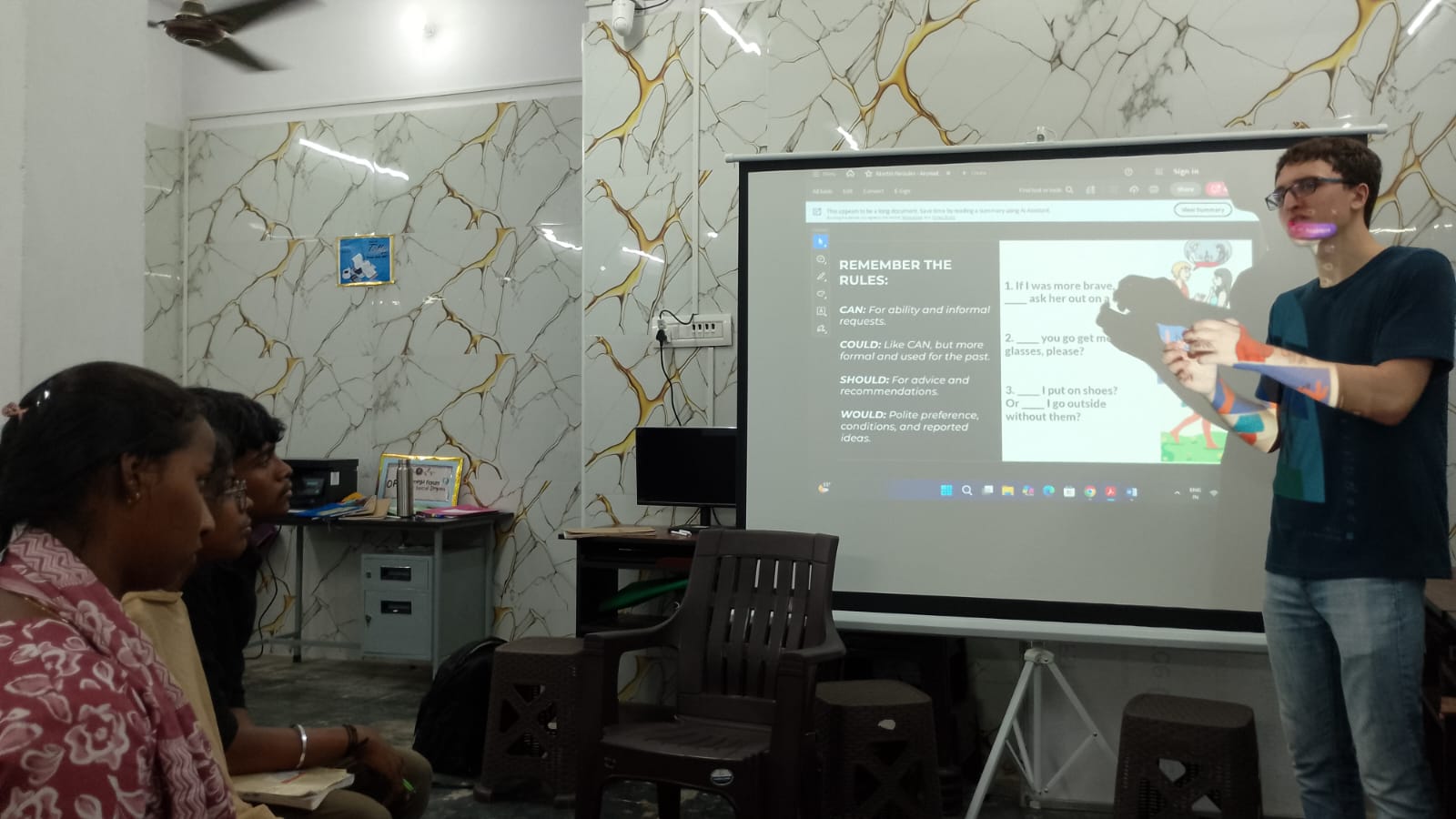
The sort of need for flexibility I'm referring to was particularly apparent in some of my most recent English lessons, wherein we discussed auxiliary verbs. For those who don't remember this from English class, these are verbs which work in tandem with other verbs to modify their meanings: can, should, would, must, and so on. There is an incredible amount of nuance in the proper usage of these terms. The students I work with are used to an educational system which prioritizes above all else the ability to deduce the right answer, and that philosophy implies that any given question will actually have a right answer. But while designing my lessons and while delivering them, I continuously run into sentences where there doesn't seem I to be one clear right answer. Sometimes there are multiple possibilities which work equally well: "It might rain today." and "It may rain today." are both perfectly acceptable and totally interchangeable sentences. Even more confusing, there are many cases where two sentences have extremely subtle differences in connotation and tone, which I as a native speaker can feel but struggle to put into words. Sure, "Can I have a glass of water?" and "May I have a glass of water?" differ only in formality- that's easy enough to explain. But another sentence came to mind while I was designing a set of practice questions, shown in the first attached image: "_____ I put on shoes? Or ____ I go outside without them?" How would a native speaker fill in this sentence? "Should I go outside without them?" seems the most grammatically appropriate, yet sounds sort of stuffy, inexplicably unnatural. "Can I go outside with them?" and "Could I go outside without them?" both sound a bit more natural, yet they contradict the previous message of the lesson that these verbs are generally to be used for possibilities and not for advice. I'm not even sure which of these I'd use as a native speaker. And all of this nuance is for what is ultimately a pretty simple grammatical structure, especially in comparison to some of the high-level concepts I've yet to cover. I've specifically made it a priority to include ambiguous questions like this in my lessons. I think it's important to be transparent about the fact that some of these questions don't have right answers, or may have answers follow unclear rules that only begin to feel natural after years of continuous practice. And I reassure my students that the intuitive understanding which experienced learners possess takes years to truly develop- as often seems necessary, when I see their frequent consternation in response to this sort of ambiguity. Every week, every lesson, every slide, presents another unprecedented challenge, for both my students and myself. But we're all learning together: they're learning how to speak English, and I'm learning how to teach it.

Hi, everyone! I'm Martin. I'm a third-year student at Georgetown majoring in Biology (with a concentration in Molecular Bio), and I'm planning to minor in Japanese. My focus has always been on cancer biology; so many people I've known have been affected by it, and my life's goal is to contribute to a cure. I'm half-American, half-Bulgarian, the child of two diplomats; I speak English fluently, and intermediate Bulgarian, Japanese, and Spanish. I have a lot of different interests outside of science: basketball and baseball, chess, politics, music, literature, and a whole list of other things that's way too long for this blurb. Here's a random fact about me which I think is kinda cool: I once saw the tallest manmade thing on Earth (the Burj Khalifa) and the tallest thing on Earth, period (Mt. Everest) from the window of the same flight!