If you see a sinking ship, jump on it, because that's where the real opportunities are. It's easy to follow success because it's obvious, but if success is your starting point, it may not be where you can make the biggest difference.


Stephen Carter: The Opportunity in the Obvious
This week, we turn to Stephen Carter, Group CEO of Informa, the FTSE 100 company and parent of Taylor and Francis, whose partnership with the Laidlaw Foundation means that Scholars' research now has a pathway to publication in F1000Research. In his Leadership Lab conversation with Susanna Kempe, Carter offered a piece of advice that cuts against the instinct most of us follow when we are starting out:
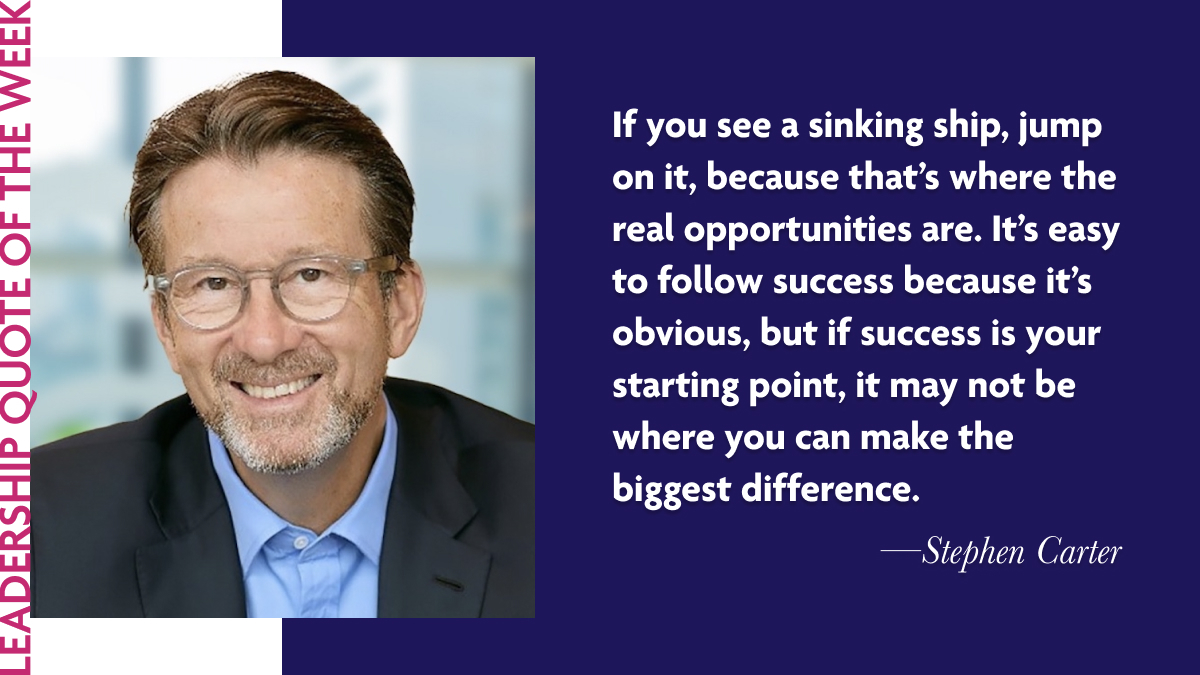
Stephen Carter: "If you see a sinking ship, jump on it, because that's where the real opportunities are. It's easy to follow success because it's obvious, but if success is your starting point, it may not be where you can make the biggest difference."
A Career Built on the Unconventional Bet
Carter's own path makes the case better than any theory could. From a sabbatical year as Students' Union president to becoming one of the youngest UK CEOs in advertising, his rise owed less to following a well-worn route than to an appetite for the uncertain and the unfinished. When he joined NTL just as the dot-com boom peaked and watched the company spiral into Chapter 11 bankruptcy, he did not treat the experience as a detour. He treated it as a classroom. The discipline around debt exposure he learned there shaped every major decision he made afterwards, including the ones that saved Informa during the pandemic.
That pattern repeated itself when he took on the creation of Ofcom, bringing six fragmented regulatory bodies together into something genuinely new, and again when he joined the Informa board and began a strategic pivot toward B2B trade shows at a time when few people in the market considered them the obvious bet. By the time the pandemic hit and the world's largest trade show business had nowhere to go, Carter acted on instinct shaped by crisis before: raise equity fast, control your own destiny, and do not fire the people you spent years building a team with. When the world reopened, Informa was better positioned than anyone.
Risk as a Form of Clarity
What makes Carter's philosophy more than a colourful soundbite is the reasoning underneath it. Chasing the obvious path means arriving somewhere already crowded, where the learning curve is shallow and the room to make a real difference is narrow. The sinking ship, in his framing, is not an invitation to be reckless. It is an invitation to go where genuine problems still exist, where the contribution you can make is legible and the stakes are real. Carter is clear that between the ages of twenty and forty, the risk of embracing the unconventional is far lower than most people assume, and the returns in experience and self-knowledge are far higher.
He also links this philosophy to a broader view of what leadership actually requires. It is not profile, not visibility, not the confidence of someone who has always chosen the winning side. It is judgment under pressure, stamina when things go wrong, and the humility to recognise that being in charge of something does not make you a different or better person than those around you.
Values in Focus
Carter's message speaks directly to the Laidlaw values of being #Brave and #Ambitious and the Oxford Character Project virtue of #Judgment. Being brave means resisting the pull of the path that already has a crowd on it, and trusting that the harder route will teach you more and offer you more. Ambition, in Carter's framing, is not about chasing visibility or prestige but about orienting yourself toward the places where the real work still needs doing. Judgment is the capacity to weigh risk under pressure and recognise where the real opportunity lies, even when it runs against the obvious choice.
A Call to Reflect
As you consider Stephen Carter's words, we invite you to reflect and share in the comments: what is the sinking ship in front of you right now, and what could you gain, learn, or change if you chose to jump on it?
Listen to the full Leadership Lab conversation with Stephen Carter here, where he explores navigating crisis with clarity, why high-ego cultures undermine collective performance, and how to dial up the optimism register in a world that defaults to what could go wrong.

Hi! I'm Amanda, a third year Neuroscience student and Laidlaw alum from UCL. I'm Swedish-Persian and grew up in Sweden before moving to London for uni. These days, alongside my studies, I work for the Foundation as a Marketing Assistant.
For my first year research project, I worked on optimising alginate hydrogels for 3D astrocyte culture systems. In simpler terms, I was figuring out the best way to prepare a jelly-like scaffolds so that star-shaped brain cells called astrocytes could grow in three dimensions rather than flat on a dish. This matters because 3D environments mimic the brain more realistically, which could help researchers develop better treatments for neurological disorders!
For my Leadership-in-Action project, I co-created Beyond the Books, a resource designed to help students from underrepresented backgrounds navigate the unwritten rules of university life, from internships and networking to professional opportunities that aren't always obvious if you're the first in your family to go to uni.
Always happy to connect, whether you want to chat about neuroscience, widening access, the Laidlaw experience, or just say hello! One of my favourite things about this community is getting to meet people from different universities and backgrounds, so please do reach out! 🌟