Patterns of Resilience: What Butterfly Communities Reveal About Forest Disturbance in the Peruvian Amazon
Preview
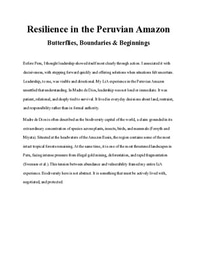
The poster presents my field research from Madre de Dios, Peru, examining how butterfly assemblages vary across primary and disturbed forest microhabitats. Rather than a simple story of loss, the data reveal trade-offs: disturbed areas often support higher butterfly abundance, while intact forests harbor specialist species found nowhere else. These patterns highlight the role of microhabitat diversity in sustaining ecological resilience. Using fruit-baited traps and community-level statistical analyses, the study underscores that conservation outcomes depend on preserving habitat complexity, not just species counts. Framed within the Brazil Nut Corridor, the work emphasizes the urgency of protecting these forests amid accelerating deforestation and mining pressures