Summer 1 Research Project Experience & Reflection
Laidlaw Research Project Experience Summer 1
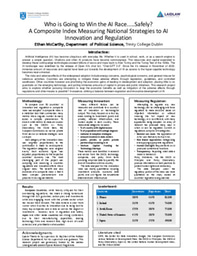
The Laidlaw Program requires its scholars to spend six weeks researching their topic and research question in an independent project where they must produce a poster with their findings as well as a reflective essay on their experience. The poster is the majority of the work, and the meat of a scholar's endeavours. I researched nation's political and economic strategies to regulate and develop artificial intelligence (AI) with the goal of discovering if it were possible to mitigate the adverse effects of a technology like AI while also reaping the economic benefits. The culmination of my work was the production of a composite index that scored a list of nations' efforts based on policies, investments, initiatives, and other relevant figures to allow people to easily compare countries' efforts and get an understanding of a nation's AI landscape at a glance.
The research portion was split roughly into three phases; first, I had to read up on relevant literature on AI regulation as well as technology development to discern what were relevant markers and measurable variables to collect data and information on the nation's current position or efforts towards these matters. This portion took a considerable amount of time as there were many sources that provided relevant information, however, as a researcher I understood that some sources and organizations had ulterior motives or were funded by organizations with ulterior motives that may cause them to produce bias finding. One surprising aspect was the number of policy memos and briefs that are produced by private companies such as Google and OpenAI. While these were relevant and helpful, I analysed their policy recommendations with a grain of salt as a pro-industry bias is clearly present. The second portion of my research was data collection. Once I had found all the relevant variables and metrics it came time to collect and research and collect and research. I spent lots of time in a singular Excel file that held all 25+ data points on all 50 + countries. While this took a significant amount of time, it was not too challenging as it was a repetition of the same data retrieval. There were definitely some days during this phase where my patience dwindled; however, a walk around campus and a coffee on Dawson St. would often resolve this. Another challenge I ran into was the consistency of data and sources. One site or database would often not cover all the countries I was looking for, so I needed to pull from multiple sources, which required me to ensure their methodology for collection or surveying was similar enough to consider the variables comparable. The final portion, which, to be frank, took place completely after the 6 weeks I spent dedicated to Laidlaw, was the culmination of all the data points into a singular figure. All data points were standardised and adjusted accordingly to relevant figures such as the size of countries' economies and populations. This portion took a lot of statistical analysis, as well as math, to rate and rank every country into a singular composite index. While challenging, I did find it enjoyable as I have not come across many numerically intense activities in my political science and social policy university courses.
The overall time from the beginning of my research to the submission of my poster was just over 4 months. Obviously, 4 months is much longer than the required 6 weeks that the Laidlaw Foundation prescribes for its scholars. I believe this was due to a number of factors, positive and negative. I finished the university term in early May and spent the weekend away with friends before commencing my 6 weeks of research. The campus got increasingly quieter as students departed from Dublin. My research largely drew on databases and resources that were online meant I only needed access to my laptop to conduct my research. While this was convenient, allowing me to work from cafes, public libraries, and even from home, I found it to be isolating. Unlike some of my peers I wasn't working alongside other researchers in a lab or conducting interviews with participants. I learned quickly that individual work is not something I thrive at. I believe I work best on a team with external pressures/motivators, such as deadlines, to provide structure to my work and keep me motivated. The deadline for my research is in September, and the majority of the work was done in May and early June, which was challenging for me. I found working alongside other Laidlaw scholars who were on campus really helped as we were able to align our schedules and schedule work sessions to keep us accountable and productive. The six weeks came to an end, and I was not nearly as far as I had planned to be and found myself somewhere between the end of phase 1 and the beginning of phase 2. I returned home to California and enjoyed some R&R with family and friends, whom I had not seen since January, which gave me a much-needed recharge after the 6 weeks of research and academic term. I then began an internship in a law firm in San Francisco, working on their data and technology team, working directly with clients on the regulation I had meticulously analysed through my research. Working with clients on compliance and product development gave me a new perspective, which was greatly beneficial to the regulatory component of my composite index. It provided me with the tools on how to assess whether these regulations and laws adequately address the risks of AI. Are they unnecessarily stifling the development of technologies, or are they not doing enough to protect from adverse effects? This new perspective from industry and private practice was invaluable, as it gave me new momentum to finish out my project as I spent nights and weekends working through phases 2 and 3. The remainder of my research was uneventful as I worked through phases 2 and 3 and finished up my poster in early September.
Overall, I really enjoyed the first summer of the Laidlaw program and am grateful I was able to spend the past few months in an area I am so passionate about. This introduction to formal academic research taught me a lot about myself, my preferred work style, and the area of technology policy. Retrospectively, some advice I would prescribe to myself or any future Laidlaw scholars would be; first, the proposal you submitted in February or March as a part of your application is going to look a lot different from the poster you submit in September, and I'm sure even more different from the experience you will have across the whole 18 months of the program. This is ok and is inevitable. You know 5% or less of your current topic and will learn so much more as you dive into your research, speak with your supervisor, and experience more in your field. Be dynamic and ready to pivot. Second, 6 weeks is nowhere near enough time. Expect to work on your research intensely for those 6 weeks and continue to engage with your topic throughout the entirety of the summer. My best work came after not working on Laidlaw for a few days or a week, as I returned with fresh eyes and a new perspective. Also, ensure you really like your topic, as you will be on and off, spending 4 months researching the topic and 18 months engaging with the topic. Lastly, rely on your supervisor and don't be afraid to ask questions, seek clarity, or use them as a sounding board for your ideas when working through your project. They have a PHD and have spent decades working in your subject area. You have spent 3.5 semesters studying your subject and maybe a few hours putting together a research proposal. They don't expect you to be an expert and only harm you if you don't utilise the knowledge they have and the support they can provide you with. Once accepted to the program, meet with your supervisor and begin brainstorming what your research will look like, timeline, and deadlines. Throughout the 6 weeks, I would suggest a standing weekly meeting with your supervisor to ask questions, check in, and provide some structure to your research period.
Where do I go from here? What's the next step? Now that I have completed my research poster, I am looking forward to the Oxford Character Project arranged by the Laidlaw Foundation for all scholars to participate in this fall. Towards the end of the year, I will begin reaching out to different organisations, think tanks, government departments, and NGOs to arrange my Leadership in Action portion of the Laidlaw program. Laidlaw provides its scholars with financial support to work in the field or continue research within an established lab or department at no cost to the organisation. The intention is to provide them with the ability to make a positive impact in their respective field without burdening the chosen organisation with the financial cost of their work. The AI policy space is rapidly developing and changing as governments and the private sector increasingly work together to achieve what I set out to discover (to varying degrees). The European Union published the General-Purpose AI Code of Practice, which leading companies such as Open-AI, Anthropic, and Google have all signed onto the voluntary pledge to work closely with regulators and build trust between the two parties. Meta and other AI labs, however, did not, so there is more work to be done to ensure the relationship between development and regulators is synergised. In the US, the 10-year moratorium, effectively banning any AI regulation, was not passed as a part of President Trump's "Big Beautiful Bill"; however, California Governor Gavin Newsom signed SB53 Transparency in Frontier Artificial Intelligence Act into law in late September, providing some regulation and safety measures in the US on AI development. It is an exciting time to be in this space, and I greatly look forward to continuing to engage in this in whichever capacity I am able to through my Leadership in Action next summer. Another intriguing aspect of this experience is the requirement that it must be international. So, wherever I end up, I know it will be outside of Ireland, which will enhance the experience as I immerse myself in a new place. Whether it's somewhere in Europe, the US, or Asia, I look forward to continuing my Laidlaw journey and the experiences to come.

Hello, I'm Ethan! I am a Political Science and Social Policy Student at Trinity College Dublin. I am originally from California, but I split my time between California and Ireland growing up. As a politics student, I am interested in the policy and regulation of the technology sector.
Through my research, I wish to study the relationship between innovation and regulation for countries looking to remain innovative while also mitigating the adverse effects that come along with the rapid development of emerging technologies such as Artificial Intelligence and Machine Learning.
I look forward to connecting with other scholars at Trinity and beyond!