Research Poster: Examining the Factors that Allowed Tanzania to Avoid Large Scale Conflict Post 1967
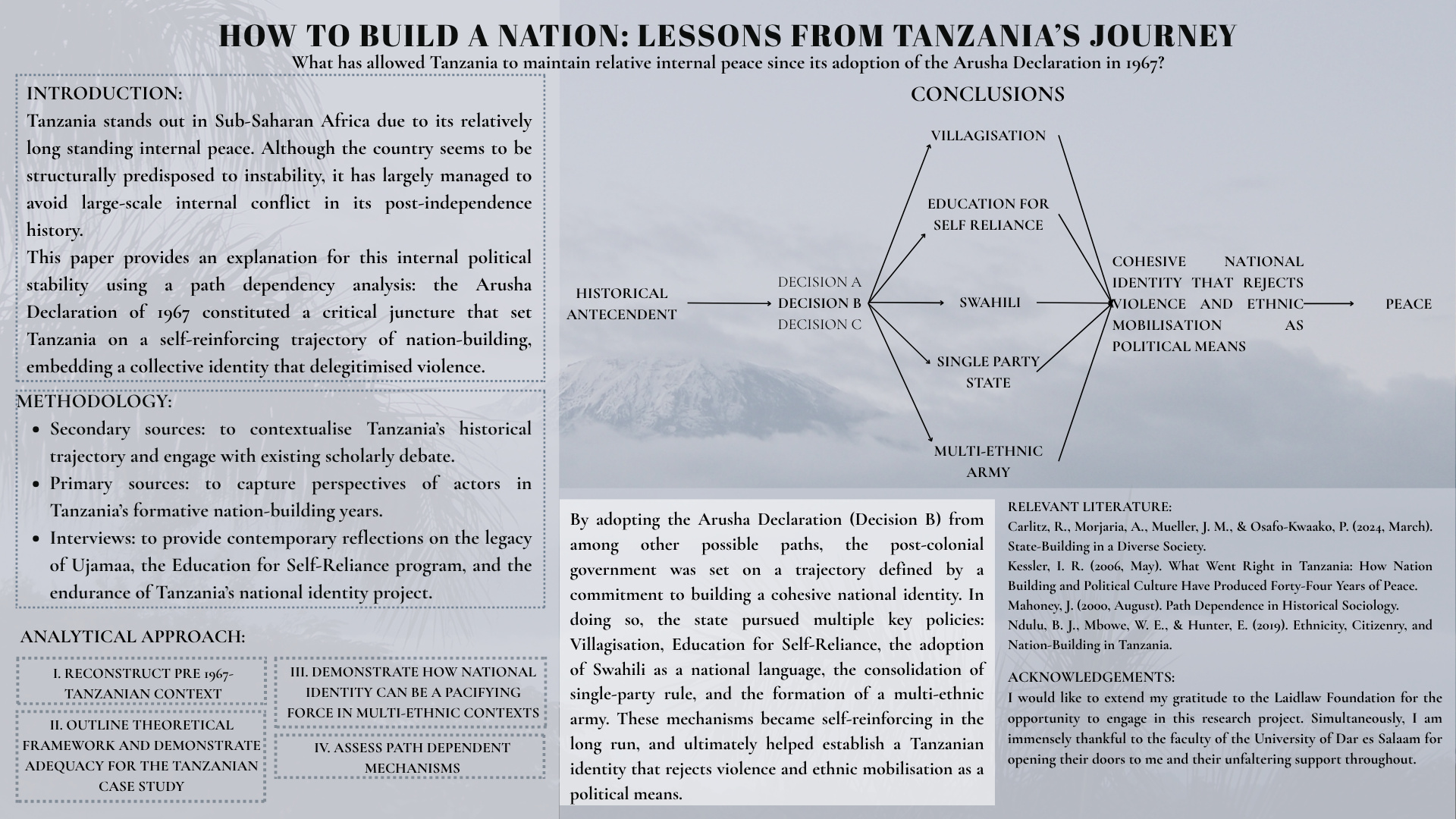
In this paper I attempt to provide an explanation for Tanzania’s seemingly unexpected relative internal political stability. Using a path dependency analysis, I argue that the Arusha Declaration constituted a critical juncture that set Tanzania on a self-reinforcing trajectory of nation-building, embedding a collective identity that delegitimised violence and ethnic mobilisation as political tools. To nuance this structural approach, I incorporate Charles Tilly’s concept of trust networks, showing how the state absorbed and replaced local, ethnically based systems of solidarity, thereby preventing societal fragmentation.
Drawing on secondary scholarship, colonial-era reports, interviews with Tanzanian scholars, and speeches by Julius Nyerere, I trace the mechanisms through which this trajectory was consolidated: Villagisation, Education for Self-Reliance, the adoption of Swahili as a national language, the institutionalisation of a one-party state, and the creation of a multi-ethnic army. Together, these policies produced increasing returns that reinforced national cohesion across generations.
While this path dependence secured Tanzania’s avoidance of large-scale ethnic conflict, it also entrenched authoritarian practices that continue to constrain political pluralism today. The Tanzanian case thus demonstrates both the potential and the contradictions of state-led nation-building in postcolonial Africa, offering lessons for understanding how peace can be constructed and sustained in deeply diverse societies.
pdf: https://drive.google.com/file/d/1Hwf8pELlGOXVN0JCz_81j_8UyI77bCKC/view?usp=sharing
Key words: path-dependency theory, Arusha Declaration, nation building, trust networks, post-colonial Africa.