Reflecting on My Leadership Journey as a Laidlaw Scholar
It has been a tremendous honour to be one of the 25 undergraduates selected to participate in the Laidlaw Leadership and Research Scholarship Programme. My journey on the Programme has been marked not only by an abundance of amazing new experiences, but also by occasional challenges and hardships.
When reflecting on how, and whether, my definition of “leadership” has changed since I applied for the Programme in December 2023, I must admit that the main essence of my definition has remained largely the same. Namely, when I was a rather anxious first-year undergraduate student writing up my application for the Programme on a late winter night, I argued that leadership was fundamentally about delivering positive change within your community, whether your university, borough, city, or even country, and delivering it through collective action. However, while my fundamental understanding of leadership as a collective endeavour was only further reinforced by my experiences throughout the Programme, my perception of the means through which leadership’s positive change-making potential can be best materialised has changed.
When applying for the Scholarship, I initially perceived that, despite its collective nature, those involved in driving positive change through leadership should share a considerable number of commonalities in their visions and ideas, as otherwise achieving any tangible outcome would become simply impossible. However, my experience on the Programme taught me otherwise. It showed me that discrepancies in visions of the end goal among those involved in leadership are key to achieving not only positive but also sustainable change: change that is a product of compromise, disagreement, and contestation rather than groupthink.
Secondly, I have always perceived the presence of a set of clear and rigid protocols as one of the key facilitators of successful leadership: the explicit outlining of responsibility boundaries between various roles within the team, the presence of pre-determined timelines and internal deadlines, and many other features of a similar nature. However, throughout my experience on the Programme, I also learned the importance of ensuring that previously agreed protocols are flexible enough to accommodate ad hoc changes that may occur “on the run” should unfortunate circumstances intervene. As I learned from my own experience at the Programme, such interventions can happen at times when you least expect them, thereby effectively rendering previously developed rigid rules and protocols obsolete.
Being on the Programme has contributed very significantly to my development as a leader, by making me a better agent of positive change, as per my definition of “leadership”. When applying to the Programme, I considered the overly managerial nature of my leadership style, previously manifested as one of my primary flaws as a leader. In my previous leadership pursuits, I always tended to emphasise efficiency and quick accomplishment of a set of objectives, rather than nurturing intrapersonal relations within the team and developing an adequate overarching vision of what had to be attained. However, over time, I was able to improve my leadership style not only through my experiences on the Programme but also through my other leadership experiences at university, such as leading one of its largest and fastest-growing academic student societies for two consecutive terms as President.
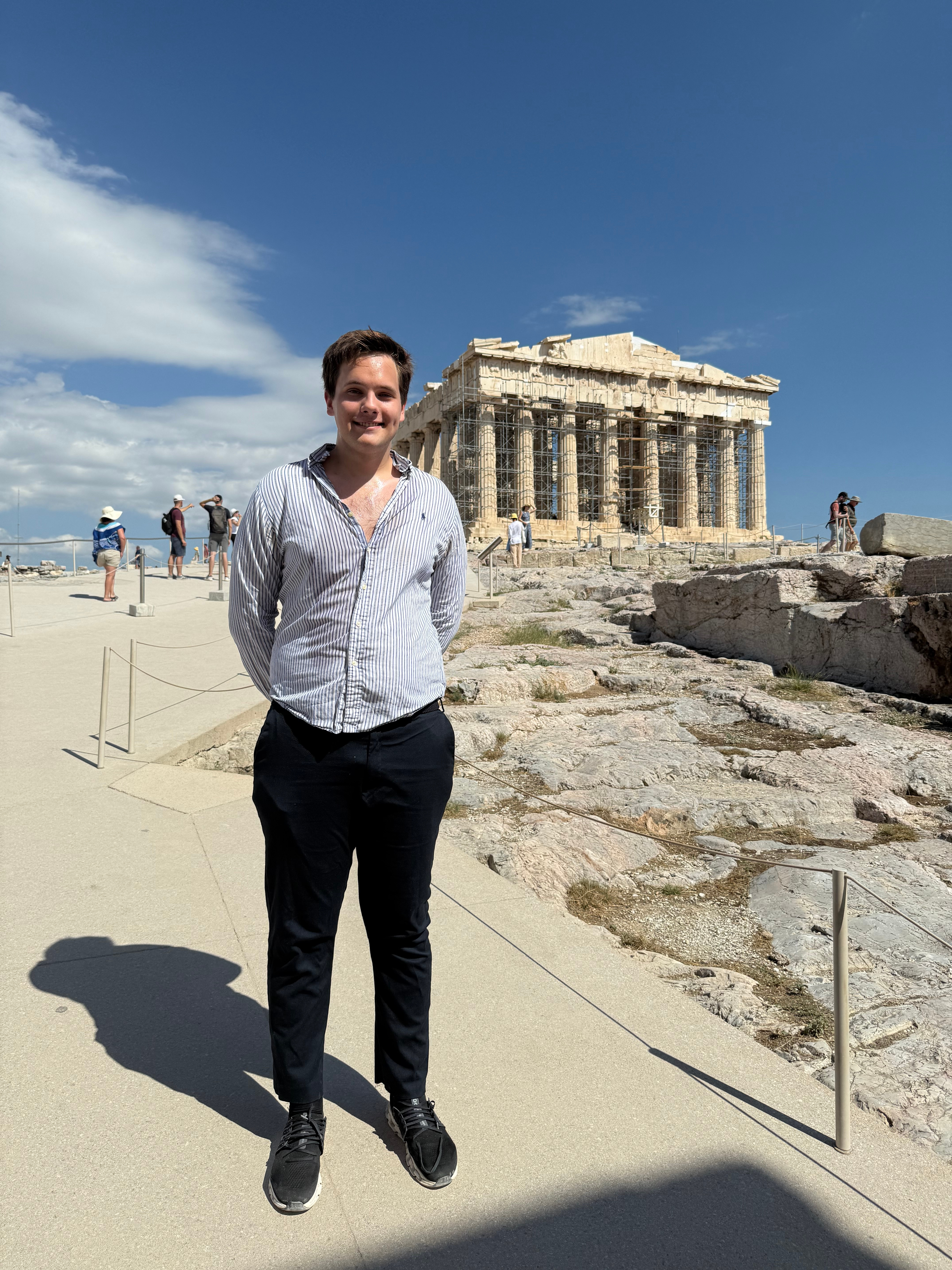
Throughout my journey as an LSE Laidlaw Scholar, I also developed one leadership quality that I had not previously realised I lacked, as well as the full extent of this quality’s significance for effective leadership in the first place. Although I have always perceived myself as someone who really likes travelling to various new places, my travels to Greece and Italy as part of data collection for the group research project made me realise that, despite the number of countries I had visited over the years, my routines when visiting those countries remained largely unchanged. This habituality, while comforting and calming, made my experience of those places less full without me even recognising that incompleteness at the time.
This trip, however, was different. I was on a mission of collecting data “in the field” as a complete outsider, without any knowledge of the local language, yet it turned out to be incredibly productive from the standpoint of my research-related endeavours. Moreover, the number of new connections I developed and the level of trust I established with my participants made the experience even more enriching and rewarding. I was particularly impressed by the depth of insights I obtained from locals throughout our interviews, especially given that those conversations touched on a wide range of highly sensitive political and economic issues facing those countries.
Being a Laidlaw Scholar has produced profoundly positive implications for both the academic and professional aspects of my future pursuits. Academically, it provided me with an incredibly fulfilling experience working on my first-ever peer-reviewed paper, our project on perceptions of the drivers of populism across Southern Europe, which will (hopefully) be published very soon. This was a highly interdisciplinary project at the intersection of political science, political sociology, and economics, and the result of incredibly collaborative group work and the collective overcoming of challenges we have faced along the way. Moreover, the rigorous, day-long methodology training sessions delivered by an extremely dedicated team of LSE Laidlaw academic supervisors were of tremendous utility in strengthening my quantitative and qualitative methodological skills, which I am very much looking forward to deploying in any future projects I may undertake throughout my academic journey.
Perhaps the most profound contribution of my experience as a Laidlaw Scholar to my professional development is that it exposed me to a real-life office working environment. I spent my Leadership in Action placement working at Unlocking Potential (UP), a London-based NGO, where I served as a policy researcher. This experience was absolutely incredible in equipping me with a wide range of interpersonal skills, as well as greatly improving my proficiency in Microsoft Excel and quantitative analysis more broadly. I will always owe a debt of gratitude to my supervisor, Helen Twigg, and to Cassie Oakeshott, the CEO of UP, for creating an inclusive, welcoming, and supportive environment for myself and fellow Scholars throughout the entire duration of our stay at their organisation.
As I conclude my journey as a Laidlaw Scholar, I would like to express my most sincere gratitude to the entire team behind the LSE Laidlaw Scholars Programme, whose tremendous work and dedication were pivotal in making our experience on the Programme an amazing one, including Philip Rauber, Kelly Zerrouk, our project supervisor, Ioanna Gouseti, and many others. I am also incredibly thankful to the team of external experts that my fellow Scholars and I were fortunate to engage with throughout our journey, particularly to Delia Lloyd for her remarkably rigorous project management sessions.