Project Outline: In Vitro NK Cell Transdifferentiation from Murine Myeloid Progenitors
Project Outline - Researching at HKU
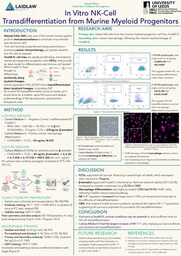
Title: In Vitro NK Cell Transdifferentiation from Murine Myeloid Progenitors
Professor Rio Sugimura
School of Biomedical Sciences at The University of Hong Kong
Background to the Project
NK cells are an essential part of the innate immune system, which acts as the body's first line of defense. The innate immune system is present from birth hence requires no prior sensitization to respond, and has a general effectiveness at protecting the host. NK cells are key to immunosurveillance, working to identify and destroy virus-infected or abnormal cells rapidly and without external activation. These abnormal cells have the potential to be, or already are considered cancerous, therefore it’s crucial to lyse them before tumours develop. NK identifies these cells based on their abnormal surfaces, before releasing a cytotoxin attack to damage their membrane to lyse them.
NK cell-based immunotherapies are a promising cancer treatment that is currently gaining significant interest, due to high success rates in clinical studies and decreased side effects. Here the patient's natural immune system is enhanced by increasing NK cell count to provide a heightened anti-tumoural response.
More research however is required on NK cell therapies before they can become mainstream. For this an efficient source of in vitro NK cells is required, which labs can use to develop the therapy. Currently human NK cell lines are available, yet murine NK cell lines are difficult to immortalise, hence there is no reliable source.
My aim
My aim is to create a rapid source of murine NK cells, by transdifferentiating myeloid progenitors. These less-matured bone marrow cells expand simply and rapidly in culture hence I will attempt to differentiate them into NK cells, providing scientists an alternative NK source for further research.
I hope to use my valuable time in the lab to achieve results that may contribute to the growing array of cancer treatments available for patients.
Objectives
My main objective is to obtain a high proportion of NK cells from the murine myeloid progenitor cell line, Hoxb8.
To do this I will:
- Use cytokines, a chemical messenger which stimulates the cell to transcribe a different combination of genes, ultimately producing a different cell type
- Experiment with different combinations and concentrations of cytokine, including IL-2, IL-15, SCF and IL-7, to create a medium that has a high differentiation rate
To measure my results, I plan to:
- Use flow cytometry to quantitatively measure the number of differentiated cells
- Take microscopy images, to observe the cell’s changing morphologies over time
Collaboration with Others
Any questions and/ or inputs on my research would be greatly appreciated as I hope to learn as much as I can during my time in the lab, to both grow my research skills and make impactful contributions in the immunology field. Please reach out to me!
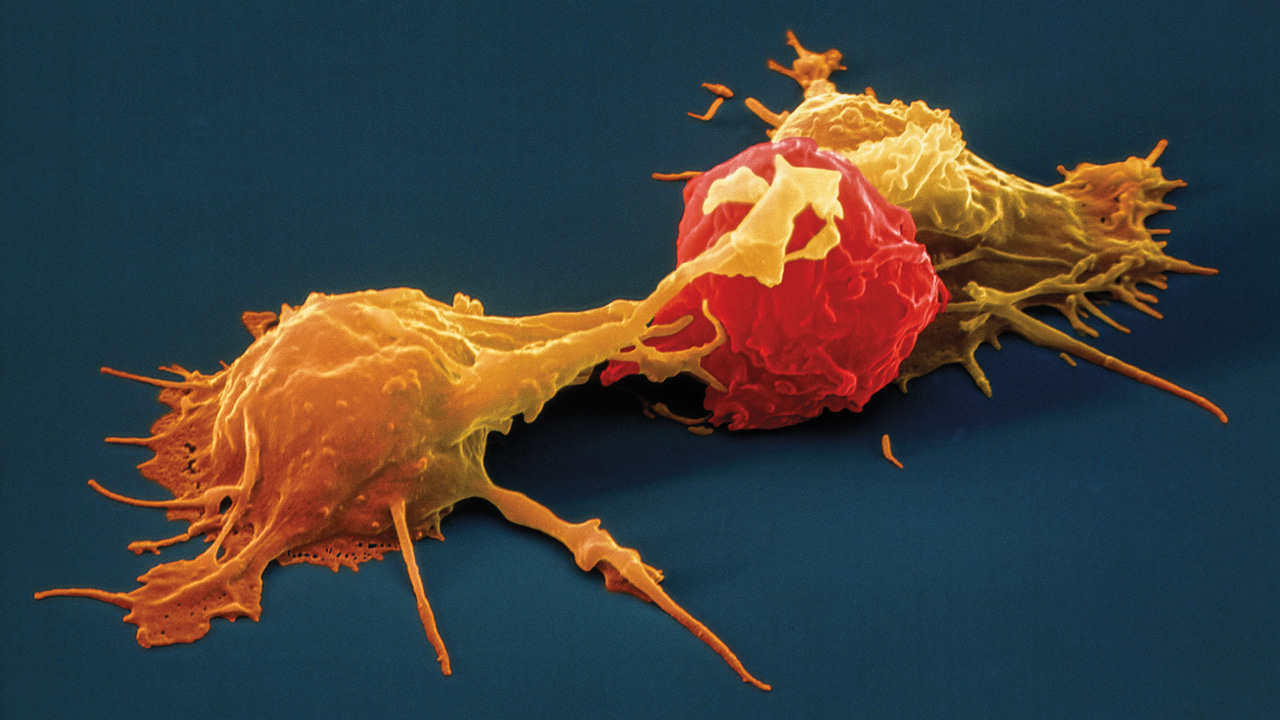
Poster image:
Natural Killer (NK) cells (yellow) attacking a cancer cell (red).
Leslie, M. (2018). Engineered natural killer cells may be the next great cancer immunotherapy. Science. [online] doi:10.1126/science.aav4154.
Hi there!
I’m Claudia, a second-year undergraduate at the University of Leeds and a proud member of the 2026 cohort. I study Biology, History and Philosophy of Science which takes a holistic lens to science. This allows me to explore and question our current knowledge, and its objectivity.
This summer I’ll be setting off my Laidlaw experience researching at The University of Hong Kong’s School of Biomedical Sciences. With Professor Sugimura, I aim to transdifferentiate myeloid progenitor cells to Natural Killer cells, an essential part of our innate immune system. NK cells identify and destroy cancerous cells, thus constructing them in vitro could provide a useful treatment to cancer.
Alongside learning I feel the happiest outdoors with other people. I love being active, running and going on long walks, or being more relaxed, doing yoga and exploring new places with friends (especially love if a cafe is involved).
I’m really excited to be part of this incredible opportunity and hope to learn and connect with as many scholars as possible. Please reach out to talk about research or anything else at all!