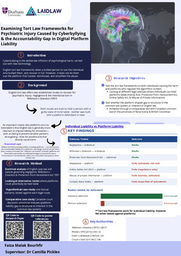
This week I moved from delving and breaking down my research to building the doctrinal foundation for Part I of my research. This includes the general law on psychiatric injury. Having settled last week on limiting the paper to primary victims only, my task this week was to understand the two pathways that framework opens up - negligence and the intentional infliction of harm.
I read Page v Smith [1996] in full, focusing on Lord Lloyd's speech rather than relying on a textbook summary. The core argument, that a primary victim only needs physical injury to have been foreseeable, not psychiatric injury specifically, is more useful to my argument than I expected, since a cyberbullying target is precisely the direct object of the conduct rather than a witness to someone else's harm. I then read Rothwell v Chemical & Insulating Co Ltd [2007] and had to adjust my initial reading of Page v Smith realizing that I had interpreted it broadly. I thought Page v Smith gave primary victims a broader right to recover for psychiatric injury, but Rothwell demonstrates that the primary victim category remains limited and that the claimant must still establish a legally recognised compensable injury. That was a useful corrective as I had been treating Page v Smith as a more generous test that what it actually is.
The main intellectual challenge this week was reconciling two very different pathways sitting inside the same 'primary victim' label, one built on foreseeability, one on strict intent. Initially this felt like a weakness in my structure.
Research skill developed - reading judicial speeches directly rather than through secondary summaries, and specifically learning to notice where a rule has hardened or narrowed since the case that is usually cited for it.

I am Faiza Malak, currently a law student at Durham University. I am excited to be commencing my research this summer and look forward to sharing updates with the network on both the breadth and depth of my work and experiences. Stay tuned!