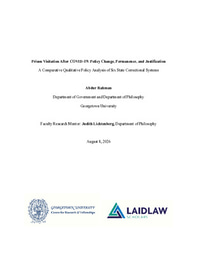
Prison Visitation After COVID-19: Policy Change, Permanence, and Justification
Faculty Supervisor: Judith Lichtenberg (Department of Philosophy, Georgetown University)
Project Background:
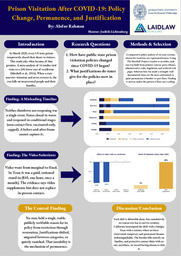
The pandemic dramatically changed how prisons operated, especially regarding visitation. Across the country, in-person visits were suspended or heavily restricted to reduce the spread of COVID-19. Although these policies were initially framed as temporary, some prison systems have kept restrictions in place or shifted toward alternatives like video visitation.
This project focuses on public state prisons, which house the majority of incarcerated people in the United States and are more directly shaped by state policy and public oversight. Research has consistently shown that visitation supports family relationships, rehabilitation, and successful reentry after incarceration. However, much of the existing scholarship predates COVID-19 and does not fully address how pandemic-era policies may have reshaped visitation in lasting ways.
Main Research Question:
How have prison visitation policies changed since COVID-19, and what reasons are offered for current visitation practices?
Additional questions:
-
Which pandemic-era visitation restrictions remained in place?
-
Are there differences between visitation practices in urban and rural prison settings?
-
How do prisons explain continued restrictions or the expansion of alternatives such as video visitation?
Objectives:
This project aims to:
-
Examine how prison visitation policies changed before, during, and after COVID-19.
-
Identify lasting shifts in visitation rules, including frequency, eligibility, supervision, and virtual alternatives.
-
Analyze how prisons justify maintaining or changing these policies.
-
Contribute to larger conversations about rehabilitation, family connection, and incarceration policy.
Methodology:
This research will use a qualitative policy analysis approach, drawing from publicly available sources such as Department of Corrections policies, administrative codes, court opinions, archived government webpages, and reputable news reporting. I will compare visitation policies over time to identify patterns in how prisons changed their practices during and after the pandemic.
The project will also examine the reasoning prisons provide for maintaining restrictions and consider how these justifications fit within broader legal and policy discussions about incarceration and rehabilitation. The final outcome will be a comparative analysis of how an emergency public health response may have reshaped prison visitation in more permanent ways.

Hi! My name is Abdur, and I am a rising junior at Georgetown studying Government and Philosophy on a pre-law track. I enjoy and feel fulfilled doing work related to prison policy reform. For hobbies, I love cooking, hiking, biking, working on fashion, and playing poker.