Leadership Lab - Stephen Carter

Summary
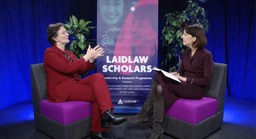
In this episode of the Leadership Lab series, Susanna Kempe, CEO of the Laidlaw Foundation, speaks with Stephen Carter, Group CEO of Informa, about the realities of building and sustaining leadership across radically different contexts, from the boardroom to government and back again. This is a conversation the Laidlaw Foundation is particularly pleased to share: Informa, as the parent company of Taylor & Francis, has recently partnered with us to shortlist Laidlaw Scholars' research for F1000Research.
Carter traces his leadership journey from a sabbatical year as Students' Union president to becoming one of the youngest UK CEOs in advertising, shaped less by formal training than by early responsibility, generous mentors, and an unambiguous appetite for challenge. He reflects candidly on the formative experience of leading NTL through Chapter 11 bankruptcy, a plunge into uncertainty that taught him that the steepest learning curves often sit away from the obvious path, and that crisis leadership depends above all on constant, transparent communication, while instilling a lifelong discipline around debt exposure that would later prove decisive. At Informa, Carter describes a deliberate strategic pivot toward B2B trade shows, doubling down on face-to-face interaction and specialist expertise at a time when both were unfashionable bets, and navigating the existential shock of the pandemic by acting fast, going to equity early, and refusing to furlough or shed staff, a decision he credits with positioning the company to accelerate when the world reopened.
Throughout, he returns to a consistent philosophy of leadership: that profile and personal visibility are poor proxies for impact, that high-ego cultures undermine collective performance, and that the ability to exercise sound judgment under pressure, grounded in humility and stamina rather than authority, is what ultimately distinguishes effective leaders. For Laidlaw Scholars, his message is to engage outwardly and stay curious, embracing risk early and resisting the instinct to simply follow the obvious path, while also pursuing environments where they feel genuinely comfortable rather than merely impressive, and cultivating the resilience to absorb setbacks without being diminished by them.
Time codes
00:17 We often talk to our Scholars about leadership as a journey, not a destination. Where did your leadership journey begin?
01:33 You were in your early 30s when you became UK CEO of J. Walter Thompson. What led to such a rapid rise?
02:25 What do you think they saw in you that made them want to back and accelerate your career?
03:30 Your next role was at NTL, again at a young age and during a major crisis. Can you tell us more about that experience?
05:15 What are the biggest differences between how business is done in the US and the UK?
07:30 You then moved into government, to Ofcom, leading another major restructuring. What was that like?
08:47 At Ofcom, you brought together six different agencies. How did you create a cohesive culture from six distinct organisations?
11:28 “Fast” isn’t a word often associated with government, but arguably it should be. Are there changes governments could make to enable that kind of pace?
14:13 We have Laidlaw Scholars all over the world. If you were advising them today on where to build their careers or simply live fulfilling lives, where would you suggest they base themselves?
16:58 Ofcom was widely seen as a success under your leadership. Is it facing greater challenges now?
19:43 You were closely involved in the Digital Britain report. If you were advising government leaders or CEOs today on AI, what would you say?
21:43 What advice would you give our Scholars about what to study or which types of organisations to pursue, given both the opportunities and risks of AI?
24:11 Informa is a FTSE 100 company with 14,000 employees, yet it’s not always a household name. Why do you think that is, and does it matter?
30:45 Informa has seen extraordinary growth under your leadership. When you arrived, it comprised three separate businesses - and you doubled down on events, which was a bold move. What drove that decision, and how did you navigate COVID in the midst of it?
38:15 You’re now based in Dubai much of the time. Why?
40:55 I love how you speak about championing specialists. In today’s world, how important is deep expertise and specialism?
43:01 You’ve worked with Prime Ministers and global leaders. Are there particular leaders you admire or traits you’ve observed that define the very best leadership?
46:38 What do you do to relax?

Hi! I'm Amanda, a third year Neuroscience student and Laidlaw alum from UCL. I'm Swedish-Persian and grew up in Sweden before moving to London for uni. These days, alongside my studies, I work for the Foundation as a Marketing Assistant.
For my first year research project, I worked on optimising alginate hydrogels for 3D astrocyte culture systems. In simpler terms, I was figuring out the best way to prepare a jelly-like scaffolds so that star-shaped brain cells called astrocytes could grow in three dimensions rather than flat on a dish. This matters because 3D environments mimic the brain more realistically, which could help researchers develop better treatments for neurological disorders!
For my Leadership-in-Action project, I co-created Beyond the Books, a resource designed to help students from underrepresented backgrounds navigate the unwritten rules of university life, from internships and networking to professional opportunities that aren't always obvious if you're the first in your family to go to uni.
Always happy to connect, whether you want to chat about neuroscience, widening access, the Laidlaw experience, or just say hello! One of my favourite things about this community is getting to meet people from different universities and backgrounds, so please do reach out! 🌟




Please sign in
If you are a registered user on Laidlaw Scholars Network, please sign in