Final Reflections

Two years ago, I wrote about Gandhi and Churchill—about how singular individuals can bend the arc of history through conviction and will. I still believe in individual agency, but my understanding of how that agency operates has shifted considerably.
Back then, I framed leadership as an attitude rather than a hierarchical status, but I think I still unconsciously located leadership in exceptional individuals acting upon the world. The Laidlaw experience has taught me something more uncomfortable: leadership is less about having the right vision and more about creating conditions where others can develop and exercise their own agency. It is, in Robert Greenleaf's formulation, being "servant first"—not as false modesty, but as genuine orientation.
The letters I wrote to myself in Toby's workshops revealed a tension I hadn't fully acknowledged: I wanted to lead, but I was often unwilling to be led. Real leadership, I've come to believe, requires a kind of porousness—the capacity to be changed by the people you work alongside, not just to change them.
This doesn't mean abandoning conviction. The historical leaders I once admired weren't great because they were immovable, but because they could hold firm on ends while remaining genuinely open about means. Leadership today, for me, means committing to a direction while staying humble about the path—and recognizing that the people walking with you often see things you cannot. It is, ultimately, an attitude of serious service rather than a position of authority.
Two years ago, I suspect I would have defined leadership development in terms of becoming more decisive, more certain, more self-sufficient. What actually happened was almost the opposite.
Coordinating research across four countries with a team of six taught me that leadership often means holding things together when they threaten to fall apart—and that this is rarely a solo endeavour. When interviews were cancelled at short notice, when we found ourselves with far less data than anticipated, I learned that the instinct to retreat and solve problems alone was precisely the wrong one. The most useful thing I did in those moments was ask for help: from teammates who saw angles I had missed, from our supervisor who had navigated similar frustrations before.
I also learned to sit with disagreement. Early on, differing interpretations of our findings felt like obstacles to overcome as quickly as possible. Over time, I came to see them as the actual work—the place where our analysis got sharper. Learning to hold space for productive friction, without either steamrolling or capitulating, was harder than I expected.
Perhaps what would most surprise my past self is this: I have become more comfortable with not knowing. Contextualizing limited and messy data required a tolerance for ambiguity that I once mistook for weakness. I now understand it as a prerequisite for honest inquiry—and for leading others through uncertainty without pretending it doesn't exist.
Before Laidlaw, I knew I was interested in international economic policy, but the shape of that interest was vague. The programme gave me something I could not have manufactured on my own: the chance to test my assumptions against reality.
My Leadership in Action placement at the European Commission's DG INTPA clarified what had been abstract. Working within an institution that operationalises development finance—deciding which projects get funded, under what conditions, with what trade-offs—showed me that this is where I want to build a career. I am now pursuing a Master's with international development banking as a clearer horizon than I had two years ago. That clarity is directly attributable to this programme.
Academically, the field research experience has been formative. Conducting interviews across multiple countries, synthesising incomplete data, and defending interpretations to peers and supervisors taught me how knowledge is actually produced—not as a solitary exercise, but as a collaborative and often contested process. I will carry this into graduate study and beyond.
Perhaps most valuably, the programme connected me to a cohort of scholars whose interests intersect with mine but whose perspectives differ. In a field like development economics—where policy decisions carry real consequences for people far from the decision-makers—surrounding myself with people who challenge my thinking is not a luxury but a necessity. The relationships formed through Laidlaw are ones I expect to sustain and draw upon for years to come.
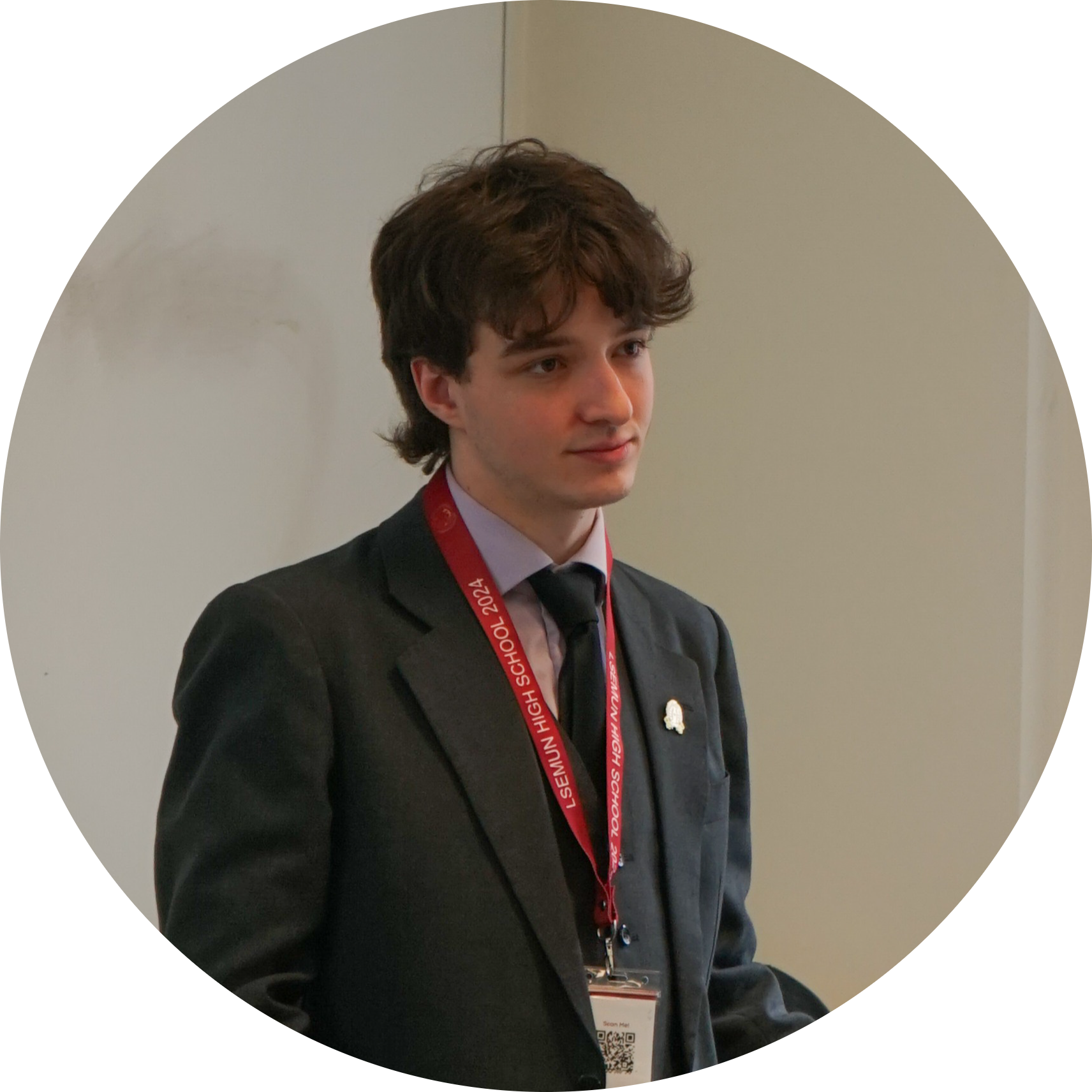
I am a final-year History and Politics student at the London School of Economics, where I also work as a Research Assistant in the Department of Government. My academic interests centre on political economy, governance, trade policy, and the dynamics of development in Latin America. At the European Commission's DG INTPA, I worked on blended finance, EU trade conditionalities under GSP+, and the Global Gateway initiative, which deepened my interest in how international economic policy is designed and implemented in practice. Outside the classroom, I have actively represented the Brazilian student community in London, managed several Model United Nations conferences for youth, and organized academic panels on various topics.