What new ideas, challenges, or other issues have you encountered with regard to your project (this might include data collection, information that contradicts your assumptions or the assertions of others, materials that have enriched your understanding of the topic or led you to change your project, etc.)?
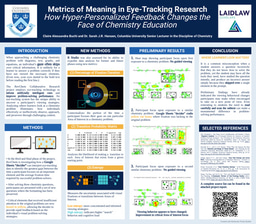
Current challenge: Statistically significant conclusions are hard to make when the surveyed population is small! I am actively analyzing eye-tracking data using R from a former phase of the broader research project where participants worked through a challenging chemistry question. However, with only 36 participants and very few who answered the question correctly, finding statistically significant differences in visual scanpaths and other eye-tracking variables between the "successful" and "unsuccessful" problem-solvers is difficult. In addition, the confidence rating that participants associated with their answers is very interesting to consider. For instance, if a participant answered a question correctly but had low confidence in their response or acknowledged that they guessed, their problem-solving strategies will likely align more with the unsuccessful participant viewing data rather than that of the successful participants.
How have these ideas or challenges shaped the bigger picture of your research? Has the scope or focus of your topic changed since you began this project? If so, how?
This challenge has inspired me to dive deeper into the details of the participant's scanpath data. We have divided up the stimulus (i.e. chemistry question) into distinct Areas of Interest (AOIs), and these can be either coarse-, medium-, or fine-grain. Coarse-grain AOIs that I have been analyzing are larger sections of the stimulus that contain elements such as the entire equation, the entire prompt, the graph, or an answer choice. However, looking closer at fine-grain AOIs, such as the coefficient before NaCl in a chemical reaction or the equivalence point in a titration curve, allows researchers to track even more niche patterns in a participant's viewing behavior. My current analysis involves redesigning my R script to track these more intricate patterns and tendencies among groups of successful and unsuccessful problem solvers that emerged when attempting a chemistry problem with more equally split results (45% success rate v. 15%). Are there smaller habits and skills employed by successful problem-solvers that we can uncover, and how do we ensure we develop a stimulus that is challenging yet produces varied participant response data?
Now that you’ve engaged in Part II of the Leadership Retreat, reflect on a learning point that remains with you as a new way to understand leadership, and to incorporate into your own engagement, in the future.
Yesterday at the Leadership Retreat, we talked a lot about receiving criticism, and I could relate to a case study character, Maya, who read between the lines of feedback to take a point of critique to heart. As a ballet dancer, critique and corrections have long been a part of my daily life, and I had a coach who drilled it into me that receiving criticism reflects the potential a critic sees in an individual. The critic has taken the time to provide constructive feedback because they care about the growth they know you can achieve. For this reason, I appreciate blunt criticism more than praise as a motivating force to continue working and pushing myself. However, as an avid overthinker like Maya, it can be easy to take a piece of criticism too seriously and re-evaluate too much of your working style or your former decisions. Something I will take away from our discussion yesterday is to acknowledge the perspective that critics provide, but to remember that it is merely that: a perspective.
On another note, during the discussion, another scholar mentioned a possible task for motivated individuals in group projects; instead of forging ahead individually with the project, let the individual forge "sideways." Essentially, instead of holding a go-getter back and ensuring that all group members are contributing equally, a coordinator can acknowledge differences in working behaviors and provide this individual with additional opportunities to support the existing stage of a project. What other sources or evidence support the work that the team is currently doing? Can you generate ideas for next steps to present to the team, without pursuing those ideas prematurely? While a coordinator can assign these sideways tasks, the go-getter can also acknowledge their own tendencies and find ways to contribute positively and strengthen the project in its current form.

Hello! My name is Claire Buchi, and I am a sophomore at Columbia University from Los Angeles, California studying Medical Humanities and Public Health on the pre-med track. Some of my academic interests include metacognition, writing, and health equity from an educational and technical perspective.
This summer, I conducted eye-tracking research in chemistry education, analyzing how learners approach challenging questions and developing an AI tutor that can encourage more effective problem-solving strategies across a broad demographic.
In my free time, I love dancing, running, reading and trying new places to eat around New York. Feel free to reach out to talk research or to just say hello!