How have the workshops and discussions on leadership this week changed your understanding of what leadership means?
It was interesting reading through the case study presented and immediately identifying one member as the group leader: "Maya." However, she held the decision-making power in the group in name only while another participant in the project was the true changemaker, driven by a need to get things done and make a lasting impression on the community. It may be a cliché that everyone can display leadership independently of the title they hold, yet what looks like leadership to one person may appear weak, ineffective, or unnecessary to another (i.e. prioritizing amiability over efficiency). The changemaker was frustrated by Maya, and Maya rechecked and rewrote much of the work by the changemaker. Whether coordinating others, fostering collaboration, maintaining a cordial working environment, or spearheading the project, an individual may believe they exude leadership qualities, yet if not all of these processes are being tackled in some way, their efforts may appear to be in vain because a lack of communication or productivity will emerge. A true leader that Maya can strive to become understands the importance of each of these processes, but also trusts her team and gives them the agency to be leaders to help bring these processes to fruition.
How might you imagine applying one model of leadership during your Laidlaw summer on campus—either within the Laidlaw cohort or beyond this community? While we often associate leadership and leaders with seniority, how might leadership be modeled among individuals who are among the youngest people on campus (i.e. you!)?
A lot of the time, freshman are not able to be the drivers in name in campus or club projects that involve upperclassman or in research teams with experienced PIs and graduate students. However, analytical leadership can be an accessible and impactful model to exude, even if you don't perceive this is as your preferred leadership model. While one individual ("Rowan") in the case study was seen as the brash and action-oriented participant, more focused on making progress and driving ahead individually than on careful analysis, her passion for making a difference could easily be redirected to be more productive in the analytical model. By instead coming to team meetings having thought ahead and researched multiple evidence-based ideas for next steps to share with the group, her brainstorming can be instrumental to the team. Throughout this research project and beyond, coming to meetings with actionable, rational ideas and presenting them clearly and passionately to your fellow team members displays the spearheading attributes of a leader that are fulfilling to Rowan (and me), with the caveat that such ideas are relinquished freely when not adopted by the group.

Hello! My name is Claire Buchi, and I am a sophomore at Columbia University from Los Angeles, California studying Medical Humanities and Public Health on the pre-med track. Some of my academic interests include metacognition, writing, and health equity from an educational and technical perspective.
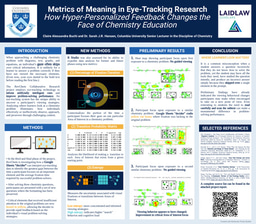
This summer, I conducted eye-tracking research in chemistry education, analyzing how learners approach challenging questions and developing an AI tutor that can encourage more effective problem-solving strategies across a broad demographic.
In my free time, I love dancing, running, reading and trying new places to eat around New York. Feel free to reach out to talk research or to just say hello!