Coal, Capital, and Climate: Theorizing China’s Green Transition under State Capitalism
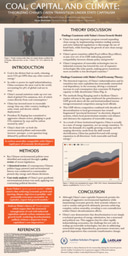
Coal has been central to China’s successful industrialization in the last century, from the Great Leap Forward’s production campaigns to the reform era’s rapid coal-driven economic expansion. However, China’s rapid resource consumption has caused significant environmental degradation and now threatens both its future development and socio-environmental sustainability, prompting the Chinese government to adopt ambitious climate goals. Despite these climate commitments, coal use has resurged since 2020, in part as a response to the economic slump caused by the COVID-19 pandemic. This has raised the question of whether decarbonization can truly align with the demands of capitalist growth. This paper examines China’s post-pandemic environmental policies through two contrasting theories in order to determine whether China’s efforts signal a successful shift toward green growth or reflect a failure to decarbonize due to the contradictions within capitalist development. Andreas Malm’s theory of “fossil capital” posits that the structural embedding of fossil fuels in the formation of industrial capitalism renders decarbonization unlikely without a fundamental and complete shift away from capitalism’s core imperatives. Conversely, Jonas Nahm’s “green growth model” asserts that achieving economic growth and meeting climate objectives is possible—and potentially even more successful—in capitalist, export-led growth models. This paper concludes that although China’s state-capitalist framework permits the passage of aggressive environmental legislation while maintaining economic growth, their systemic reliance on coal to sustain said growth ultimately prevents achieving complete carbon neutrality, revealing a core contradiction within China’s decarbonization efforts.

Hello everyone! My name is Stella Dull, and I'm a rising junior at Barnard College double majoring in East Asian Studies and Applied Math. My research interests lie in the intersection between environmental justice, political theory, and renewable energy. Last summer, I researched China’s approach to green industrial policy and their associated outcomes through a political theorist lens with Professor Alyssa Battistoni. This summer, I travelled to China to work with an environmental NGO called Green Camel Bell, where I will help lead an environmental educational summer program for youth.