Week 1 Laidlaw Reflection: A Reassessment of Research and Leadership
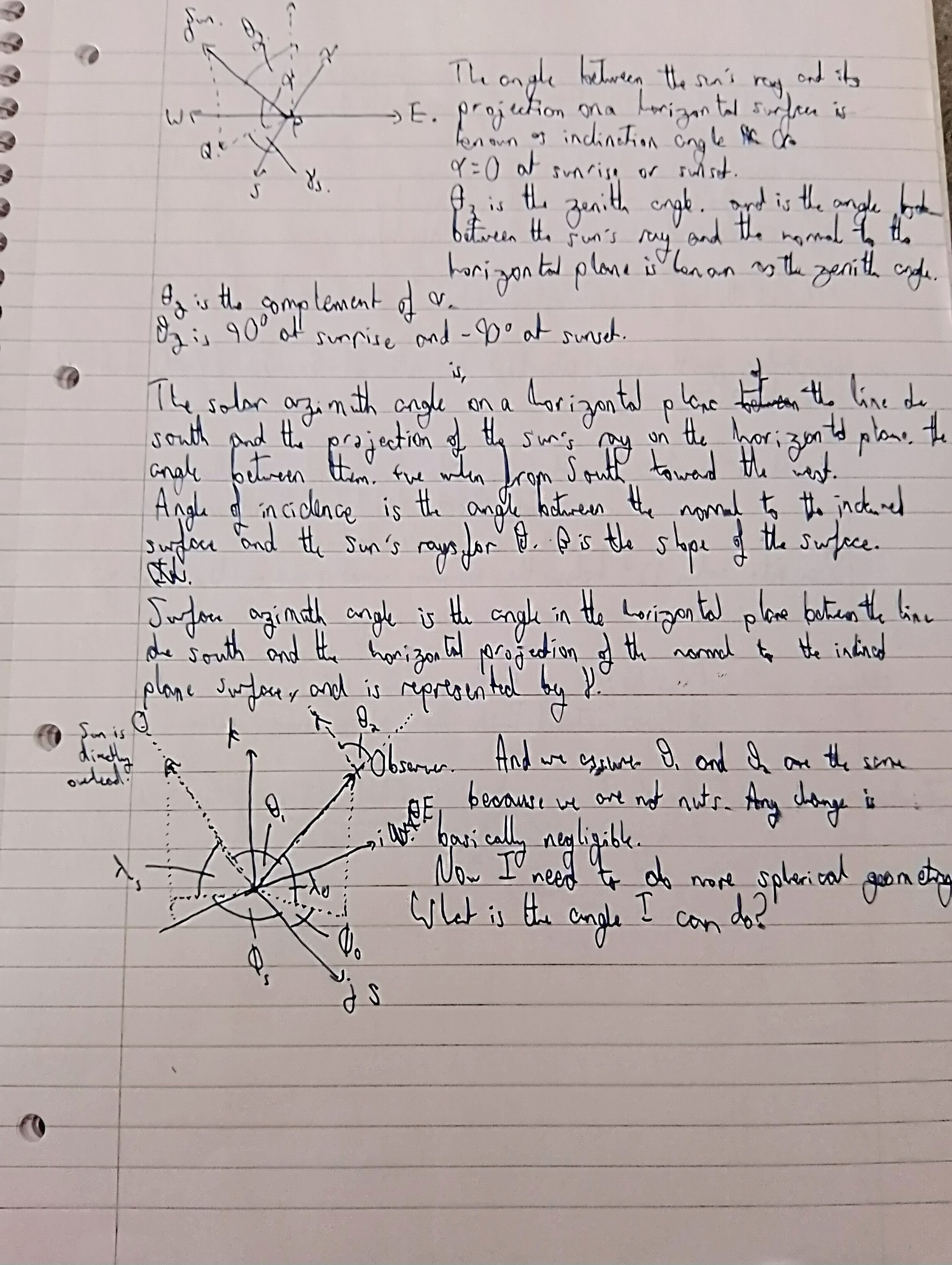
I started off the week quite ambitiously. I had set a goal of determining how efficient a whole vertical solar array was going to be. You can see a drawing of the plan below. However, I ran into difficulty deriving an expression for the whole solar array, with solar panels casting shadow on each other.
I had a chat with my supervisor (Professor Christopher Marcotte) about this, and he suggested building a model with the solar panels not interacting with each other, as this would make completing the project more feasible. I agreed with this, and moved onto determining a more simple objective function f(phi, t, epsilon), where phi is the position of the Sun in the sky, t is the time, and epsilon is the orientation of the solar panel with respect to the Earth. This determines the energy generated each hour over a year, which I can then integrate using the trapezium rule to find total energy generated.
The first issue was determining how the phi changes with time. This can be broken down into solar elevation angle (how far from the horizon the Sun is), and azimuth (measuring how far the Sun is from the South direction). Sandia National Laboratories [1] uploaded a set of equations for solar position that I tried to implement. They produced values that were accurate– assuming you were at the equator. As these didn’t work, I used a modified sine function to simulate how the position of the Sun in the sky varies over the course of a year in Durham.
I’m using cloud cover as a way of measuring how efficient solar panels are. I took the mean and standard deviation of the cloud cover data for each month in the UK from 1901-2025, taking the data from the Climatic Research Unit, University of East Anglia [2] (CRU). The data was useful, but I wish there had been more available.
Energy generated per hour can then be written as E=max(phi.epsilon, 0).
This is a plot of the results for my initial objective function:
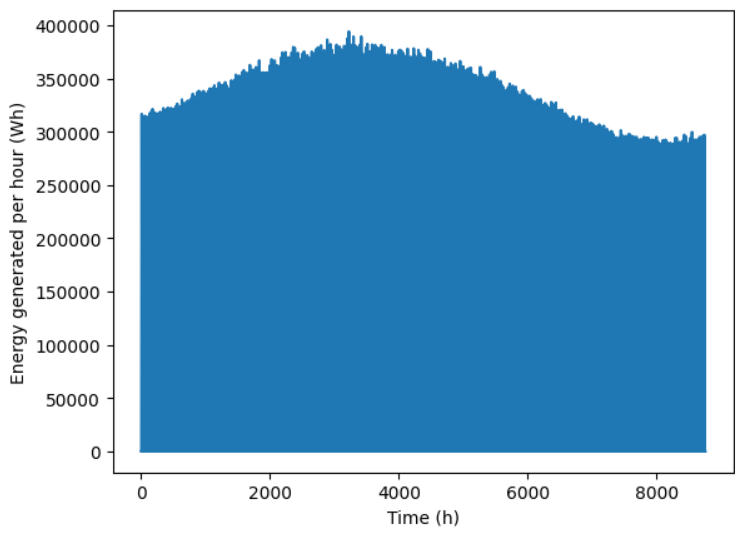
This data is noisy, but there are limitations due to assumptions (e.g. discrete distributions depending on months of the year for cloud cover).
The leadership training sessions this week were useful. We had a session on “What makes good research?” by Dr Alison Whelan, RIS. It was challenging: she had us made a Diamond 9 of different statements about what makes research valuable. A point of contention was the importance of research being publishable, and benefiting communities. How valuable is research if it’s published in newspapers, and how do you put a value on research that will only have an impact 50 or 100 years into the future? We also had a session introduce different reflection methodologies, e.g. Gibb’s Reflective Cycle and Brookfield’s Four Lenses. The drop-in with the Durham Centre for Academic Development on Wednesday afternoon was also useful, though I was a bit hamstrung in asking questions as I’ve not started to write my report/make my poster yet.
I learnt a little bit about research last week, and how to limit down your topics. While it would have been useful to have solar panels casting shadow on each other, and I’m interested in exploring that in the future, the goal was too ambitious and doesn’t match my research objectives, which are primarily exploring different types of optimisation method, variable fidelity surrogate functions and the probabilistic bisection method through the lens of solar panel orientation.
I’m getting more interested in the theory of leadership. What makes an effective leader? How much of it is vulnerability, as put forth by Brené Brown [3]? Vs. How much of it is understanding the roles people fill in the team, as per Belbin [4]? John Kotter, in his book “What Leaders Really Do” [5], says that there is a fundamental difference between leadership and management; you can manage an army, but “no-one has yet figured out how to manage people effectively into battle. They must be led.” In a few ways, this is more interesting than the research aspect of the Laidlaw programme. How do I become a more effective leader?
My research goals for next week are to improve on my objective function, both by making the probability distributions for cloud cover continuous over the course of a year, and implementing a more accurate way of factoring in cloud cover to my objective function. I should also implement the equations from Sandia National Laboratories [1] to generalise the function beyond Durham in particular. After meeting with my supervisor, I will probably limit coordinates to within the UK (including Channel Islands and Northern Ireland, excluding overseas territories) so that I don’t have to use excessive weather data. Some of the datasets from CRU [2] are around 14GB, which is too large to use comfortably! Additionally, I’ve no experience handling these datasets. This may be useful to explore after completing my research, or if I have more time before training my surrogate functions.
My leadership goals are to continue learning more about effective leadership, by reading books and listening to podcasts. Learning about more theoretical frameworks of leadership and teamwork seems interesting. I hope I get given the opportunity to put these into practice in the future.
[1] Basic Solar Position Models – PV Performance Modeling Collaborative (PVPMC) (Accessed 03/07/2026)
[2] CRU-TS high-resolution gridded climate datasets Climatic Research Unit (CRU) (Accessed 06/07/2026)
[3] The Power of Vulnerability | Brené Brown | TED (Accessed 06/07/2026)
[4] Belbin Team Roles | Belbin (Accessed 06/07/2027)
[5] Kotter, J. P. (1999) What Leaders Really Do Harvard Business School Press

Hi! My name's Charlie, I'm doing a research project on surrogate functions for solar panel optimisation on tall vertical facades. I'll be comparing optimisation methods between surrogate functions, particle swarm optimisation and genetic optimisation.
I'm studying Engineering, but when I'm not working I am a part of DU Solarcar (looking forward to the European Solar Challenge 2026!), as well as going to church and running in my free time. I'm always up for a game of chess or a chat about science. I'm also learning French and Spanish in my free time. Fun fact: I'm also enrolled on a Welsh language course at Prifysgol Bangor!