Trust in Healthcare and Public Health Among LGBTQ+ Young Adults

“Distrust doesn’t even begin to cover it.”
I was 30 minutes into an hour-long interview with a transmasculine Boston resident, who had been neglected and mistreated by the healthcare system to such an extent that they no longer seek any form of care—not gender-affirming care, not dental care, not even basic primary care. My heart sank as the individual shared stories of parental and familial neglect, judgement in the healthcare setting, and unexpected charges from insurance companies.
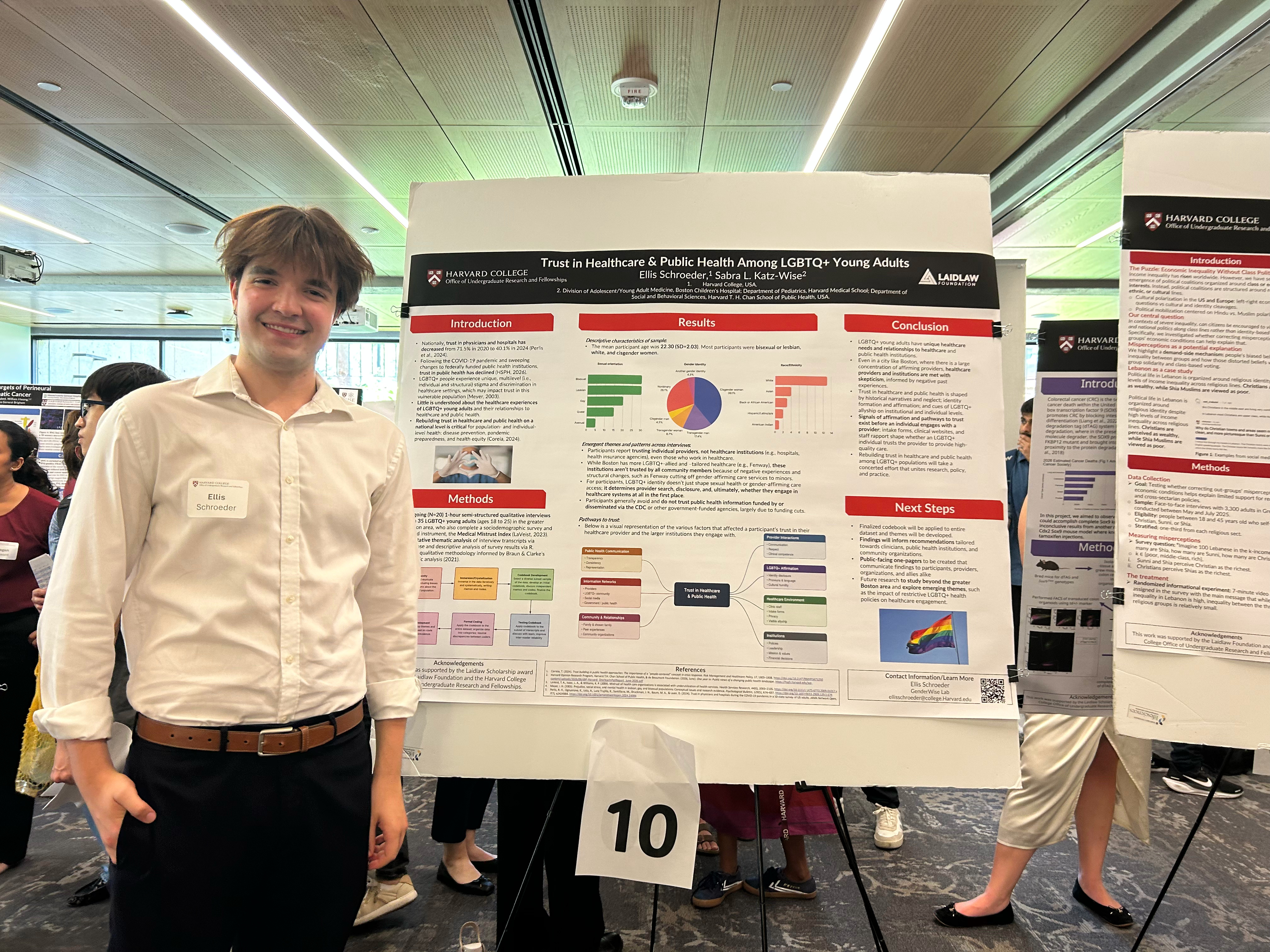
This was one of the many stories I heard this summer conducting semi-structured, hour-long interviews with LGBTQ+ (i.e., lesbian, gay, bisexual, transgender, queer, etc.) young adults in the greater Boston area about their healthcare experiences and relationships to healthcare and public health institutions both in Boston and beyond—a timely project informed by what I call ‘The Trust Crisis.’1–4 Trust in medicine and public health has declined in the U.S. following the COVID-19 pandemic. Indeed, trust in hospitals and physicians has declined from 70% to 40% in just four years,3 a statistic that informed this project’s line of inquiry in the first place.
My project, for which I applied to and secured grant funding and Institutional Review Board approval, was conceptualized by me, with guidance and mentorship from Dr. Sabra L. Katz-Wise at Boston Children’s Hospital, Harvard Medical School, and the Harvard T.H. Chan School of Public Health. Before this summer, I had yet to engage so intimately in qualitative research conceptualization, design, and methodology. This project has been one of the most inspiring, eye-opening, and satisfying academic ventures of my life thus far. While this project will continue into the academic year and will be central to my future academic work, innumerable lessons and insights about what it takes to pursue rigorous inquiry in an ethical manner emerge. Each takeaway and reflection aligns closely with the progression of the summer and the structure of a larger research paper. Thus, both to describe my key intellectual findings and personal reflections, my learnings are delineated underneath each element of an Abstract.
Introduction:
Trust in medicine and public health has declined in the United States following the COVID-19 pandemic. However, the patterning of this decline is poorly understood, particularly among minoritized populations vulnerable to adverse health outcomes, such as sexual and gender minority (LGBTQ+; e.g., lesbian, gay, bisexual, transgender, and queer) individuals who experience health disparities due to minority stress related to stigma. This study examines how LGBTQ+ young adults experience trust and mistrust in healthcare and public health.
This research came about through the coalescence of lived experience, prior literature, and sociopolitical context. Starting in high school, I researched LGBTQ+ health disparities, informed by my lived experience as a member of the LGBTQ+ community. But with each project, each population-level study of adverse health outcomes, I kept returning to the classic idea of “So what?” What do we do with knowledge of disparity? Do we keep describing egregious inequities, or do we study why they emerge and how we can solve them?
I thus became interested in how trust in institutions is built, eroded, and repaired, and how research can inform intervention, moving beyond simply describing disparities. Growing up gay in the South, I witnessed how mistrust in medicine and science intensified across communities. Within queer spaces, this mistrust carried additional layers: histories of neglect during the HIV/AIDS crisis, stigma, and disinformation. These dynamics are not simply academic; they shape whether my community seeks healthcare or disengages altogether. These insights formed the foundation of my research project.
Methods:
Participants will include thirty-five young adults ages 18–25 years who speak English, identify as LGBTQ+, and reside in greater Boston. Each participant will complete a demographic and healthcare usage survey, an interview, and a healthcare mistrust survey. Interview transcripts will be coded and themes will be developed using a multi-step method adapted from Braun and Clarke’s reflexive thematic analysis, including data familiarization, inductive and deductive coding in Dedoose, and theme development. Survey responses will be analyzed descriptively via R.
I wasn’t new to research this summer—I have lead projects, conducted complex statistical analyses, and published papers. However, I was new to the theory, rigor, and execution of qualitative research. I had taken an ethnography class, which taught me what it means to enter into research reflexively, reflecting on my own background and biases as I prepared for people-based research. Nothing prepares you to conduct qualitative research, however, like actually doing it. No class or methodological paper prepares you to do the work.
To prepare for my study this summer, in addition to trainings led by Dr. Katz-Wise and members of the GenderWise Lab, I read chapters and summaries of Braun and Clarke’s 2021 book “Reflexive Thematic Analysis,” various research articles about semi-structured interviews, and practiced with members of my research lab. As I read about qualitative analysis, I found the prospect exciting. Immersing oneself in the dataset, treating oneself as the instrument…how hard could that be? As I began to interview and read qualitative research papers, I found myself going back to the idea of rigor and ethics. In a post-Positivist world, quantification of qualitative data improves the “rigor” — I found myself frustrated, as I dug deeper into the immersive experience of interviewing, reflecting, and analyzing qualitative data, by the perceived absence of the same rigor I found in prior quantitative projects. There was always a confidence interval for point estimate calculations; there was always a statistical test to confirm the analysis, always a way to make sure one was “doing it correctly.” With every interview I conducted, there wasn’t someone over my shoulder to tell me I was “doing it correctly.” There wasn’t even agreement in the broader scientific and academic world regarding how to conduct interviews, probe participants, and develop codebook—as a student and budding researcher eager to “do it correctly” throughout the project, it was an adjustment sitting down with myself and viewing me, Ellis, as a “valid instrument” in the research process. I came to realize that ethical research started with not understanding your discipline or conducting an immaculately thorough literature review but understanding the self. To understand oneself, one’s biases, one’s assumptions, one’s desires, and one’s position within the larger community of researchers and the population being studied. Unlike quantitative research, where the post-Positivist world searches for confidence levels to approach the infinite asymptote of objectivity, qualitative research finds objectivity in intersubjectivity and honesty, towards the self, about the population being researched, and the dynamic between the individual researcher and the interview participant.
As I conducted interview after interview, starting as early as 9 am and as late as 10 pm, I came face-to-face with the lesson that one must not just understand the self, the instrument, but also protect the self to preserve the quality of the research. Doing too many interviews in a day, losing sleep, and taking on too many projects leads to less ability to probe thoughtfully, meld research insights during interviews and develop high-quality, rigorous data for analysis. My desire to produce products and share my rapidly evolving insights about this important research outpaced the version of me that takes his time and thoroughly and thoughtfully conducts research. Moving forward into both future projects and the analysis stage of the project, I plan to treat myself both as a rigorous instrument and take my time to immerse myself in the data and thoughtfully do the research.
This balance between thoughtfulness and product is a lesson that extends beyond research—it’s a lesson in leadership. Prestige, money, and power seem to be awarding speed and production. But what if the product is poor? What if it cuts corners? Building a moral force of character and an ethical code might seem to “slow the path” to a product, but the quality and longevity of both a product, and its greater impacts, rely on thoughtfulness.
Results:
Interviews conducted thus far (N=33) have revealed a lack of trust in public health agencies; lower levels of trust in medical institutions than in the individuals within said institutions; negative experiences due to lack of provider knowledge of LGBTQ+ needs; the role of social networks in determining how LGBTQ+ individuals access healthcare information; and the existence of mistrust pathways before a provider interaction (e.g., through intake forms). Participants desire providers who do not convey judgement or surprise at identity change or disclosure, visibly support LGBTQ+ communities through affirmation and allyship (e.g., pronoun pins), and actively listen and engage in a culturally-competent manner (e.g., using gender-neutral language).
Coming into the interviews, I used literature review and anecdotal conversations and experiences as a member of the LGBTQ+ community to inform my questions, as well as probes. For instance, in my interviewer guide document, underneath the question “What might signal that a healthcare provider or space might be affirming or safe for LGBTQ+ patients?” I listed probes such as intake forms, visible signs of allyship, mission statements, and provider language. Interviews met my expectations in this way—for multiple questions. However, what left more of an impression was the sheer heterogeneity in people’s perceptions of and experiences with healthcare. It didn’t even align with assumptions one might make about demography. For instance, a transgender participant of color shared that they have had “nothing but positive experiences in healthcare.” However, a white male participant who is currently in a heterosexual relationship shared innumerable negative experiences. It is tempting as a researcher to construct a narrative and make assumptions based on the most flashy, exciting, or ground-breaking findings. But that isn’t conducive to honest research. Research isn’t meant to be perfectly consistent. If we don’t exist in nuance or contradiction, we don’t produce knowledge. While it might serve a publication or community intervention better to only present “the bad stuff” as a battle cry for community intervention, that simply isn’t honest, or accurate. Trust is personal. Even in a community like the LGBTQ+ young adult population of the greater Boston area, there exists much diversity that cannot be glossed over.
What stuck out to me most from this research project was the ways in which institutional changes (e.g., a hospital terminating care) on local levels can have trickle-down effects and function as a signal of whether a practice is affirming or safe, even if the care being affected by changes isn’t being accessed by all patients. For example, Fenway Health Institute, a medical institution in Boston that was founded to serve the LGBTQ+ community, terminated gender-affirming care provision to minors in October 2025. Participants, even those who do not seek gender-affirming care or are no longer minors, radically changed how they perceived Fenway Health because of the policy. Some participants stated verbatim that they have lost all trust in Fenway Health. Nevertheless, some participants still seek care at Fenway, were unaware of the changes, or recognize the federal pressures placed on Fenway. Some saw their providers in a different light, others saw the providers in the same, positive light, but placed the onus of the change on the hospital administration. Just 33 interviews revealed immense complexity as it relates to how institutions are responding to the current American sociopolitical moment. Still, what I found was those policies signal values. A mission statement isn’t enough. LGBTQ+ young people look at the actions of organizations, where their money goes, what they stand for, and the actual experiences of patients—to earn trust, an organization can’t simply signal virtues, they must provide evidence.
Across positive and negative healthcare experiences, I understood intimately how age, not just LGBTQ+ identity status, shape care. Young people face barriers to care when they are put in the shoes of the person finding providers, navigating insurance, asking questions of providers, and managing care independently. I came to realize the importance of security, privacy, and confidentiality for LGBTQ+ young adults. Some participants do not speak to their parents, others have not disclosed their LGBTQ+ identity to their parents, some are forced to call their parents on the phone during visits despite being over the age of 18.
The presence of an affirming, supportive parent, as well as confidentiality and safety in the healthcare setting, are pathways to trust. A provider and healthcare institution must recognize the heterogeneity of LGBTQ+ youth and their relationships with their families, which shapes whether they seek care, disclose information, and navigate healthcare safely. Originally, when I designed this study, I discussed inclusion criteria with my mentor extensively. Do we focus on all LGBTQ+ youth? Do we focus on LGBTQ+ minors? We decided to study LGBTQ+ young adults because they are at a unique inflexion point in their care, where they may, for the first time, navigate healthcare independently without oversight. I came into the research with the expectation that participant experiences and perceptions of institutions would be removed from parental influence; however, participant relationships with their parents or guardians consistently came up throughout interviews in diverse ways.
I learned, thus, that research-informed expectations can be accurate and yield insights, but even the utmost preparation and discussion with advisors and collaborators won’t be able to predict the realities of lived experience. No literature review or committee-driven research decision can predict how the research goes. This is precisely why research is exciting. We can’t predict. No matter how hard we try. And with surprise is new knowledge.
Future Directions:
These findings may inform strategies for improving both LGBTQ+ healthcare experiences and fractured relationships with larger systems. Future directions may include conducting the study nationally and comparing LGBTQ+ experiences to heterosexual, cisgender populations.
This project was transformative both intellectually, professionally, and personally. As I move into my sophomore year at Harvard, I’m eager to continue the project—conducting rigorous qualitative analysis, developing themes, revising codebooks, and drafting manuscripts to share this work with the world.
What excites me most, however, is not the academic environments the project will find itself in, but the translation of the work into something. Some intervention. Some solution. Some step towards change.
While the Leadership-in-Action (LiA) project is intended to be that bridge, there is a critical tension that cannot be ignored: my findings were shaped by the unique social, cultural, and political context of Boston. At Harvard, the LiA project is international—how can I translate findings of a study of Boston-based LGBTQ+ young adults to a completely different place? It would be unethical in nature to extrapolate my findings to other communities. However, my project, from the conceptualization to the final question I ask is conducive to local action.
Every interview ended with the same question: “What do you think providers and institutions could do to earn, or rebuild if broken, the trust of LGBTQ+ young adults?” I hope to use these responses to shape my future efforts in Boston, extensions of the research outside of the bounds of an international LiA project. Whether it’s a community service project, a clinic accreditation process, or a social enterprise, I hope to ground my actions in the community, moving beyond the ivory towers of academia and entering the world that shapes health outcomes for LGBTQ+ young people.
Nevertheless, I see the LiA project as a unique opportunity to ask similar questions about institutional trust and healthcare experiences of marginalized populations in new contexts. Whether it be in Rwanda or South Korea, or England, LGBTQ+ people face inequities in health and human rights. The entire world has faced the brunt of the COVID-19 pandemic’s impact on public relationships with healthcare and public health. While my research is conducive to Boston-based intervention, I hope my LiA project extends the research to new, community-engaged territory.
As an aspiring physician and public health leader, I hope to continue studying not only why trust forms or erodes but also translating my findings to meet the needs of marginalized populations that face barriers to health across the world.
I entered the summer wanting to understand why people distrust healthcare. I leave it understanding that earning trust requires something from researchers, physicians, and institutions alike: humility about what we do not know, honesty about our assumptions, and a willingness to translate knowledge into action.
References
- Sajwani A, Whitton SW, Swann G, Newcomb ME. Factors Associated with Medical Mistrust Among Sexual and Gender Minority Young Adults. Sex Res Soc Policy. 2026;23(1):357-370. doi:10.1007/s13178-025-01139-y
- Hall MA, Dugan E, Zheng B, Mishra AK. Trust in physicians and medical institutions: what is it, can it be measured, and does it matter? Milbank Q. 2001;79(4):613-639, v. doi:10.1111/1468-0009.00223
- Perlis RH, Ognyanova K, Uslu A, et al. Trust in Physicians and Hospitals During the COVID-19 Pandemic in a 50-State Survey of US Adults. JAMA Netw Open. 2024;7(7):e2424984. doi:10.1001/jamanetworkopen.2024.24984
- Udow-Phillips M, Smyser J, Bagdasarian N. Rebuilding trust in public health and medicine in a time of declining trust in science. J Hosp Med. 2025;20(7):787-790. doi:10.1002/jhm.70086

Ellis Schroeder is a student at Harvard from Atlanta, Georgia, passionate about health equity. He is studying anthropology alongside art history, exploring how science and visual culture shape understandings of health, illness, and care.
Before Harvard, he led the nonprofit DermaTeens and various initiatives for skin cancer prevention and health equity across Atlanta, working with city government and public health officials to install IMPACT Melanoma sunscreen dispensers, promote access to preventative healthcare and sun safety, and educate youth on skin health. He advises the first National Skin Cancer Prevention Youth Council, an initiative he founded, and mentors youth across the country on public health community impact projects.
At Harvard, Ellis researches LGBTQ+ population health, eating disorder epidemiology, and medical sociology. Inspired to understand the growing mistrust in healthcare and science in a post-COVID-19 world, as a Laidlaw Scholar, he researches how LGBTQ+ young adults come to trust or distrust healthcare systems, using mixed methods to trace how real experiences shape engagement with care and impact health outcomes. Ellis hopes to pursue a career in medicine and public health leadership.





Please sign in
If you are a registered user on Laidlaw Scholars Network, please sign in
Incredible piece, Ellis! I resonate with your research, especially as another LGBTQ+ person of color from a conservative, predominantly homogenous state—and I can see many of the experiences I’ve observed in your work. My favorite things you mentioned:
1. the difficulty of transitioning from quantitative research (shaped by, as you mentioned, admittedly crucial yet still often incomplete positivist conventions in our standard research practices) to qualitative research, which is more holistic (“post-positivist”) and perhaps consequently more challenging.
2. Your prerogative of prioritizing longevity, thoughtfulness, and “moral force of character” is incredibly mature and thoughtful, not just in isolation, but also vis à vis what is “rewarded” by capital (“speed and production”). This will definitely serve you well as a researcher in the long-run!
3. Your observation of the temptation to disingenuously “construct a narrative” and your commitment to the idea that the most productive research outputs are bred in nuance and complexity.
So lucky to have gotten to know you more this summer, and as always, looking forward to hearing more great things from you :)
Wow Ellis this is really important and interesting research! The future of public health in Boston (and beyond) is all the better for this sensitive and neccessary work.
Really important work, Ellis - an absolute pleasure to read. As someone currently diving headfirst into qualitative research for my thesis, it was refreshing to read such an open and vulnerable reflection on the process.