Thematic Connections Between Late Medieval Gothic Armour and the Modern Gothic Sensibility

Research Introduction and Aims
Over the course of this initial research period, I have been participating in the Creative Approaches to the Historical Collections of the Royal Armouries Museum project - the brief for this project emphasised reassessing an aspect of the Royal Armouries’ Medieval object collection from an unconventional angle, highlighting the historical context, cultural and political dimensions of my chosen objects, as well as producing a creative piece inspired by my research. I selected the Armouries’ fifteenth century set of Gothic armour, created in Austria from 1475-85, and decided to explore through a literature review and thematic analysis Late Medieval Gothic armour’s symbolic connections to the Gothic architecture and art of the period, as well as how these artforms served as inspiration for the themes of eighteenth and nineteenth century Gothic literature. Throughout my research, I have aimed to emphasise the artistry involved in creating full plate armour by focusing on its cultural and conceptual qualities rather than its practical ones. In addition to this, I am in the process of designing a Medieval-inspired crochet tapestry combining Gothic armour, architecture and religious art in one image in order to represent their interconnected nature. I intend to write an accompanying blog post explaining these connections and my creative decisions more thoroughly.
My primary objective with this research was to contribute to the knowledge surrounding an often overlooked aspect of the origins of modern Gothic artistic sensibility. Because the term ‘Gothic’ has been applied to Late Medieval artforms retroactively, these artform’s thematic connections to modern Gothic have often been dismissed as arbitrary, especially considering that the label was first used derogatorily by Renaissance scholars attempting to distance their Neoclassical ideals from the previous decorated style. However, from my reading, I believe that there are certain discernible similarities in the ideas and concepts that underlie the themes of both Late Medieval and Modern Gothic artforms, tying the two traditions together despite the fact that the creators of twelfth to fifteenth century Gothic works would not have conceived of their craft in this manner. These connections primarily stem from the creators of eighteenth century Gothic literature, many of whom were antiquarians with a deep fascination for the artistic sensibilities of the pre-industrial Medieval world.
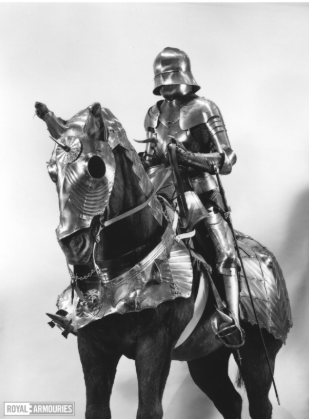
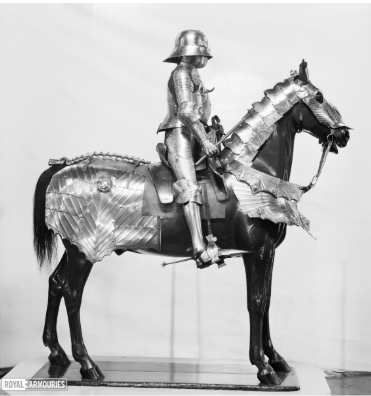
Gothic Armour (c.1475-85), Austria (Source: https://royalarmouries.org/collection/object/object-1293)
Methodology
I began research into my chosen subject with data collection in the form of an extensive literature review of majority secondary sources, considering that most information on the symbolic and cultural significance of Gothic armour and the Gothic sensibility is retrospective. However, I also collected numerous examples of Late Medieval Gothic armour, architecture and art as well as relevant passages of Gothic literature in order to ground my observations in tangible examples. The purpose of recording relevant information and my own observations and critiques of the academic literature was to establish the pre-existing theories as to how the Gothic is defined, as well as the particularities of the intentions behind how Medieval Gothic armour and architecture was constructed, and the surrounding social context that influenced this construction. From this point, I could identify initial thematic throughlines between the two periods and was able to more narrowly define my research aims.
I determined that a primarily qualitative approach was most useful for the insights that I wanted to achieve, as these would heavily depend on my own interpretation of my recorded observations. After some experimentation with various modes of further analysis, I decided that a thematic analysis model would most effectively organise the large volume of information I had accrued into an accessible format, in order to succinctly communicate the conclusions, I have come to concerning the symbolic connections between Medieval and Modern Gothic at this stage of research. Creating a thematic analysis model serves to identify conceptual patterns within data through a process of initial familiarisation, identifying recurring ideas through creating codes, synthesising these codes into a number of overarching themes, and finally creating a conceptual model summarising the overall analysis. Though this analytic mode was originally developed by Braun and Clarke (2006) for psychological research purposes, it has frequently been applied to sociological and historical research.
After accounting for the fact that I was entering into a thematic analysis with a number of preconceptions on the subject due to my previous research, which risked causing the analysis to be highly deductive, I attempted to take a consciously inductive approach to the familiarisation stage of analysis so as to avoid producing overly subjective insights or falling into confirmation bias. None of the eventual codes or resultant themes were pre-determined before my literature review; I instead chose to only include ideas that I could clearly source from multiple academics, with tangible examples of such ideas being represented in Medieval and Modern Gothic works. I then subjected these observations through critical reflection, trying to identify any underlying assumptions of mine that were not founded in the content of my sources. I wished to avoid unfounded extrapolation at this point so as to ensure that I was not either cherry-picking which ideas I wanted to include in my codes and themes. These codes were then condensed into three major themes, or broader patterns of meaning, that illustrate the connections between the ideas underlying the themes of both Medieval and Modern Gothic works. I am still in the process of developing these themes and constructing a summative conceptual model that will bring the initial themes together into a cohesive whole.
Results and Findings
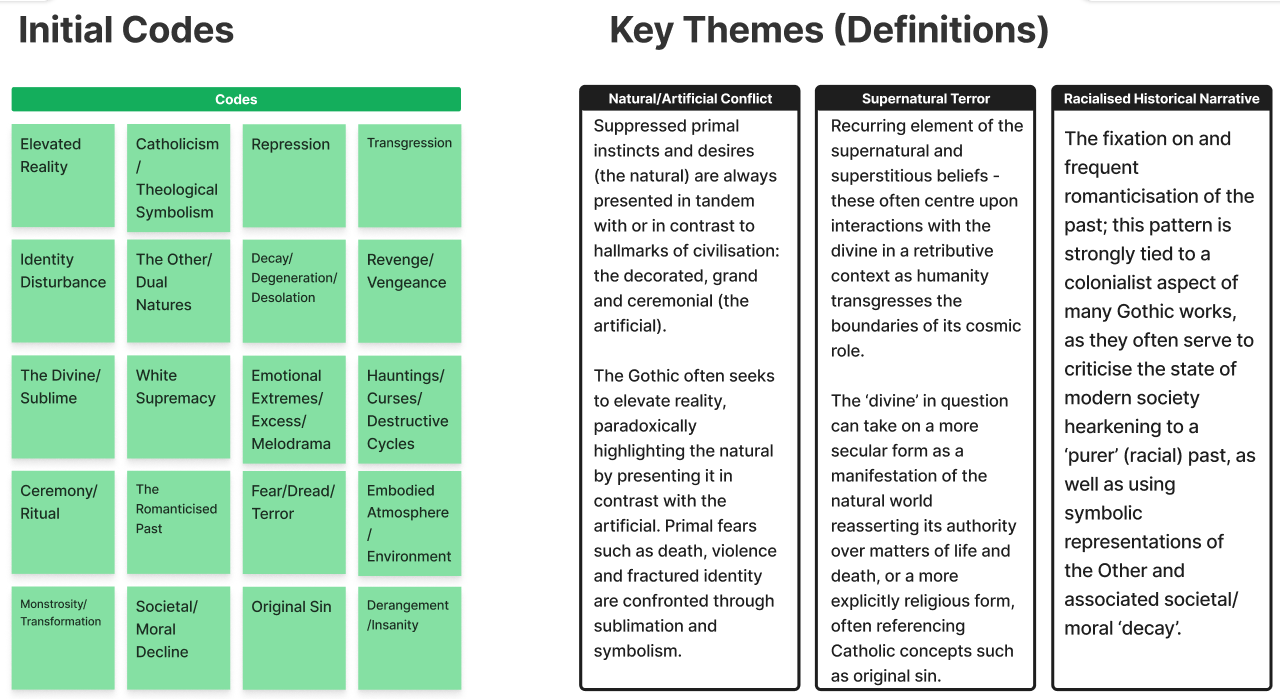
After generating a series of initial codes based on the most often repeated key words and ideas that appeared in my literature review, I determined my own working definition of what the Gothic sensibility is broadly before formulating three primary themes that apply to both Late Medieval and Modern Gothic. I am still fully developing the third theme, which I intend to explore in more detail through an academic article.
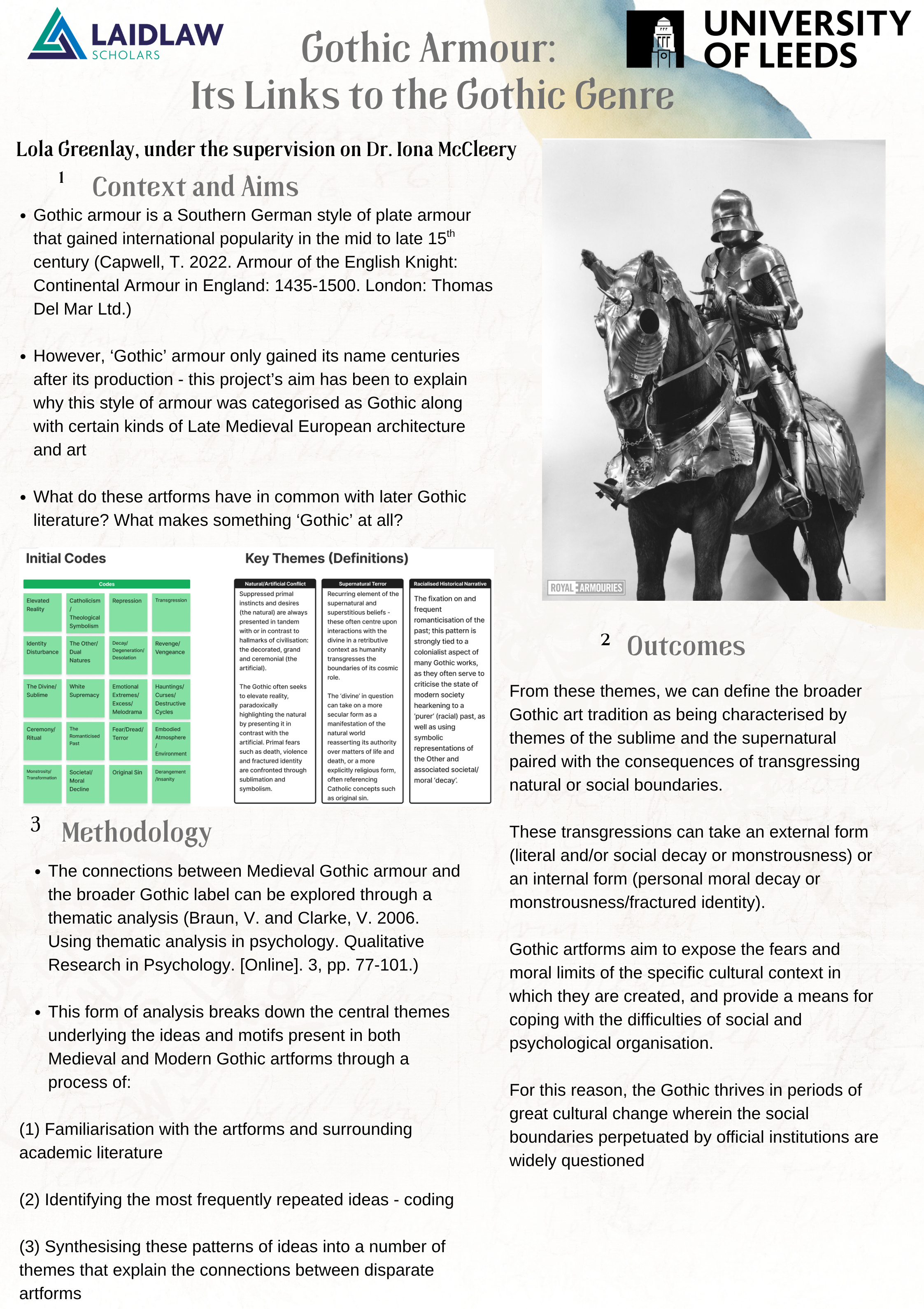
I define the Gothic sensibility as an unconscious movement characterised by the persistent themes of the sublime and the supernatural paired with the consequences of transgressing natural or social boundaries. Important to emphasise is that the consequences of these transgressions can take an external form (literal and/or social decay or monstrousness) or an internal form (personal moral decay or monstrousness/fractured identity). From this definition and the initial codes, I extrapolated my themes. These include:
- The Natural/Artificial Conflict: Medieval and Modern Gothic works always portray, through symbols and recurring motifs, the conflict between the natural state of the world/person and the artificial world of civilisation. The Gothic sensibility carries with it the idea that the instinctual functions, desires and behaviours of the natural are inherently unable to be harmoniously integrated into the functions of organised society and industry, which depend on the suppression of such instincts. Gothic works seek to present/confront this conflict through metaphor; an elevated version of reality is used to explore the consequences of societal/personal transgressions of the natural into the artificial (leading into the second theme:)
- Supernatural Terror: Medieval and Modern Gothic works always pay homage to the supernatural, whether in the form of a deity, a sentient natural world, or supernatural phenomena (traditionally a monster or common supernatural entity, such as ghosts). These supernatural elements function as the ultimate representation of a higher power (whether in a religious or secular context) that is able to act as an arbiter for the natural/artificial conflict, or a representation of it. Traditionally, the Christian God would meter out divine judgement/punishment for humanity’s transgressions of Biblical law, but this theme has been adapted into many versions over time - often, the supernatural element serves as a manifestation of the consequences of transgression. Gothic works do not exclusively present the higher power either reasserting its authority or, as in the case of monsters, being defeated in order to restore societal order. In many Gothic works of recent centuries, the monster must ultimately be embraced and accepted in order to resolve the natural/artificial conflict, presenting a more peaceful (or realistic) alternative to confronting the consequences of the natural encroaching on mannered society.
- Racialised Historical Narrative: Medieval and Modern Gothic works fundamentally examine the past from the lens of its consequences in the present (for instance, in the form of a haunting, or revenge for past sins) as well as how the values and beliefs of previous societies can continue to exist with those of the present. This causes the Gothic image of the past to often be heavily romanticised, affording misplaced credence to colonialist and European white supremacist attitudes. The frequent depiction of present societal ‘decay’ frequently blames the racial ‘other’ as its source and presents a reversion to a ‘purer’ or more ‘simple’ past as the solution for strife.
From these themes, I came to the conclusion that the aim of Gothic works is to expose the fears and moral limits of the specific cultural context in which it was created and provide a means for coping with the difficulties of social and psychological organisation. For this reason, Gothic works thrive in periods of great cultural change wherein the social boundaries perpetuated by official institutions are widely questioned by cultural forces; it is heavily concerned with interactions of power and what it means to become estranged from dominant cultural values.
Discussion and Conclusion
The aim of this project was to provide a deeper insight into a chosen aspect of the Royal Armouries’ Collection, examining the cultural and political dimensions these pieces; my personal aim was to give more meaning to certain Late Medieval European artforms, primarily Gothic armour, as part of the Gothic sensibility that was first defined in the Modern period. I feel that I have made good initial progress with this aim but still have much to elaborate on in terms of grounding my themes by offering tangible examples from the fifteenth century. I feel that my study could be improved by narrowing my focus further to link specific artifacts to my stated themes. Though my reading was far-reaching and I organised my preconceptions, notes and observations carefully, not all of my secondary sources were strictly relevant to my aim, as I was concerned with gaining as much understanding as possible about the cultural context of Europe in the Late Medieval period. I would like to more clearly link the Gothic themes that I have determined to the specific historical context of German Gothic armour, and how the production and intended use of such armour was deeply tied to a colonial expansionist prerogative which was romanticised by eighteenth century authors. While I believe that my analysis has been intentional and systematic, I have yet to properly articulate a cohesive argument that would contribute to the literature surrounding the subject of the Medieval Gothic.
The outcome of my project so far has been the completion of my initial literature review and the beginning of a model that can be used to make definitive links between the Medieval Gothic tradition and the Modern’s artistic intentions and symbology. With more development of these themes through a conceptual model and conducting a case study on a work of armour such as a Gothic tomb effigy or ceremonial plate armour, I will be able to apply my conceptual model to a tangible object and bring my project to a satisfying conclusion.

I am a Criminal Justice and Criminology undergraduate student at the University at Leeds, with an interest in bodily autonomy, transgender rights, and experiences of social marginalisation. I am passionate about social research, heritage, and dispelling pseudo-scientific misinformation. I intend to create a dissertation exploring how to combat the negative effects of discriminatory media campaigns on trans rights in the UK. I have recently participated in the Laidlaw Research Programme to bring a creative approach to the historical collections of the Royal Armouries, and am currently planning my LIA project.