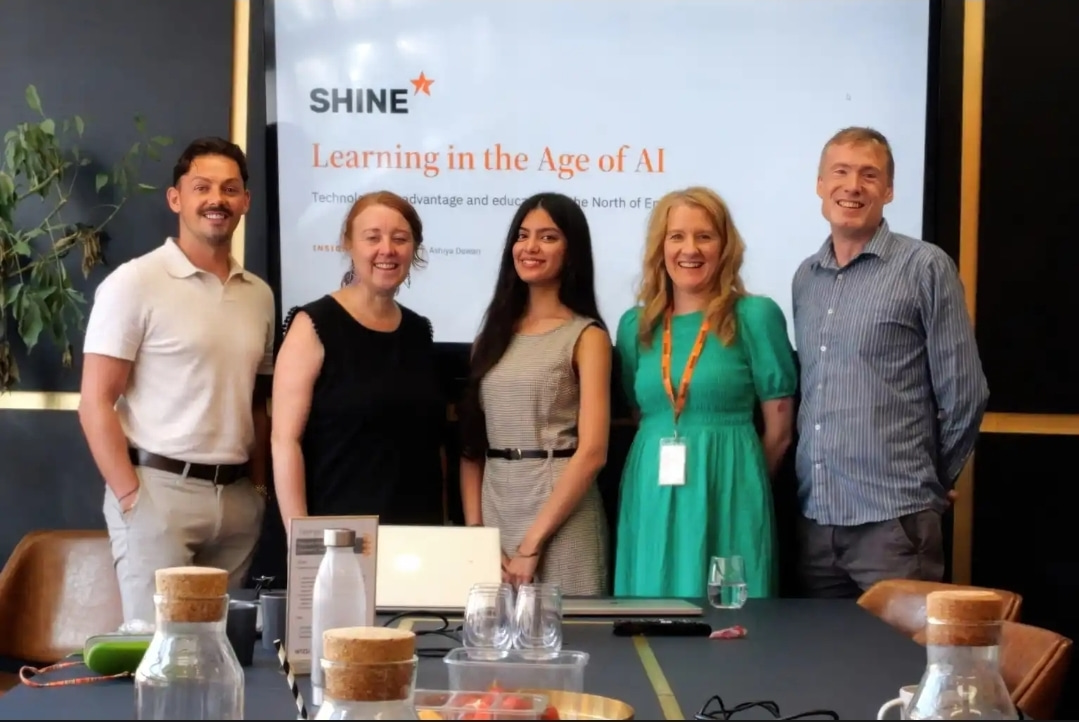

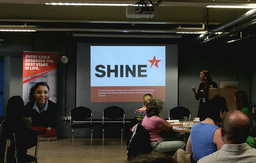
The final week of my LiA was about consolidation: holding together everything I've gathered over the previous five weeks and contributing it back to my team at SHINE. The aim was to convey what is happening on the ground in schools serving students facing disadvantage, prompt a rich discussion and explore how AI and other technologies are reshaping learning. I hoped to capture both the risks and the genuine promise of EdTech, how it might be better harnessed, and what we now need to consider as we look to the future of education and SHINE's responsibilities as an innovation-focused charity in this space.
This was a daunting task. In the lead-up I felt nervous and unsure, continually asking myself how I could possibly capture more than 40 hours of conversations with over 25 teachers and 70 children over the past 5 weeks, including everything they shared with me about their hopes, circumstances, concerns, lives, aspirations, and needs, in one workshop presentation. Reflecting on how all these interactions have moved and changed me, what they meant to me, I decided to speak from the heart and it all began to click.
Growing up, I struggled the most with spontaneous speaking. I left every debate club I ever joined because my mind would go blank. To this day, when I ask a question in a university lecture, I rethink the wording three times and usually write it down before raising my hand, so I don't mess up or forget. I have never given a presentation without some script. I used to resent not being able to do those things that others seemed to manage so smoothly, on a whim. But the most important lesson I've learned is not to compare what you can do with what someone else can do better, instead focusing on honing and sharpening what you are naturally good at. For me, that's being curious, learning, researching, connecting ideas and new perspectives, so I went all in on those strengths. I learned that you don't need to invent points on your feet to demonstrate knowledge; you can speak spontaneously when you are a subject-matter expert on something you've worked hard to understand.
As a team of 7 people, SHINE had not had the capacity dedicate someone to spending time in schools solely to understand the changing landscape of technology, how people think about its effects and approach controlling it, especially those facing deprivation. The LiA project allowed me to contribute this to SHINE by spending 5 weeks immersed in communities. The presentation ran to 4 hours because of how much we discussed and followed up on throughout. The team was fully engaged and interacted generously, which says a great deal about how deeply they care. It was gratifying to know my work had been meaningful to them and opened their eyes to what is happening on the ground from this angle. It was rewarding to watch colleagues build on each other's points in sustained discussion, and above all, to see how visibly their thinking shifted over the course of the presentation. Afterwards, many shared they found it immensely useful, while one colleague said he was impressed I could hold the attention and interest of a room of professionals for several hours. That meant an enormous amount to the shy, introverted, often nervous girl inside me.
Inspired by the Mentimeter word clouds from Corey Crossan's monthly Oxford Character Project sessions, I opened by asking the team what confusions, questions, concerns, and applications came to mind when they heard the word "AI". At the very end, after a rich deep dive into how technology intersects with disadvantage in school for better and worse, and how we must balance children's academic performance with their wellbeing in the age of digital media, acknowledging that none of these issues can be understood in isolation, we ran one more word cloud to the same question. The results were strikingly different. The team had moved from thinking largely out of emotion, fear, and uncertainty toward considering AI through the lens of different societal factors, arriving at a more grounded and productive, if still uncertain, approach. If a few hours of discussion could produce this shift, imagine what structured workshops, written policies, and strategic frameworks could achieve as SHINE begins to define its role as an innovation- and tech-focused funder in this space. I will be working with them on next steps and a formal report throughout the next month; in the meantime, the word clouds are included below:
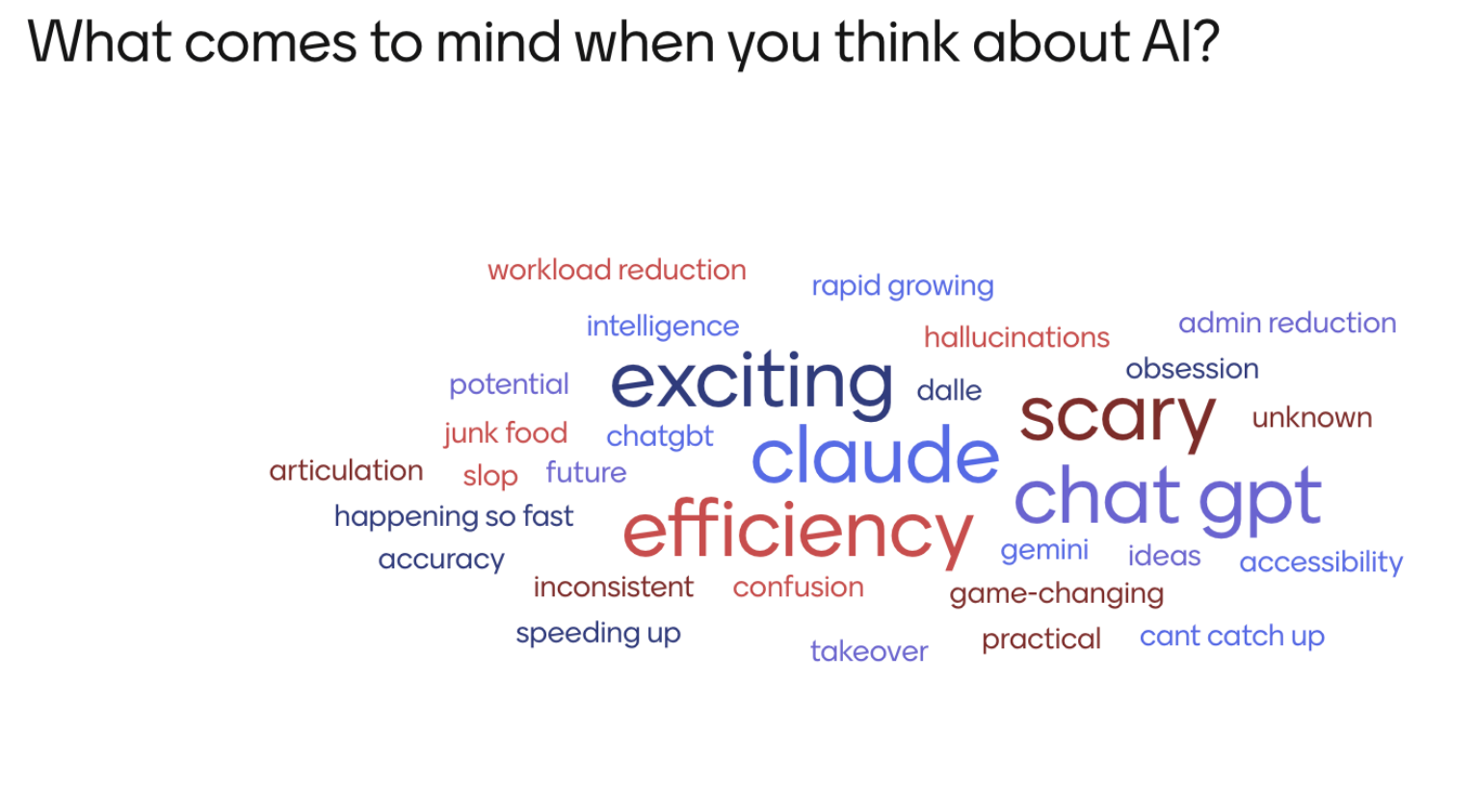
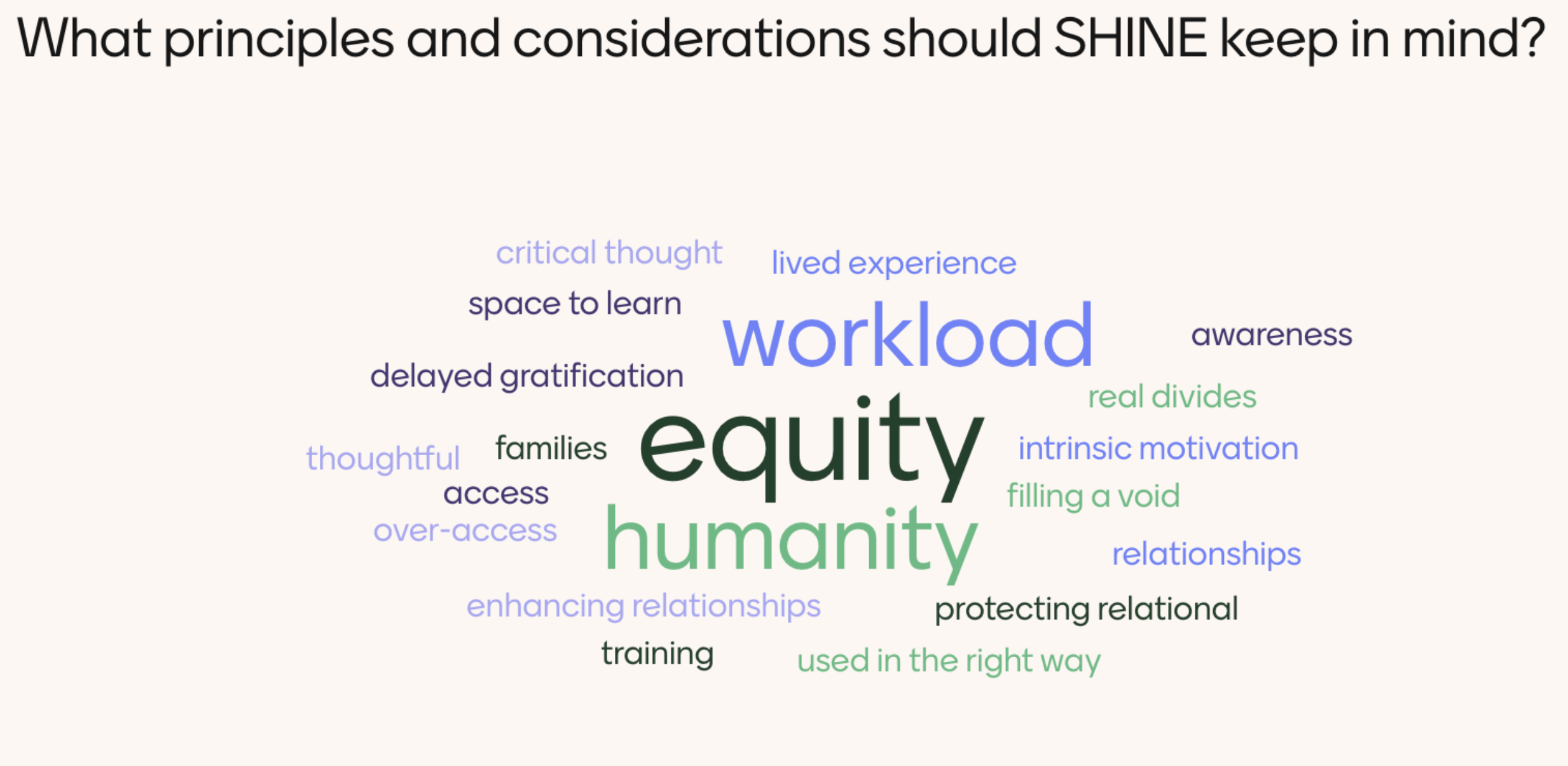
On leadership, I learned a great deal from how SHINE operates and from my own experience leading this project. Watching our CEO closely, her grace and passion paired with a firm sense of direction in a small team that feels like a family, I saw that leadership isn't about ruling over people or making every decision yourself. It's about making space for different perspectives and drawing them together into a cohesive step forward for everyone. It's about making people feel heard and valued while remaining grounded in the organization's principles, and taking care to implement those, not just your own. The teachers I spent time with observed the same: treating the children's ideas as intelligent contributions from equal partners, regardless of their abilities - each capable of enriching the classroom in their own way.
My LiA project worked the same way. The goal was never to dictate how schools or the SHINE team should think about the changing landscape of AI in education. It was about drawing out perspectives and connections, giving a platform to voices that are rarely heard and bringing them to the strategic level of a charity committed to supporting them. It was gratifying to know that my presentation did the same for the team: connecting those unheard voices to one another, while connecting the team's own thoughts and concerns to the people's voices. By hearing their sentiments, relating them to real-world experiences and seeing what surfaced, we were able to begin consolidating it all by drawing out the principles that clearly mattered to all of us as we approach the issues communities here face. This was an entirely new way for me to see, conceptualize and practise leadership: from the bottom up, focused on communities and for communities, bringing people together toward a shared goal.
Fundamentally, we came to realize that there is something about the process of learning that is deeply human and meaningful in its own right. Even if an AI "knows the answer" to everything, there is something enduringly important about pursuing an education. Something deeper fulfils us about the act of learning, innovating, thinking through new ideas and being creative - something that education systems too often quash, particularly for students facing disadvantage, who have few external resources to keep that spark alive. Artificial Intelligence, ironically, gives us many reasons to ask what it means to be human, and how we might amplify and support that, especially for those who most need support to reconnect with education and to see themselves in it again.

Hello there! I'm Ashiya, a member of the 2025 Laidlaw Leadership & Research Programme Cohort. I am a student at the University of Toronto's Munk School of Global Affairs and Public Policy, pursuing a double major in Peace, Conflict & Justice and Ethics, Society & Law.
My passion lies at the intersection of education and the governance of digital technologies, particularly artificial intelligence. I am currently exploring how this affects children facing socioeconomic disadvantage through my Leadership-in-Action project in North-East England. This builds on my previous work in student voice advocacy, my research of Indigenous-led education initiatives in Canada for my first Laidlaw summer, and my new role as a Center for International Governance Innovation Digital Policy Hub Fellow.
I look forward to reading and contributing to the incredible body of work on this platform. Outside of research, I love to read, explore, learn new things and make new friends - please feel free to reach and connect anytime! :)



Please sign in
If you are a registered user on Laidlaw Scholars Network, please sign in