
This week I visited Macmillan Academy, the first secondary school in my fieldwork for SHINE. Until now, every school visit, focus group and session I had run was with primary school staff and pupils. I spent the days leading up to it more nervous than I have at any other point in this project. These students are not much younger than me - the 'sixth formers', in years 12 and 13, are sixteen to eighteen years old. As a nineteen-almost-twenty university student, I have no natural authority in that space - this I was glad for, as I would rather speak to them as people - if they found me and the questions burning in my mind interesting enough, which proved to be a challenge. They use technology in much the same way I do, and hold many similar views towards different applications. The idea was roundtable conversation to gather opinions rather than interrogation, but I underestimated the fact that me being close in age to them isn't a guarantor of this flowing naturally!
What I seemed to get, at first, was a room of deer in headlights. They avoided eye contact and shrugged at prompts. Breaking through to them was more difficult and imposter syndrome-inducing than speaking to a room full of professionals at any other point in my LiA. Until this point, I had spent the project in a primary school mindset, speaking to kids in years 2-6, where a small nudge is enough to set them talking for ages! Secondary students tend to not want to say the wrong thing. I remember being more self-conscious myself, in high school just a few years ago. If I could do this week again, I would have spent less time deep in my own head conducting nervous preparation and more time speaking to friends my own age, perhaps other Laidlaw Scholars, asking them what they would find interesting in my field of work to remind me what would help engage these teens.
On Staying Grounded
At the midway point of my LiA this week, I had a check-in with Elena Shik, our Laidlaw advisor from the University of Toronto. Finally being in touch with someone from the team back home was unexpectedly, and pleasantly, grounding! For weeks I have been far from everything familiar, and it was a reminder that there are people rooting for us as scholars, who made it possible in the first place. Elena advised me to keep a log of the day-to-day small moments as much as the big ones. Over time it is easy to forget what we have done, seen, learned and thought - but logging the experience what lets us see its shape. Here is my list of moments from Week 4:
- Macmillan serves a community facing serious deprivation, yet I found it an extraordinarily advanced school.
Being shown around, I witnessed the range of what they offer: plenty of resources for physical activity and outdoor learning (rock climbing, a running track, a forest school being built), culinary classes and exceptional art showcases, a stylish campus with well-loved business and ICT programmes. On a surface level, you would expect every student to flourish with access to such resources. In reality, it demonstrates that pupils affected by deprivation require more support and nurturing to achieve similar results to those more well-off.
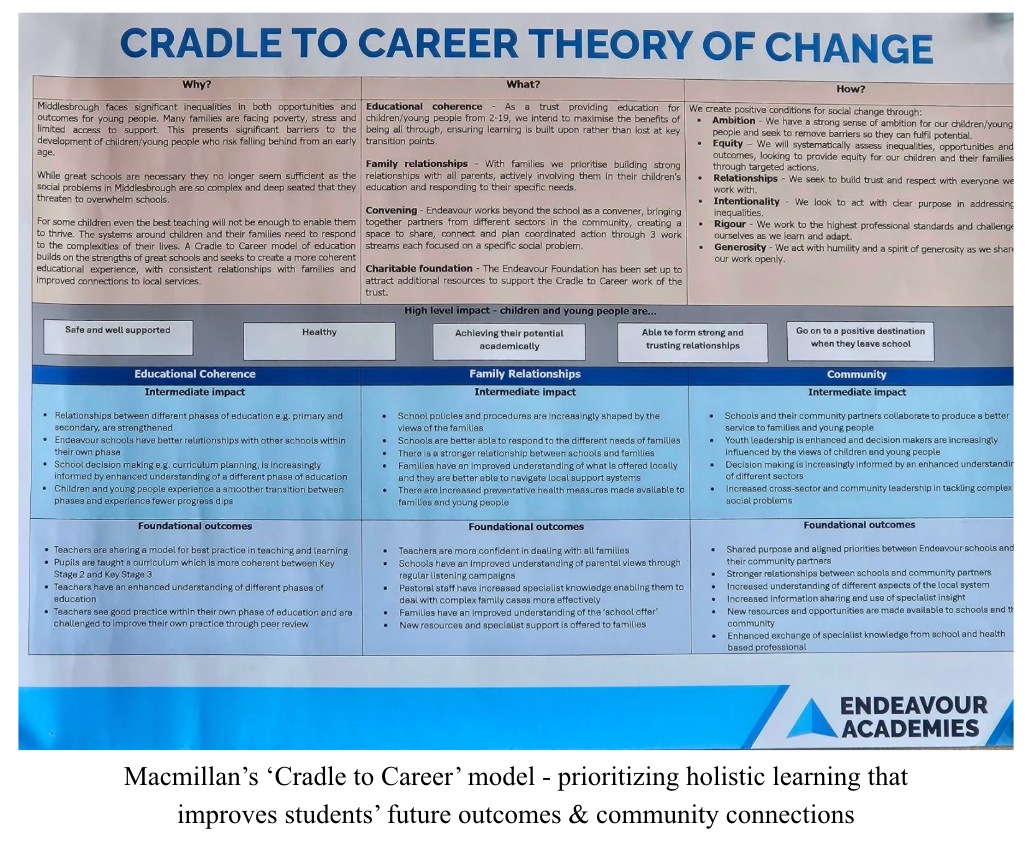
Many teachers I've spoken with expressed that schools in England are unfairly judged on test scores based on the national exams. A school posting less than average results is looked down on, when in reality its teachers may be pouring exponentially more effort than those at a wealthier school, where staff can afford to be hands-off because their students arrive already supported. What a school's starting point was, and where its children began and how far they improved, is a much better measure of success than where they land.
- Appreciating how secondary schools compensate for a lack of continuity
Students from disadvantage backgrounds are hit hardest by the transition to secondary school between years 6 and 7. They go from having one teacher who knew everything about them, focused on one class year-round and built an intimate understanding of each student, to a large campus where they have a different teacher for every subject and may not see the same adult two days running. That loss of continuity makes the transition incredibly difficult for some. At Macmillan, I was pleased to learn that every pupil is assigned a homeroom teacher in year 7 - even if they never formally teach them, they meet for thirty minutes every midday for the next seven years. Whatever else changes, they always have a home base.
- Seeing the transition in action
I visited the school during transition week, a time when year 6 pupils come in to their new school to get accustomed to the building, the staff and the way things work before formally joining in September. They also produce a piece of work that gets hung around the school so they feel they belong in it on day one. I watched them bumbling around the cafeteria, learning to tuck their chairs in and where to put their trays. Then I learned that half of them will be on free school meals when they start in the autumn. Among them I spotted a few faces from my primary school focus groups in my very first week in England, anxiously looking around at their soon-to-be school.
- How to leave no one behind
Having put myself inside the mind of the institution, I learned how secondary schools in particular are faced with the challenge of supporting two polar groups at once: those most at risk of becoming NEET (Not in Education, Employment or Training), and those identified as most able. Both carry their own risk of being left behind. The most able cannot be ignored, because they are often the ones on the verge of breaking their family's cycle and falling just short of it for want of resources. Being the most able and aiming at top universities, in a community where few to no people around you have similar goals, is a lonely place to be.
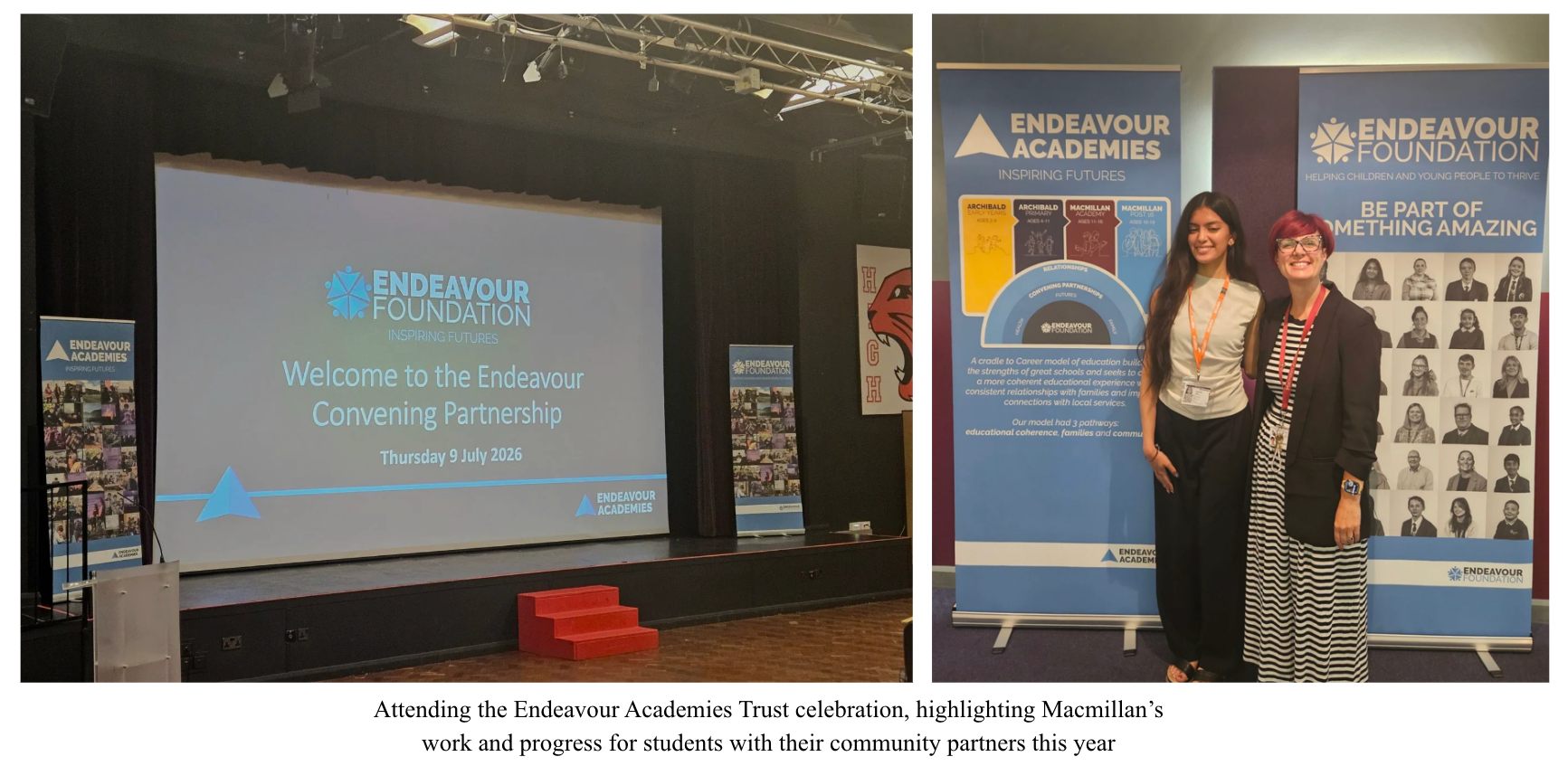
It was incredibly inspiring to see what their school leadership is building for them. Staff showed me a set of AI tools they had developed themselves, tailored to their needs, in a short span of time given the latest developments in AI applications that make coding accessible to all. One website connects their most able students to competitions, conferences and opportunities across the UK to bolster their portfolios. Another gives them personalized practice for the major UK higher education admissions tests. They have built an internal analysis tool that handles a vast amount of data to pinpoints every pupil's strengths and weaknesses across subjects without having to manually guess at trends, so teachers know where to concentrate their support for a student before it is too late.
- Learning, through a build-up of small conversations, why school staff are overwhelmingly AI-positive
From the perspective of educators serving communities facing acute disadvantage, the sentiment around artificial intelligence is one of hope and possibility. With a deep commitment to coming up with creatively effective solutions for their students' unique needs, AI tools seem to offer unprecedented potential. Beyond the excitement, though, it raises questions. The same tools that are rapidly affecting how staff and teachers do their jobs will reshape the careers their students are heading toward, and the school is left asking what it can do to prepare them for these changes.
One of the most enriching moments of this week was a conversation between the deputy headteacher and I, on the ironic quality of AI to make us think harder about what it means to be human. If a machine can replace or augment so much of what we are able to do, then being human must amount to more than the sum of our skills. There must be some fundamental quality about us worth honing and appreciating. Extending this logic to education, there must be something we find fulfilling about the process of learning that makes it still important. If we are able to identify and enhance that quality, could we design a more responsive education system? In hindsight I wish I had put those questions to the sixth formers I had the chance to speak to! Instead I carry them forward, eager to bringing them up to my team in my final week.


Hello there! I'm Ashiya, a member of the 2025 Laidlaw Leadership & Research Programme Cohort. I am a student at the University of Toronto's Munk School, pursuing a double major in Peace, Conflict & Justice and Ethics, Society & Law.
I'm passionate about education and the governance of digital technologies, particularly artificial intelligence. I am currently exploring how this affects children facing socioeconomic disadvantage through my Leadership-in-Action project in Northern England. This builds on my previous work in student advocacy, my research of Indigenous-led education initiatives in Canada for my first Laidlaw summer, and my new role as a Center for International Governance Innovation Digital Policy Hub Fellow.
I look forward to reading and contributing to the incredible body of work on this platform (you all are awesome)! Outside of research, I love to read, dance ballet, explore, learn new things and make new friends - please feel free to reach out anytime :)