Scholar Spotlight - International Women's Day
International Women's Day: The Scholars and Trailblazers Shaping What Comes Next
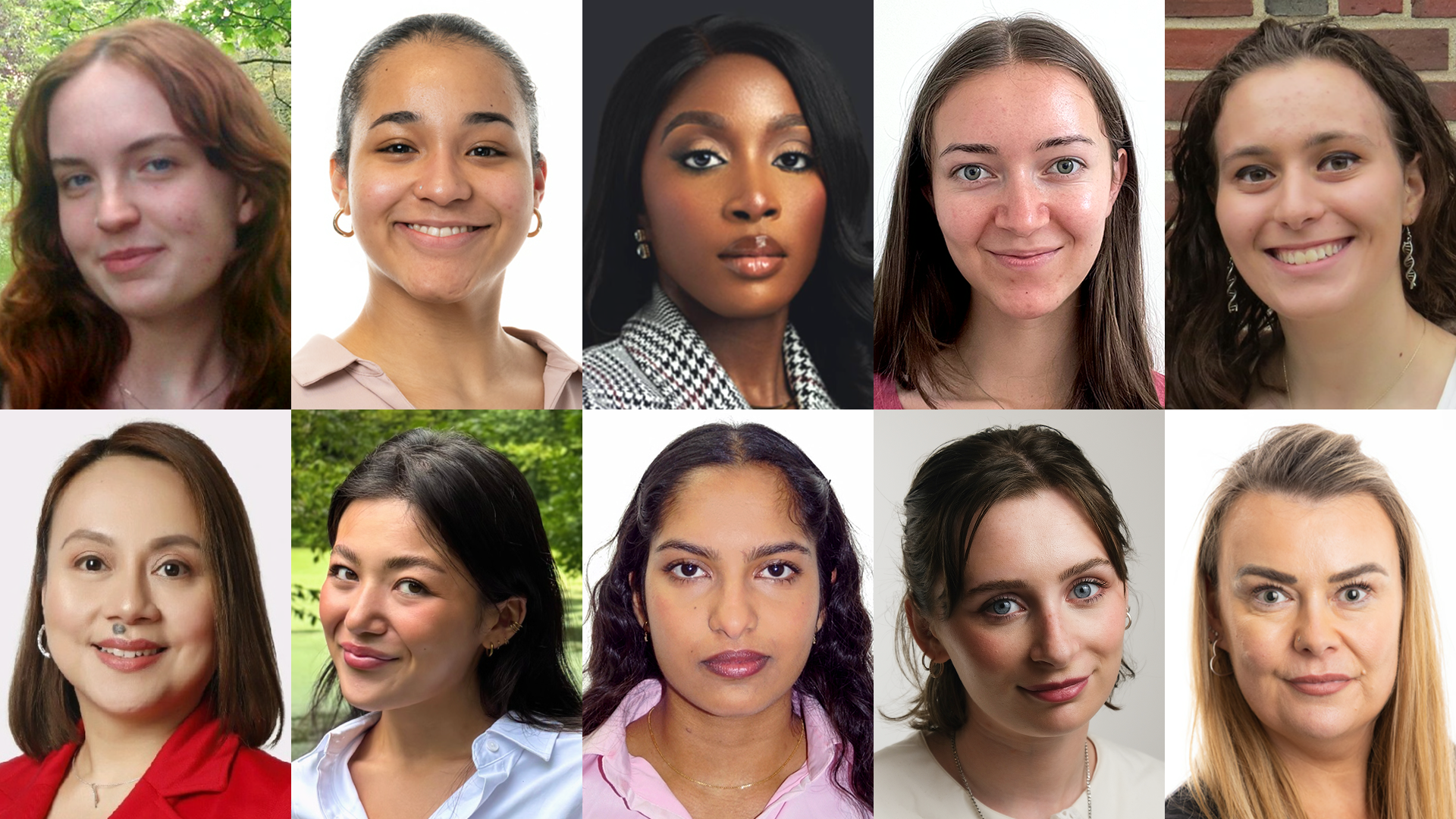
Earlier this week, we marked International Women's Day with Voices That Have Stayed With Us, a collection of the words and wisdom of women whose thinking on leadership has shaped our community. Today, for our Scholar Spotlight, we wanted to do something a little different: to turn that same spirit of celebration towards the Laidlaw Scholars, Women in Business Scholars and Trailblazers who are already putting those ideas into practice.
The women featured here are working across disciplines that rarely sit in the same conversation: DNA repair and decolonial mathematics, diasporic healing practices and nanoscience, educational policy and infrastructure finance. They are at different stages of their journeys and in different parts of the world. But read together, their words and their work trace something that feels worth sitting with: a shared insistence that the world as they found it is not the world as it has to remain, and that the work of reshaping it belongs to them as much as to anyone. We hope you find in their stories what we found in gathering them: pride in what this community is already achieving, and a renewed sense of purpose about what we can achieve together.
Beginning Before the Path is Clear
Some of the most honest accounts of leadership start not with certainty, but with its absence. The scholars in this section share a willingness to move before the route is mapped, to start from where they are rather than from where convention says they ought to be.
Cothney Lasaracina, a Laidlaw Scholar at the University of Leeds, is recovering the stories of colonial soldiers who fought in the French Resistance during the Second World War and whose lives were never recorded in the history books she grew up reading. As an immigrant herself, she felt an immediate, personal connection to those erased journeys, and chose to make their restoration her research.
 "I see a room full of people smiling and hugging each other while sharing vulnerabilities. I want to be the host in that particular room."
In a different discipline but with the same instinct, Risandi Kodagoda, a Laidlaw Scholar at the University of St Andrews, noticed a striking absence of introspection in mathematics that the humanities take for granted, and is now investigating how colonialism continues to shape maths education and its impact on students from the Global South. Her research asks whether listening to underrepresented voices can humanise a discipline that has often resisted that impulse.
"I want this future to be working towards ameliorating educational disparity and seeing the space of academia as an equitable and uplifting space for underrepresented voices through contextualised and empathetic treatment of others."
What unites Cothney and Risandi is where they choose to begin: with the people whose stories and experiences have been left out of the dominant record. On a day that asks us to consider what progress really requires, their work is a reminder that some of the most important contributions begin without with a mandate or a platform, but with a scholar who looked at what was missing and decided it mattered enough to act
The Science of Who Gets to Matter
One of the deeper questions International Women's Day poses is not simply whether women are represented, but whether the systems that shape our lives, medical, academic, environmental, were ever designed with everyone in mind. The scholars here are working within those systems and, through their research, reshaping them. In laboratories, archives and classrooms, they are doing the careful, exacting work of asking not just how things function, but who they function for, and what it would take to make the answer broader.
Neasa Nic Corcráin, a Laidlaw Scholar at Trinity College Dublin, is investigating potential links between heavy metals in period products and reproductive health outcomes. Her research originated from something deeply personal and deeply telling: her experience as a woman whose health concerns were routinely dismissed. Her work is an answer to that dismissal: rigorous, evidence-based, and driven by the conviction that millions of people deserve to know what is in the products they use every month.
"I imagine a world where girls walk into boardrooms, labs, stages, and classrooms, speaking boldly, their voices shaping change."
At the molecular level, Shoshana Daly, a Laidlaw Scholar at Tufts University, is characterising the interaction between proteins involved in DNA repair, work with direct implications for our understanding and treatment of breast, ovarian, endometrial and prostate cancers. The connection she draws from protein to disease to therapy is what drives her, and her vision of the future leaves no room for ambiguity about what is at stake.
"In the future I am striving to create, anyone can walk into a hospital or health clinic anywhere in the world and receive high quality healthcare regardless of their ability to pay."
The question of whose knowledge counts runs through Isabel Iino's, research too. A Laidlaw Scholar at Barnard College, Isabel is examining how the New York Health Department's campaign against medical "quackery" in 1920s Harlem served to uphold medical knowledge rooted in white supremacy while dispossessing Black communities of their healing traditions. Her research reframes what was dismissed as ignorance as something far more powerful: the agency of communities seeking care on their own terms.
"In the future, I imagine a scene where young women from different backgrounds are sitting together at a large, long table, sharing food, stories, and ideas without the fear of being silenced or overlooked. On this table, different types of knowledge are equally valued, not just the ones that come from university classrooms."
And Diotime Pellet, a Laidlaw Scholar at EPFL, is synthesising copper nanoflakes with potential applications in the reduction of CO2 into useful multi-carbon products, driven by a growing conviction that fundamental research should connect to real-world problems in energy and climate.
"I believe that science can rise up to the challenges faced by people on a daily basis, especially those affected by issues related to climate change and water and energy scarcity, which are becoming increasingly threatening."
Each of them arrived at their research through a different path, but each arrived at the same place: the recognition that the systems we rely on carry assumptions about whose lives warrant attention, and the determination to hold those assumptions to account.
Building What Was Never Built for You
International Women's Day asks us to celebrate progress. It also asks us to be honest about the fact that much of that progress was not handed down. It was built, often by women who looked at the institutions and pathways available to them, found them inadequate or absent entirely, and decided to create what was missing. What the scholars and Trailblazers are building here, a policy, a network, an infrastructure, a precedent, did not exist before they made it. And in each case, they are building it not only for themselves, but for the people who will need it next.
Holly Toombs, a Laidlaw Scholar at the University of Oxford, led research revealing that no existing UK policies address extra-curricular activities and that even Ofsted's criteria for outstanding schools barely mention them. As someone from a comprehensive state school in the North of England, Holly experienced that gap first-hand: hiring a tutor was unheard of, internships required connections, and she did not even know that Olympiads were a thing. Her research represents the children still on the other side of that gap.
"I'm looking towards a future where access schemes, women's safety measures, and even some forms of therapy are not present – because they're not necessary."
At a continental scale, Ajibola Bolanle, a Women in Business Alumna at Oxford Saïd Business School, is designing and delivering infrastructure solutions across Africa, mobilising capital alongside governments, development finance institutions and private investors. Born and raised in Nigeria, Ajibola sees the Laidlaw Scholarship as a platform to contribute to building Africa's future as a centre of innovation and sustainable growth.
"Empower others: true leadership is about lifting others as you rise."
The absence Genevieve Esguerra identified was closer to home. A Women in Business Scholar at IE Business School, Genevieve observed something simple and persistent: women are well represented in managerial roles, but as you move up, you see less and less. So she co-founded the Women Inter-Industry Network in the Philippines, and after graduating plans to institutionalise it as a research-driven organisation advancing equity across Asia and funding scholarships for young women.
"Listen to understand. Share the spotlight. Push people to become the best version of themselves."
And Amanda Flanagan, a Laidlaw Trailblazer at Trinity College Dublin, was told as a young woman that people like her do not do jobs like teaching: that people from her background work in shops or factories. Today, Amanda is a mature student at Trinity, and both of her sons are studying there too. She has changed generational patterns through persistence, and she is characteristically clear-eyed about what the future should look like.
“Every human being has the capacity for greatness, and in the world I am striving for I would want to make sure every human feels listened to, understood and invested in, and is confident and capable to contribute to society, from an early age”
For Every Woman in This Community
The scholars and Trailblazers in this piece are doing work that International Women's Day exists to celebrate: careful, bold, deeply personal work that reaches far beyond their own lives. They are uncovering erased histories and humanising the disciplines that need it most. They are pursuing cures with personal urgency and building networks, policies and platforms where none existed before. They are proof of what becomes possible when women are given the support, the platform, and the freedom to lead on their own terms. But they are ten among many. Across the Laidlaw community, scholars, alumni and Trailblazers are doing this work every day: beginning before the path is clear, asking who the world was built for, and building what it still needs. This piece is our way of celebrating them, and of celebrating every woman in this community who is shaping what comes next