When I began my Laidlaw Scholarship, I thought that becoming a global leader would primarily mean developing the knowledge and skills to address global challenges. I expected my research into the Global Challenges Research Fund (GCRF) Neglected Tropical Diseases (NTD) Network to teach me about international research partnerships, and I expected my Leadership-in-Action (LiA) project with Offene Arme to teach me more about humanitarian work with displaced people. Both experiences did that. However, the most important lesson of the Scholarship has been less about what I have learnt about global challenges and more about how I have learnt to approach them.
Across the Scholarship, I have increasingly understood leadership as a responsibility rather than a position, global citizenship as a practice rather than an identity, and character as something that has to be developed through difficult decisions and genuine engagement with others. The Laidlaw 3Cs framework of Curiosity, Compassion and Courage has provided a useful way of understanding this development.
Curiosity: learning to ask better questions
My first major experience as a Laidlaw Scholar was my research project examining the impact of the GCRF on Early Career Researchers within the Global NTD Network. I conducted thematic analysis of 19 semi-structured interviews, exploring how researchers experienced an international research programme intended to address diseases that disproportionately affect some of the world's poorest communities.
At first, I approached the project primarily as a researcher. I wanted to understand what the participants had experienced and identify patterns within the data. As the project progressed, however, I became increasingly conscious that qualitative research requires much more than extracting information from interviews. It requires listening carefully, questioning your assumptions and recognising the limitations of your own perspective.
This was particularly important when considering the relationships between researchers from different countries and institutions. International research partnerships can create opportunities for collaboration, training and capacity building, but they can also reproduce existing inequalities if decision-making, resources and recognition remain concentrated in institutions in wealthier countries. I became increasingly interested in questions of power: who gets to define the research question, who controls resources, whose expertise is valued and who ultimately benefits from the research.
This changed my understanding of curiosity. Curiosity is not simply wanting to know more. It is being willing to ask uncomfortable questions and to discover that your initial understanding may be incomplete.
The project also taught me the importance of intellectual humility. As someone studying global health from a UK university, I am able to approach many of these issues from a position of considerable privilege. Recognising this does not make my contribution meaningless, but it does create a responsibility to listen carefully and avoid assuming that my perspective is automatically the most useful one.
The Oxford Character Project further encouraged me to think about the relationship between knowledge and character. Being a good researcher is not simply about producing technically rigorous work. It also involves honesty, humility and responsibility towards the people whose experiences make that research possible.
Compassion: moving from people as subjects to people as partners
If my GCRF research taught me to listen more carefully, my LiA experience challenged me to put that lesson into practice.
During my six weeks with Offene Arme, I worked alongside a team supporting asylum seekers and refugees. Entering the placement, I had some theoretical understanding of displacement, migration and humanitarian responses. But being present within a community made the limitations of that knowledge much clearer.
One of the most important lessons was that humanitarian work is fundamentally relational. People cannot be reduced to categories such as "refugee", "asylum seeker" or "beneficiary". Behind these labels are individuals with different histories, ambitions, skills, frustrations and hopes. The most meaningful interactions were often not the moments where I felt that I had achieved something substantial, but the ordinary conversations, shared activities and opportunities to build trust.
This made me reconsider what compassion means in leadership.
Compassion is sometimes understood as simply caring about other people. During my LiA, I came to see it as something more demanding: being willing to understand another person's experience without immediately trying to impose your own solution upon it.
This connected strongly with what I had learnt through my research. In both settings, listening was essential. In the GCRF project, I needed to listen to researchers whose experiences differed from my own. In Greece, I needed to listen to people whose lives had been shaped by circumstances I could never fully understand. In both cases, the temptation was to arrive with assumptions about what the problem was and what should be done.
Instead, I learnt the value of asking first.
The experience also made me more aware of the potential for good intentions to become paternalistic. Wanting to help does not automatically mean that you know what help is needed. Ethical leadership therefore requires not only compassion, but a willingness to give up some control and allow other people to shape the response.
Courage: acting when the answer is uncertain
The third of the Laidlaw 3Cs, courage, perhaps became the most important during the transition between my two projects.
The Scholarship encouraged me to step outside the environment in which I was most comfortable. My research gave me an opportunity to contribute intellectually to an international project, while my LiA required me to enter an unfamiliar humanitarian context and work alongside people from different backgrounds and cultures.
Neither experience provided simple answers.
One of the most valuable forms of courage I developed was the courage to acknowledge uncertainty. Leadership is often presented as the ability to know what to do. My experiences have instead taught me that responsible leadership sometimes means admitting that you do not know.
This is particularly important when working across cultures and in complex global contexts. There are rarely perfect solutions to problems involving poverty, migration, health inequalities or international research. Acting ethically therefore requires the courage to make decisions while remaining open to challenge and willing to change course.
The Scholarship has also made me more comfortable with the idea that leadership does not always mean being the person at the front. Sometimes leadership means creating space for other people to lead. Sometimes it means asking a difficult question. Sometimes it means recognising that someone else's expertise is more relevant than your own.
Developing a global mindset
Together, the GCRF project and LiA fundamentally changed my understanding of what it means to have a global mindset.
Previously, I might have understood global citizenship primarily through geography: working internationally, understanding different cultures or contributing to global challenges. I now see it as something much deeper.
A global mindset means recognising the interconnectedness of our lives while also recognising that those connections are not necessarily equal.
The NTD project demonstrated this through global health research. Diseases that disproportionately affect communities in low-resource settings are connected to international systems of research funding, universities, governments and pharmaceutical development. The decisions made within these systems can have consequences far beyond the institutions where those decisions are taken.
My LiA experience provided a different perspective on the same principle. Migration and displacement are not isolated events occurring somewhere else in the world. They are connected to conflict, political decisions, economic inequalities, international law and the responsibilities of countries such as the UK.
In both experiences, I came to appreciate that global challenges cannot be understood solely from one perspective.
A global mindset therefore requires perspective-taking: the ability to recognise that people can experience the same system very differently depending on where they are situated within it.
It also requires recognising my own position within those systems. As a UK student researching global health and later volunteering in a humanitarian setting, I was not an outside observer. I brought my own education, assumptions, privileges and expectations into both environments.
Recognising this has made me more conscious of the difference between working for people and working with people.
What kind of leader do I want to become?
The most significant outcome of the Scholarship is that I now have a clearer idea of the type of leader I want to become.
I do not want leadership to be defined by authority or status. I want it to be defined by trust, responsibility and service.
My research experience has strengthened my ambition to work in global health, particularly in areas involving infectious disease, health inequalities and international partnerships. But I now approach this ambition differently. I do not simply want to work on global health problems; I want to contribute to partnerships that are equitable, locally informed and genuinely collaborative.
This means carrying the lessons of the NTD project forward by questioning extractive approaches to research and advocating for meaningful local leadership and ownership. It means recognising that expertise exists outside the institutions traditionally regarded as centres of knowledge. It also means being prepared to question systems that I benefit from.
My LiA has added another dimension to this. It has shown me that ethical leadership is not only about large-scale policy or research. It is also demonstrated through everyday interactions: how we speak to people, whether we listen, whether we notice who is excluded, and whether we are prepared to change our behaviour when someone tells us that we have got something wrong.
These lessons will influence how I approach my future career, whether I work in global health, humanitarian organisations, research or another field. I want to retain the curiosity to keep learning, the compassion to understand people as individuals rather than categories, and the courage to act when remaining comfortable would be easier.
Continuing as a global citizen
The end of the Laidlaw Scholarship is therefore not an end point. It is a point from which I need to decide how I will continue putting these lessons into practice.
I want to continue developing my global mindset through international experiences, language learning, engagement with people from different backgrounds and continued involvement in global health and humanitarian work. More importantly, however, I want these experiences to influence how I behave in my everyday life.
Being a global citizen does not require constantly travelling or working internationally. It requires recognising our responsibilities to people beyond our immediate communities and considering the consequences of our decisions within a wider system.
I will therefore try to carry the 3Cs beyond the Scholarship.
Curiosity will mean continuing to ask questions, particularly when an issue appears straightforward. I will seek out perspectives that challenge my assumptions and remain willing to change my mind.
Compassion will mean listening before acting and treating people as partners rather than problems to be solved. I will try to ensure that my desire to contribute does not override the voices of the people I am trying to support.
Courage will mean acting on my values, even when doing so is uncomfortable. It will mean challenging inequitable practices, acknowledging mistakes and taking responsibility for the consequences of my decisions.
Ultimately, the Laidlaw Scholarship has taught me that ethical leadership is not something that begins when someone receives a leadership position. It begins much earlier, in the way we listen, the questions we ask, the assumptions we challenge and the choices we make when nobody is watching.
My GCRF research taught me to look critically at the systems through which global challenges are addressed. My LiA taught me to look more carefully at the people within those systems. Together, they have changed the way I understand leadership.
I began the Scholarship wanting to become a better global leader. I leave it understanding that this is not a destination that can be reached through one project, one placement or one qualification. It is an ongoing practice of curiosity, compassion and courage.
The responsibility now is to continue practising it.
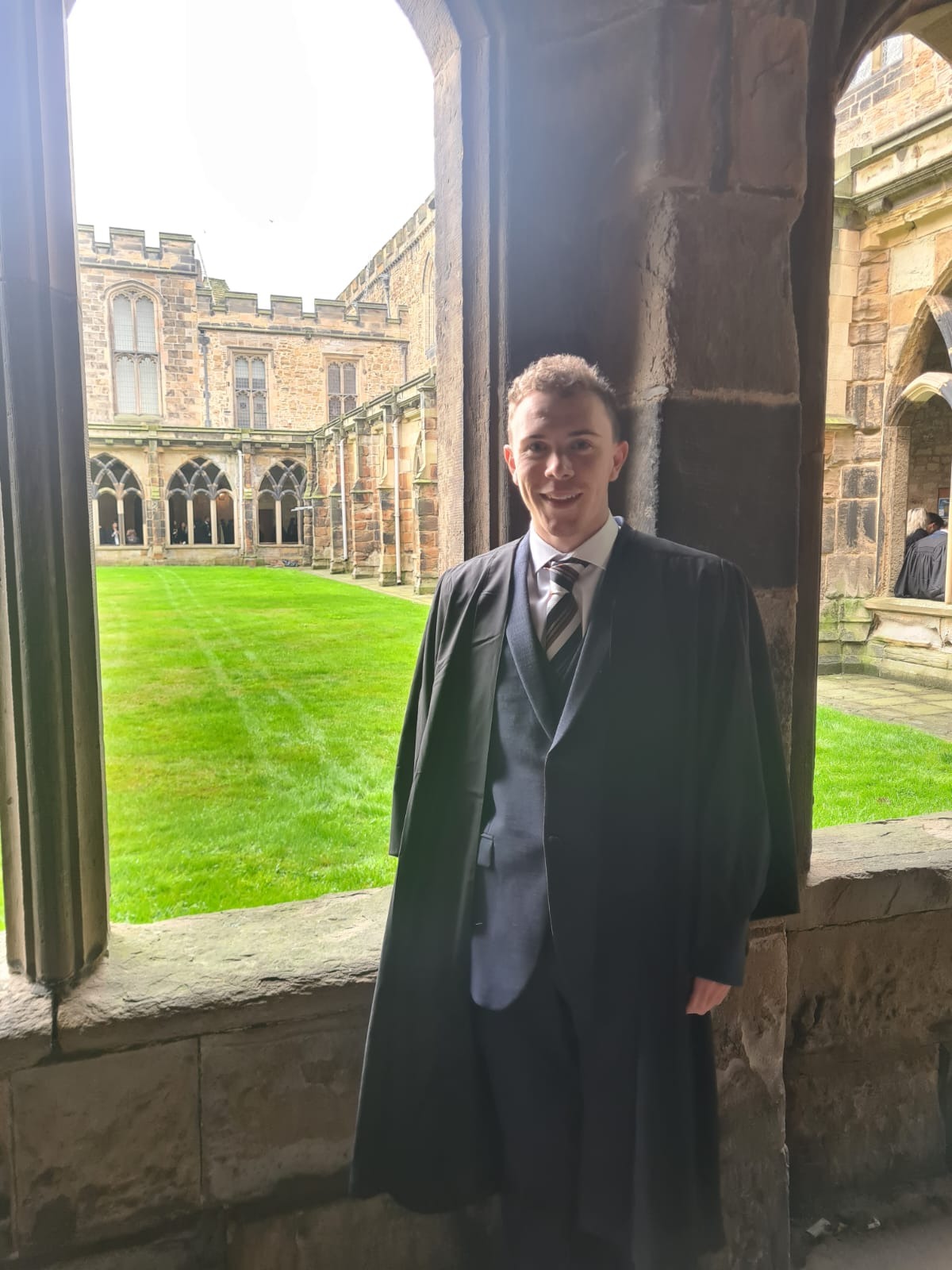
I'm Devon, a first year bioscience undergraduate at Durham University. My main interests are in global health and immunology. When not studying I can be found hiking, climbing, white water kayaking, and mountain biking.