Laidlaw Week 2 Journal
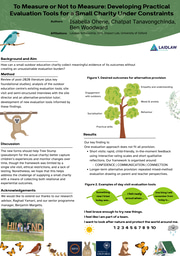
This week is focused on better understanding the context surrounding Hill End and outdoor education. However, unlike last week, we were focused on getting a deeper dive by visiting the center in person and starting a more detailed literature review about the different methods of measuring the outcomes of outdoor education.
In regard to the broader goal of understanding Hill End's context, I think my team and I made significant progress. Before visiting Hill End, I did not really recognize the broad range of stakeholders and activities that Hill End engages in. For instance, I initially understood that Hill End was a purely outdoor education space. In other words, I thought that Hill End solely focused on outdoor learning via activities you'd expect in outdoor education like camping or hiking. These forms of activities certainly exist at Hill End. However, Hill End seems to engaged in outdoor education via diverse methods that also concern other goals. For instance, the director explained that one of their most popular programs is the historical simulation program where students would role-play as an Anglo-Saxon or a Viking and live in small ancient villages. This enables them to be immersed to both historical education while also engaging with the outdoors. Hence, I understood that Hill End's programs are much more diverse and outdoor education may be supplemented by other key goals such as history teaching. Much of this seems to be due to the fact that schools, a key stakeholder, have limited resources and therefore need to prioritize which programs they prefer. Often, schools already have gardens and facilities for conventional forms of outdoor education but they lack the space for historical teaching in the outdoors. This results in history teaching becoming one of the main goals for Hill End's visiting schools even if it is still focused on outdoor education.
Hill End's stakeholders are similarly broad. Originally, I thought that Hill End's target group would be everyday school children who were just trying to access the outdoors. This is predominantly true. Yet, they also work with students who require alternative education, often with tangible improvements in their behaviour and self-confidence. Furthermore, Hill End also often works with adults who may just be visiting to access the outdoors or with adults who may be educationally challenged. Understanding the diversity in the stakeholders and their aims made me realize how it is not possible for us to narrow down Hill End's desired outcomes to a short single list. To do so would be reductive. Instead, I must recognize that Hill End's desired outcomes, eventhough they fall under the umbrella of outdoor education, differ from context to context.
This connects to the first thing I would do differently. I think I would have better understood Hill End and outdoor education much more deeply if I had a less rigid view of the potential of nature-based education. I originally had a boy-scout style view of natural education that it was about getting people into the wilderness and "appreciating nature" whatever that meant. However, outdoor education can help us fulfill other goals such as providing alternative education while also involving a wide range of stakeholders.
Therefore, one adjustment I would make to this week's approach so far would be to think about organization and institutions in a more flexible way and recognize the heterogeneity of educational work. This means avoiding having a single concrete idea about who an organization serves and how they do so just because you've read their mission statement once. Instead, I need to recognize the reality that community and educational institutions are much more complex.