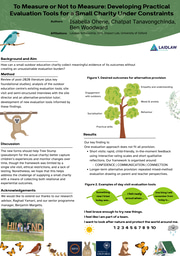
My first week in the Laidlaw Scholars program is characterized by a need to understand the specifics of the project I will be working on. To this end, most of our time was spent looking at the resources and problems sent to us by Hill End, an educational charity that aims to expand access to the outdoors for those in Oxfordshire.
With regard to this broader goal, I think my team and I made significant progress. Not only were we able to quickly identify the tension between creating detailed, granular data and the limited resources of an educational nonprofit, but we were also able to connect this to wider themes within the Oxford community. Specifically, we realized the connection between the Town & Gown divide and how this may perpetuate unequal access to green spaces for those living in Oxford who are not members of the university.
These understandings translated into two tangible outcomes. Firstly, we have been able to formulate a coherent research proposal that is more streamlined than we first imagined. This enables us to act on it in a limited time frame of six weeks. Secondly, we have also been able to prepare a list of questions and areas of inquiry for our upcoming visit to Hill End. Here, understanding the context of their limited personnel and time has helped us formulate an approach that recognizes these limitations when trying to evaluate and suggest new methods of outcome assessment. I think this is particularly pertinent because the usual social science approach of ensuring rigour by implementing all sorts of controls is often very time and resource intensive, making it difficult to implement effectively in contexts such as Hill End.
This leads to the first thing I would have done differently. I would have tried to step away from my formal social science training (mostly economics and political science) earlier in the week. This is because when our team first started, I was very insistent on ensuring that the evaluation methods we explored were up to high statistical standards. However, I did not realize the fact that for small educational charities, it may be impractical for them to run weekly regressions, statistical tests, or control for many confounding variables using conventional statistical approaches. Instead, I learned that we need to look at more novel methods that are less resource intensive but may still produce useful data.
Such a realization grew from the discussions that I had with my team members and graduate impact advisor, whose varying backgrounds provided much more perspective than I ever realized were possible on this issue. I think my role in these discussions tended towards learning and facilitating by both taking in new ideas and furthering the discussion by issuing new challenges or questions. I think this was ultimately beneficial since it advanced my understanding of the various approaches that we could take to this project.
One adjustment I would make to this interaction is to be even more open-minded to other's approaches to the project. I think I already do a good job of listening to new ideas. Yet, the way I evaluate them is still too rooted in the framework of an economics exam paper. I need to be much more flexible and cognizant about what controls and methods are reasonable from a practical standpoint for a small educational charity such as Hill End. Only then would I be able to contribute to actionable work in this project.