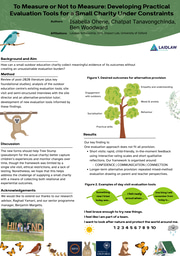
This week, our main piece of progress has been formulating and summarizing our process so far. We have made strong progress in this area so far as all three members of the group have been able to focus on writing the methodologies for the areas that they are most specialized in. For instance, I took the lead for writing the methodology section for our literature review as I was most involved in that section whereas one of my counterparts who did much work in documenting the visit wrote the methodology regarding that part of our research. This enabled us to outline the method accurately and in detail.
Let me tell you a little bit more about each part of the methodology in greater detail. In terms of the literature review, we conducted an in-depth dive into existing papers surrounding the topic of outdoor education. This process involved a high level of rigour as it would be problematic to include any random list of papers. Instead, we reflected on what the center staff needed to know. From our visit, we knew that they wanted more up to date information so that they would be more informed of recent evidence about outdoor education. We further recognized that the center staff was mostly interested in redesigning their evaluation methods to determine the outcomes created by outdoor education. Therefore, we narrowed down our searches to post-2020 papers regarding the evaluation of outdoor education and the established consequences of outdoor education itself. In terms of our visit, we conducted semi-structured interviews with the staff. This process was recorded in detail in the methodology by my friend, Ben, who played a large role in guiding the semi-structured interviews. Simultaneously, we also paired this information with the analysis we performed on Hill End's existing forms, enabling us to better grasp the gaps that the Hill End staff would like us to help fill.
In addition to recording how we approached past research, we have also planned for how to continue our research in writing this methodology. Specifically, we discussed how to develop frameworks for creating new methods of evaluation. We conducted this by synthesizing our interview data with our literature review. This enabled us to consider the key stakeholders in Hill End and their unique circumstances. Therefore, we understood that we had to formulate new methods of evaluation such as a board for students to rate their experiences about outdoor education. We also considered more targeted research methods such as suggesting that the center staff conduct more in-depth surveys with the alternative education provision, which will enable them to collect both quantitative and qualitative data.
While this overall approach seems to be well-informed, one of the issues with our methodology work is that some sections of the methodology write-up are inadequately specific. This may create confusion and misunderstanding. For instance, we often fail to mention specific numbers or time-ranges in our literature review approach. Hence, it can be difficult for others to replicate our literature review methodology. Additionally, explanations about why specific approaches such as "mixed methods" have been chosen are often missing. This makes it even more difficult to rationalize our approach. Lastly, the details about how exactly our mixed methods approach will be carried out are still missing. It would be more clear if we had an explicit step-by-step account with an appendix that includes actual examples of the questions and forms we would recommend to the Hill End staff. Hence, we will aim to include more specificity and clarity in our methodology section so that it can be more easily understood and replicated by others in future drafts. It will also help others recognize why we have chosen certain approaches in our research journey.