Impact Unpacked (LiA Week 6)
Related Content
 Laidlaw Scholars Network
One After the Other (LiA Week 5)
Beyond embracing the uncertain, change requires consistency during times of certainty
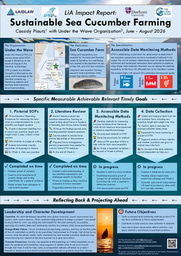
⛵️ Please view my LiA Impact Report here: https://laidlawscholars.network/documents/lia-impact-report-sustainable-sea-cucumber-farming
Last summer while I was waiting for one of my reactions to complete, I began brainstorming what I could possibly do for my Leadership in Action project. I knew I was interested in sustainability and climate change, and my research project focused on minimizing PET derivatives in wastewater, so I grew more intrigued by marine science. Nevertheless it seemed unreachable to design an LiA that could use chemistry and physics to implement tangible change in just six weeks. When I heard about Under the Wave Organization at the European Laidlaw Scholars Conference last November, I had high hopes; though I had limited formal education in marine biology, their wide variety of conservation projects appealed to me. After an initial interview I was drawn to their sea cucumber farm, seeking to replace overfished wild populations with a small aquaculture project. They needed assistance with data analysis and designing investigations and procedures, which suited my scientific research background. I was recruited to conduct data interpretation for an experiment that would finish shortly before my arrival in Zanzibar.
However, by the time I arrived, delays due to weather and other factors meant that the experiment was delayed, and would not begin until near the end of my LiA. There was some work that I could still do – creating graphic methodologies of established procedures for measuring sea cucumber length and weight and farm maintenance which could be understood without words. After this, though, I needed to redesign a six-week project that could support the farm. I began by conducting a literature review to understand what other aquaculture projects had prioritized, and eventually decided to determine which variables sea cucumbers are sensitive to, and develop methods to measure them without lab-standard equipment. This project was enjoyable, but really challenged me to use my chemical and physical intuition, as there were no nearby experts or past values I could rely on to verify my results. This is where I most developed my capacities, specifically for process (project management, design thinking and problem solving, research and analysis) and performance (critical thinking and reflection creative ideation). The overarching capacity was impact measurement and analysis, since I was continuously confirming that the work I was doing was the most productive use of time and resources for the organization, and that there were no unintended negative consequences on the local community. To supplement these, I drew from my ambition and determination to complete a far-reaching project, while focusing on balancing temperance and drive to prioritize gradual but persistent change without over-exhausting personal or organizational resources.
Outside of my project, there were further opportunities for character and mindset growth, including acclimating to the unfamiliar environment. Many of the luxuries of home in the US/UK were absent, and while the UTW accommodation was quite comfortable, adjusting to factors such as non-potable tap water, insect infestations, no public transport, and the English-Swahili language barrier took time. Initially motivated my curiosity, I also relied on humility and collaboration to get guidance from other volunteers and supervisors, who taught me about living here and helped me navigate. Their encouragement inspired me to be a better leader in the middle and later weeks, as I felt more at home in the organization and could follow their example in completing some conservation activities. Traveling with them to explore the gorgeous Zanzibari landscape from forests to reefs was also an unparalleled experience that furthered my understanding of the relationship between coastal communities and the surrounding environment.
Alongside observing the natural world, observing Zanzibari culture was vital to my LiA. While I had considered global citizenship in workshops before, collaborating with locals in discussions and practical work on the farm gave me a renewed understanding of the socioeconomic factors prohibiting climate resilience in the area. People-based capacities were essential, primarily diversity, equity and inclusion to ensure that people's voices had equal weighting. In many discussions of conservation or new methods, local experiential knowledge is cast aside in favor of external perspectives, which counters the idea of global citizenship and mutual progress. It was rewarding to develop this for myself in practice beyond pondering it theoretically. I felt a deeper sense of accountability and humanity as well, as decisions that can be made with a research focus (such as marine protection) are intertwined with the health and economics of communities who are prioritizing survival. This shifted my understanding of the issue from being principally climate-focused to including human life on land and life below water as one ecosystem, in which both must prosper for true resilience.
Considering the project, personal growth, and global citizenship aspects of my project, the message which runs through is transcendence: comprehending how different factors affect each other and what end objective creates the most benefit. Determining the "most benefit" requires a strong sense of character values and understanding of multiple perspectives to prevent subjective experience from generating unintended negative impact. On an individual level, I was tested to employ judgment to make decisions and integrity to ensure that they were the right ones, and it was difficult yet fulfilling to apply them to a project in which I have substantial interest. I managed to produce graphic data collection instructions and materials, a database, a literature review proposing future work for the organization, and the most essential aspect, new methods for variable monitoring. Looking ahead, I feel inspired to work further with oceanography and making lab-based science accessible to lower-budget organizations.
I would like to close by expressing my gratitude for the people who made this internship possible: @Nicola Mayer for championing this NGO and answering my questions, @Chantelle Cumming and the Laidlaw team at @Durham University for supporting me throughout, my peers at UTW for helping me adjust to life in Zanzibar, and of course @Under the Wave Organisation management for allowing me to complete this incredible project. While there is still progress to be made, this has been a wonderful complement to my previous research and character development with Laidlaw, and I look forward to how this work continues to grow in the future.
I became a Laidlaw Scholar in 2025 during the first year of my BSc in Physics & Chemistry at @Durham University, with interest in researching interdisciplinary solutions to anthropogenic climate change and pollution.
In my first summer, I developed biosourced polymers for use in laundry detergents, producing a compound with promising performance compared to industry standards. For my Leadership in Action project, I partnered with @Under the Wave Organisation to assist data monitoring at a sea cucumber farm and support sustainable livelihoods in Zanzibar.
Please sign in
If you are a registered user on Laidlaw Scholars Network, please sign in