Drag is a Contact Sport - Week 3 Reflection
Drag as Cultural Practice - Week 3 Reflection
Supervised by: Kareem Khubchandani
Department of Theatre, Dance, and Performance Studies and Studies in Race, Colonialism, and Diaspora, Tufts University
Studies of Women, Gender, and Sexuality, Harvard University
"Drag shows are entertaining, as we have seen. They attract a whole slew of people who might never venture out to watch, much less join, a gay pride celebration or demonstration. Yet they elicit strong emotions, even sexual responses, which are likely to have a powerful impact on people. Such visceral moments make change possible. We suggest that what makes drag shows—as well as other cultural performances—political is that they subvert the traditional (in this case, gender and sexual) order, that the performers intend them to have these consequences, and that they build and affirm a gay/lesbian collective identity and also broaden the meaning of community by linking diverse audience members to the performers and to each other. Drag shows help us to see how social movements have an effect, how social movements matter." — Taylor & Rupp, Drag Queens at the 801 Cabaret, p. 210
This week, I read Drag Queens at the 801 Cabaret, an ethnographic account that follows ten drag queens performing at the 801 Cabaret in Key West, Florida. More than simply documenting performances, the book explores the queens' lives, labor, identities, and the ways drag functions as both art and activism. What struck me most was not only the stories themselves, but the way they were told. The authors approached the queens with remarkable care, allowing their voices, vulnerabilities, and experiences to remain at the center of the narrative. Rather than speaking for the performers, they created space for them to speak for themselves. As I continue developing my own research, the book has challenged me to think carefully about how I can similarly prioritize the voices of the people whose stories I hope to document while ensuring that my own analysis never overshadows their lived experiences.
One passage that particularly resonated with me conceptualizes drag as inherently political because it challenges traditional gender and sexual norms while creating opportunities for community, visibility, and collective identity. The authors argue that drag performances often reach audiences who may never otherwise participate in Pride celebrations or LGBTQ+ activism, demonstrating how performance itself can become a vehicle for social change. This idea remained with me throughout the week as I continued my fieldwork.
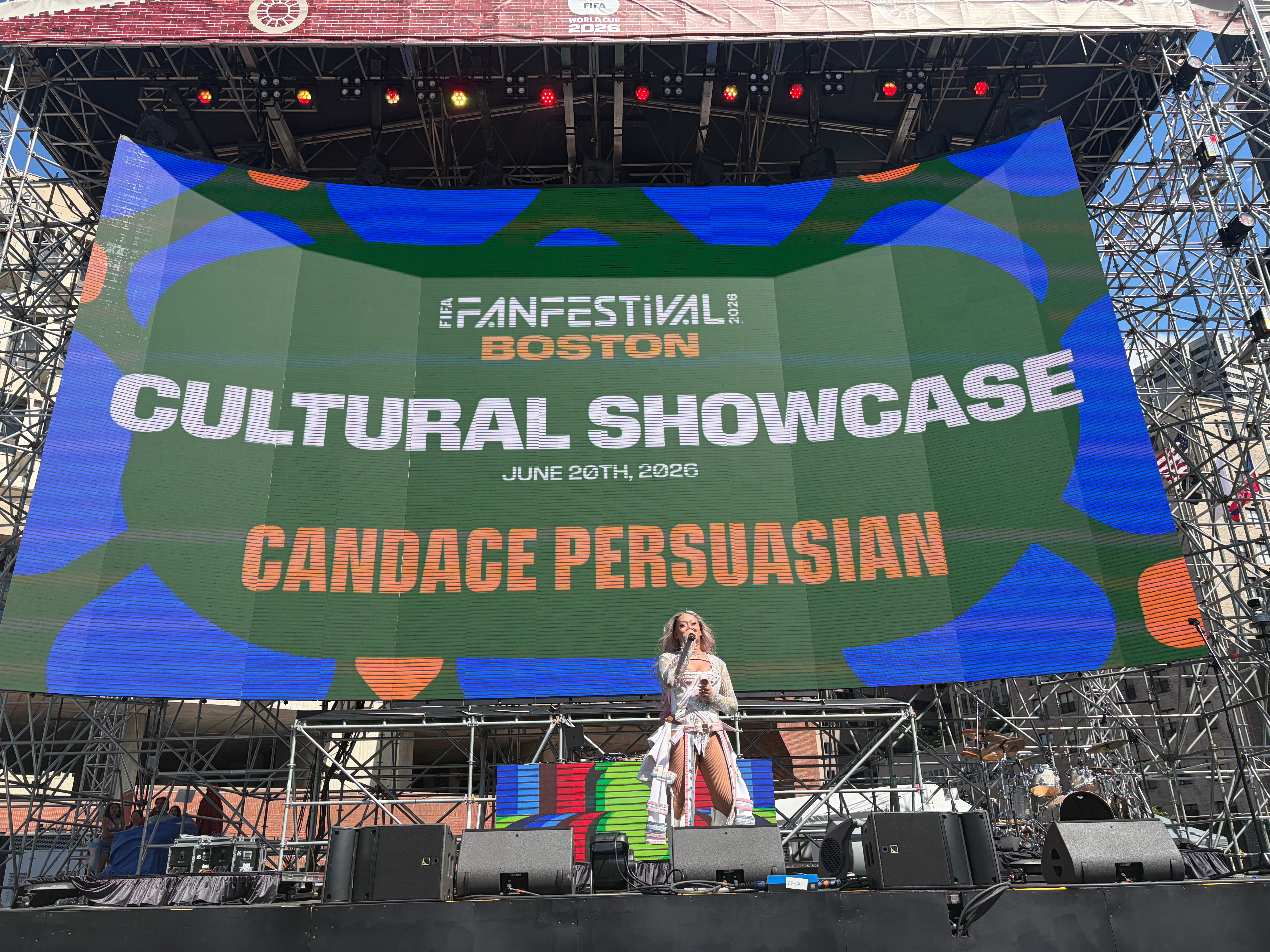
This week, I attended the FIFA World Cup Fan Festival in Boston and watched Candace Persuasian, Destinee Boston, Chanel Thee Angel, Princess Aurora, and the Vivify Dance Crew perform for a diverse international audience. Seeing queer performers take the stage at one of the world's largest sporting events felt significant. Sporting spaces are not typically associated with LGBTQ+ visibility, yet here were drag artists and queer performers occupying that space unapologetically. When Candace wished the crowd a "Happy Pride," I was reminded that drag is not confined to bars, clubs, or explicitly queer venues. It can exist on global stages, reaching audiences who may have never attended a drag show otherwise.
The performance also felt particularly meaningful within the context of Boston. Seeing Candace Persuasian, a Vietnamese American drag queen, alongside the predominantly Asian Vivify Dance Crew at an international sporting event challenged many of my assumptions about where queer performance belongs. As my research centers on Asian and Asian American performers in Boston's drag community, witnessing this level of representation reinforced the importance of documenting the stories of artists whose contributions are often less visible within mainstream drag spaces. It demonstrated that Asian drag artists are not only participating in Boston's queer community but are helping shape what queer visibility looks like on some of its largest public stages.
Outside of participant observation, I have also continued preparing for the interview phase of my project. After nearly a month of revisions, my Tufts SBER IRB application is nearing completion, with only a handful of clarification requests remaining regarding the research protocol, informed consent process, and interview procedures. Although the review process has been lengthy, it has encouraged me to think more intentionally about how I will protect participants, obtain meaningful consent, and ethically document personal narratives. In many ways, the process mirrors one of the central lessons I took away from Drag Queens at the 801 Cabaret: people are entrusting researchers with deeply personal stories, and that responsibility requires careful preparation and thoughtful consideration.
Furthermore, I have begun actively searching for and compiling a list of Asian and Asian American drag performers to interview as part of my research. What I anticipated would be a relatively straightforward process has proven more challenging than expected. Through extensive searching on Instagram and local event promotions, I have found comparatively few Asian performers represented in highly publicized events and promotional materials. Interestingly, many of the Asian queens I have encountered appear to perform in surrounding areas, particularly Rhode Island, rather than within Boston itself.
This challenge has become a finding in its own right. The difficulty I have experienced in locating Asian and Asian American performers raises questions about visibility, representation, and access within Boston's drag ecosystem. Is there a genuine lack of representation, or are these artists simply participating in networks that operate outside of the most visible and mainstream drag spaces? As someone entering this community as both a researcher and participant, I am beginning to recognize that what is most visible is not always representative of the community as a whole. Like Taylor and Rupp, I hope my research does more than document performances. I hope it creates space for performers to tell their own stories, revealing the communities, identities, and forms of activism that exist both on and beyond the stage. If Drag Queens at the 801 Cabaret taught me anything this week, it is that understanding drag begins not with observing performances alone, but with listening carefully to the people who bring them to life.