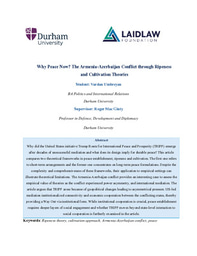
Why Peace Now? Turning a Complex Argument into One Visual Story
Preview
My project examines a question that is academically complex and personally significant to me: Why did movement towards peace between Armenia and Azerbaijan become possible at this particular moment?
Answering this question required me to engage with a long and painful history, a rapidly changing political context, competing interpretations of peace, and theoretical concepts that cannot easily be reduced to a few sentences. The greatest challenge of creating the poster was therefore not deciding what to include. It was learning what the argument could not exist without.
At the centre of the poster, I placed the question that had guided the entire research journey: Why Peace Now?
I wanted this question to immediately invite curiosity. It does not assume that peace is inevitable, nor does it suggest that the existence of an agreement automatically produces meaningful reconciliation. Instead, it asks why political movement became possible after years of failed negotiations, recurring violence, diplomatic frustration, and profound mistrust.
The poster presents my answer through three connected ideas: asymmetrical ripeness, international mediation, and the cultivation of a credible Way Out.
My research argues that the peace process did not emerge because Armenia and Azerbaijan arrived at the same political position or experienced the same pressures. The moment became ripe asymmetrically. Armenia was pushed towards negotiation by vulnerability, loss, and the consequences of a deeply painful conflict. Azerbaijan was pulled towards negotiation by military consolidation, regional opportunity, and the possibility of transforming its position into longer term political and economic gains.
Yet ripeness alone could not explain how this opening might be converted into a political process. This is where the role of international mediation became central to my analysis. Under United States auspices, the Trump Route for International Peace and Prosperity emerged as a possible institutional Way Out. It offered a structure through which interests, connectivity, sovereignty, and regional cooperation could be brought into the same political conversation.
This became the central argument of the poster:
Ripeness explains how the door to settlement opened, although asymmetrically. Cultivation explains what is being constructed beyond that door, although, so far, primarily at the structural level.
Visually communicating this argument required careful decisions. Every image, sentence, colour, and placement had to contribute to the central message. I wanted the historical timeline to demonstrate that the present moment did not appear in isolation. I wanted the theoretical concepts to remain accessible without losing their academic meaning. Most importantly, I wanted the poster to guide the viewer through an argument rather than present disconnected pieces of information.
The process taught me that clarity is not the removal of complexity. Genuine clarity comes from understanding complexity well enough to reveal its underlying structure.
I also wanted the poster to communicate the limitations of the current peace process. Although progress can be identified at the structural level, particularly through diplomatic frameworks, regional connectivity, and institutional proposals, the relational, personal, cultural, and justice dimensions of peace remain far less developed. A political pathway may be emerging, but sustainable peace will require much more than political architecture.
This distinction became essential to the poster because my research does not simply celebrate movement towards an agreement. It asks what kind of peace is being created, whose experiences are included within it, and what must still be cultivated for that peace to become meaningful and durable.
Throughout the design process, my father was once again one of my closest sources of encouragement and intellectual support. We discussed how the poster should feel, what a viewer should notice first, and which ideas should remain with them after they had looked away. Those conversations reminded me that research communication is also relational. An argument becomes stronger when we are willing to explain it, question it, reconstruct it, and allow trusted people to challenge how clearly we understand our own ideas.
I am also deeply grateful to Professor Roger Mac Ginty, whose guidance helped me recognise the importance of a clear central message. His support encouraged me to trust the argument I had developed and to communicate it with greater confidence.
Looking at the completed poster, I see more than a summary of my findings. I see the evolution of a question that began as something deeply personal and gradually became a structured academic investigation. I see the uncertainty that accompanied the early stages of the project, the difficult decisions involved in selecting theories and methods, and the moment when separate ideas finally formed one coherent argument.
Most importantly, I see myself becoming more confident in communicating research that matters to me.
This poster represents the moment when my project became visible. It brought together history, theory, mediation, regional politics, and the continuing human need for peace within one visual narrative. It allowed me to present not only what I had studied, but also how I had learned to think.
I am very excited to share it as the third reflection in my reverse Laidlaw journey.
As I continue moving backwards through this journey, my next reflection will return to one of the most intellectually demanding moments of the project: the moment when the case refused to fit neatly within the theory.
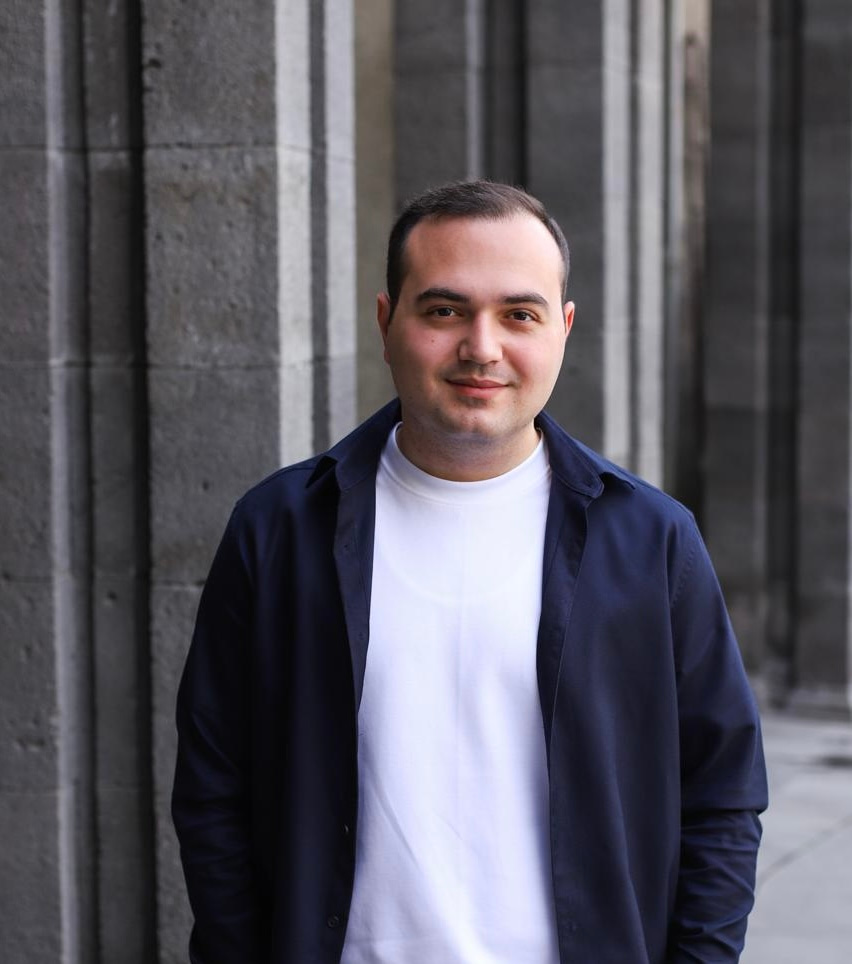
Hello! I’m Vardan Umbreyan, a Politics and International Relations student at Durham University and a Laidlaw Scholar. My academic interests lie at the intersection of peace and conflict studies, diplomacy, European governance, humanitarian action and international institutions. Through my Laidlaw research, I examine how ripeness theory and a Lederach-inspired cultivation approach can help explain the emergence and prospective transformative significance of TRIPP within the Armenia–Azerbaijan peace process.
Alongside my academic work, my involvement with the Armenian and British Red Cross has strengthened my commitment to humanitarian values, ethical leadership and service to others. I am particularly interested in how rigorous research can move beyond the university environment and contribute to meaningful policy conversations and social impact. I am always delighted to connect with other scholars, exchange ideas and learn from people working across different disciplines, countries and communities.