From Question to Argument: Sharing My Laidlaw Research Paper
Preview
There is a particular kind of silence that follows the completion of a research paper.
For months, the project existed across open documents, highlighted sources, unfinished paragraphs and questions that seemed to generate further questions. Then, eventually, those separate pieces became one argument.
Today, I am delighted and honestly quite emotional to share my Laidlaw research paper:
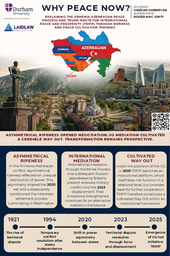
Why Peace Now? The Armenia–Azerbaijan Conflict through Ripeness and Cultivation Theories
As an Armenian studying Politics and International Relations, I have never experienced questions of conflict, negotiation and peace as entirely abstract. I wanted to understand why movement towards settlement emerged after decades of unsuccessful mediation and whether a new institutional framework could represent something more durable than another temporary arrangement.
The project examines the Armenia–Azerbaijan peace process through ripeness theory and a Lederach-inspired cultivation approach, with particular attention to the emergence and prospective transformative significance of the Trump Route for International Peace and Prosperity (TRIPP).
At the beginning, I expected ripeness theory to provide the most straightforward explanation. Yet the case repeatedly resisted a simple story of two equally exhausted parties reaching a mutually hurting stalemate.
Armenia and Azerbaijan entered the emerging peace process from profoundly unequal positions. Armenia faced military loss, insecurity, displacement and the possibility of further coercion. Azerbaijan retained significant military leverage and entered negotiations from a strengthened position.
I therefore came to understand the process as an asymmetrical convergence. Armenia was pushed towards settlement by vulnerability and the costs of continued confrontation. Azerbaijan was pulled towards settlement by opportunities to consolidate its gains and obtain political and economic benefits. United States mediation helped connect those different calculations to a potentially credible institutional Way Out.
The cultivation approach allowed me to ask a second question: even if negotiating space had opened, could the resulting framework sustain transformation?
TRIPP potentially develops structural foundations for peace through connectivity, reciprocal economic interests, institutional cooperation and continuing third-party engagement. Yet structural arrangements cannot automatically produce reconciliation. The relational, personal, cultural and justice-oriented dimensions of transformation remain considerably less developed.
My central conclusion became:
Ripeness explains how the door to settlement opened, although asymmetrically. Cultivation explains what is being constructed beyond that door although, so far, primarily at the structural level.
Researching such a recent and politically contested subject was not easy. Peer-reviewed scholarship directly addressing TRIPP remained limited, while many available sources reflected official positions and competing political narratives. I had to learn that the responsibility of a researcher is not to produce the most dramatic conclusion, but the most defensible one.
This required distinguishing institutional proposals from implemented outcomes, public positions from private motivations and prospective transformation from demonstrated change.
The process transformed how I understand academic research. Methodology became more than a section of the paper; it became the discipline governing what I could responsibly claim. Leadership similarly became less about displaying certainty and more about remaining accountable to evidence, criticism and revision.
I am profoundly grateful to Professor Roger Mac Ginty for his patience, intellectual generosity and guidance throughout this project. His feedback challenged me to clarify the argument, strengthen its theoretical foundations and become more careful about the relationship between evidence and interpretation.
I am equally grateful to the Laidlaw Foundation and Durham University for giving me the opportunity to investigate a subject of such personal and academic significance. Laidlaw trusted me to pursue a difficult question and encouraged me to imagine that undergraduate research could contribute to wider academic and policy conversations.
Finally, I remain endlessly grateful to God, my father and my family. My father stood beside this project from its earliest idea to its final sentence, providing encouragement, perspective and the safest space in which I could continue whenever the research felt overwhelming.
This paper is not the end of my engagement with the subject. I hope to continue developing the expanded manuscript, strengthening its evidence and exploring whether its theoretical argument can contribute to future academic discussion.
But today, I want to stop and recognise what this paper represents: a personal question transformed into an academic argument, uncertainty transformed into intellectual discipline and an opportunity transformed into a direction for the future.
In my next reflection, I will share the accompanying academic poster and reflect on the completely different challenge of making months of research understandable in only a few seconds.

Hello! I’m Vardan Umbreyan, a Politics and International Relations student at Durham University and a Laidlaw Scholar. My academic interests lie at the intersection of peace and conflict studies, diplomacy, European governance, humanitarian action and international institutions. Through my Laidlaw research, I examine how ripeness theory and a Lederach-inspired cultivation approach can help explain the emergence and prospective transformative significance of TRIPP within the Armenia–Azerbaijan peace process.
Alongside my academic work, my involvement with the Armenian and British Red Cross has strengthened my commitment to humanitarian values, ethical leadership and service to others. I am particularly interested in how rigorous research can move beyond the university environment and contribute to meaningful policy conversations and social impact. I am always delighted to connect with other scholars, exchange ideas and learn from people working across different disciplines, countries and communities.