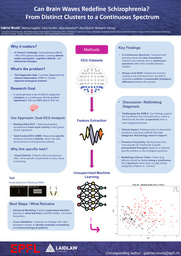
Research Report: Can Brain Waves Redefine Schizophrenia? From Distinct Groups to a Continuous Spectrum
Preview
Hello everyone!
This report summarizes my summer research project conducted at the Laboratory of Psychophysics (LPSY) at EPFL. My research question was: when we let raw neurophysiological data organize itself without imposing clinical labels, does the distribution of schizophrenia patients and healthy controls form isolated subtypes, or does it represent a continuous biological spectrum?
To answer this, I applied dimensionality reduction techniques (PCA and UMAP) to 194 EEG features extracted from both a visual task (Visual Backward Masking) and resting-state data in a Georgian cohort. Our findings strongly support a dimensional approach to the disease, challenging the strict categorical boundaries of current psychiatric diagnosis.
It was a deeply insightful and intense experience that bridged the gap between clinical neuroscience, psychophysics, and data science. I learned a tremendous amount about machine learning and the critical need for a more personalized "precision psychiatry." I am very grateful for this opportunity and would be delighted if you read my report. I would greatly appreciate any thoughts, feedback, or questions you may have!
Best, Gabriel

Life Sciences Engineering, EPFL Bachelor Student