When Collaboration Is Not Enough: Reflecting on My Research Poster
When I first began this project, I thought I was asking a question about collaborative learning. By the end, I realized I was asking a much broader question about equity:
who does collaborative learning actually work for?
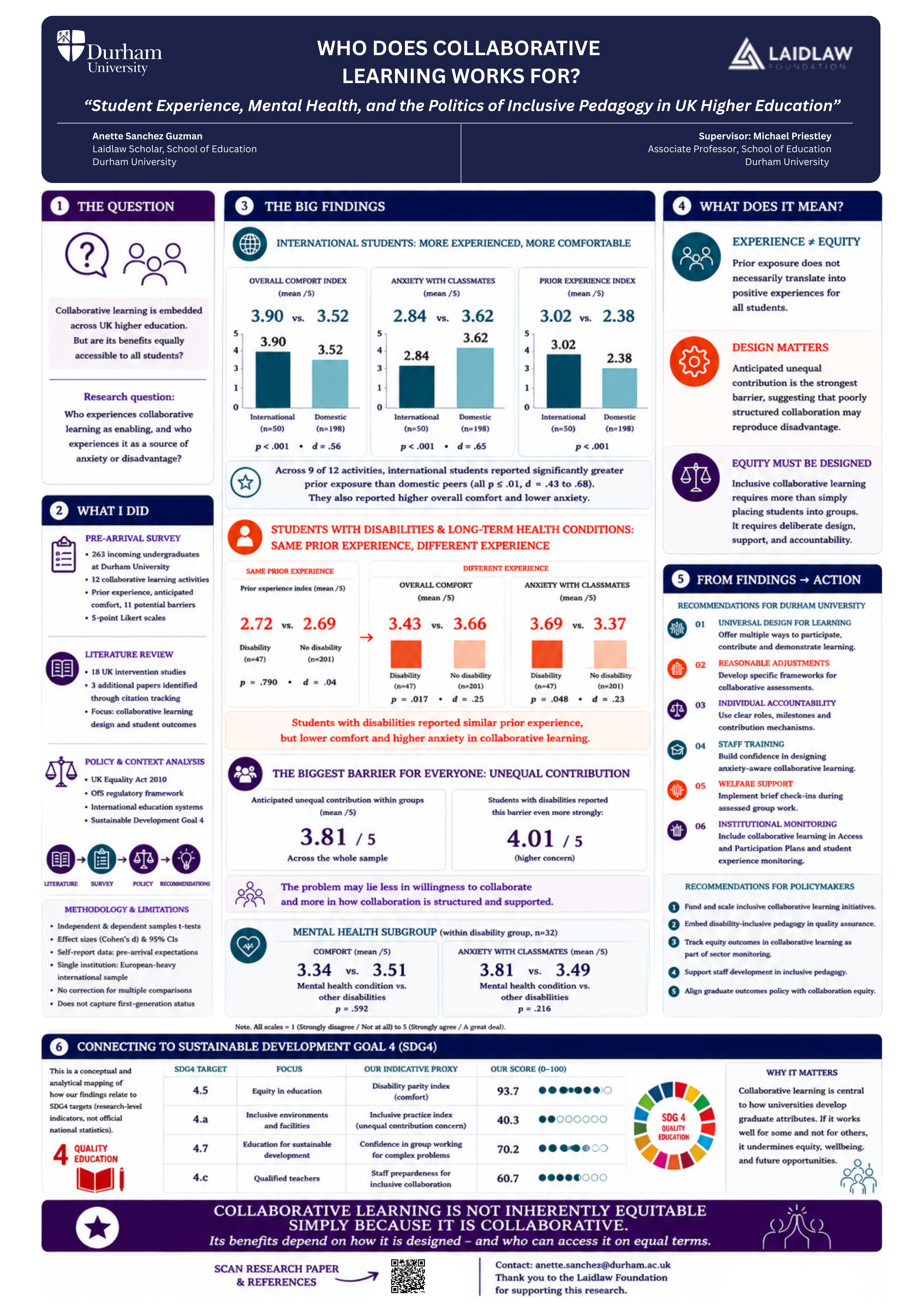
My research explored how students from different backgrounds experience and anticipate collaborative learning in higher education. Using a pre-arrival survey of 263 incoming Durham students, alongside a literature review and comparative policy analysis, I began by looking for differences in students’ previous experiences. What I found challenged some of my expectations. International students reported greater previous exposure to collaborative learning and higher overall comfort than their domestic peers. At the same time, students with disabilities or long-term health conditions reported lower comfort and higher anxiety despite having broadly similar previous experience. Across the whole sample, the strongest anticipated barrier was unequal contribution within groups.
These findings made me reconsider an assumption I had initially taken for granted: that previous experience would naturally make collaborative learning more accessible or comfortable.
Experience does not automatically produce equity.
This became particularly important when I began designing my poster. At first, I thought the main challenge would be making a large amount of research fit into a limited space. I soon realised that the real challenge was deciding what the audience needed to understand, and in what order.
Writing the research paper had allowed me to explain my methodology, develop my argument gradually and qualify each finding in detail. The poster required something different. I had to decide which findings were essential, which statistics could communicate an idea visually, and which details could be left for the reader to explore through the full research paper and references.
This process changed the way I think about research communication. I was not simply summarising my research; I was making decisions about how another person would encounter it. I therefore designed the poster as a visual journey, beginning with the research question, moving through the evidence and differences between student groups, and ending with interpretation and possible action.
For me, this was one of the strongest leadership lessons of the project. Leadership is not always about leading people; sometimes it is about taking responsibility for how an idea is communicated and understood. I had to make decisions, justify them, listen to feedback and be willing to change elements of my original approach. This required confidence, but also openness to ideas that were different from my own.
It also made me more aware of my own strengths and weaknesses. One of my strengths is that I am ambitious about the impact I want my work to have. I want research to lead somewhere beyond the page. At the same time, this can make me want to include too much or make an argument as strong as possible. Designing the poster taught me that impact does not come from saying everything. It comes from identifying what matters most and communicating it clearly.
Learning to prioritise therefore became an important capacity I developed during this stage of the project. I became more comfortable making difficult decisions about what to include, what to remove and what to emphasise. I also became more willing to ask for feedback rather than assuming that because I understood the research, an audience would automatically understand it in the same way.
That process required humility. Feedback is easy to accept when it confirms what you already believe; it is more valuable when it makes you reconsider something. I learned to see feedback not as criticism of the work I had already done, but as another source of evidence about whether my message was actually reaching its intended audience.
The research itself also taught me to be more comfortable with uncertainty. My survey is cross-sectional and captures students’ expectations before university. It therefore allows me to identify patterns and associations, but it cannot establish causation. I became particularly conscious of this when presenting the differences experienced by students with disabilities or long-term health conditions. The findings are important, but they cannot be used to claim that collaborative learning itself causes anxiety or disadvantage.
Communicating this limitation on the poster was an important exercise in integrity. A visually striking result can easily appear more certain than it really is. I learned that responsible research communication means resisting that temptation and being precise about what the evidence can and cannot tell us.
A strong researcher knows where the evidence ends — and has the confidence not to claim what it cannot prove.
This experience has also changed how I understand inclusion. Before this project, I often thought about inclusive education primarily in terms of providing additional support when students encounter barriers. The research encouraged me to think further upstream: how might the learning environment itself create or reduce those barriers?
The finding that students with disabilities reported lower comfort and higher anxiety despite similar prior experience was particularly significant for me. It made me question whether universities should focus only on preparing students to adapt to collaborative learning, or whether they should also reconsider how collaborative learning is designed.
This shift is central to what I take from the project as a Laidlaw Scholar. The 3Cs ask me to consider not only what I have produced, but the values, capacities and character I am developing through the process.
My values have become clearer through the research. Curiosity encouraged me to question assumptions about who is prepared for collaborative learning. Integrity required me to communicate limitations rather than overstate my findings. Ambition pushed me to think beyond identifying a problem and towards what institutions could realistically change.
My capacities have developed through research, analysis and communication. I have become more confident in interpreting evidence, making decisions about how findings should be presented and translating complex academic arguments into something accessible to a wider audience. The poster particularly strengthened my ability to communicate across different levels of expertise.
My character has developed through the less visible parts of the process: being open to feedback, recognising when I needed help, accepting uncertainty and being willing to change my mind. These experiences have reminded me that becoming a better researcher is not simply about becoming more knowledgeable. It is also about becoming more self-aware, accountable and willing to listen.
The project has also changed my understanding of what it means to create positive change. The findings do not suggest that collaborative learning should be abandoned. Instead, they suggest that its design needs to respond more intentionally to the diversity of the students who participate in it. The recommendations I developed therefore focus on practical changes such as individual accountability, clearer group roles, inclusive design, reasonable adjustments, anxiety-aware facilitation and stronger institutional monitoring.
Collaborative learning is not inherently equitable simply because it is collaborative.
For me, this is where research and leadership come together. Identifying an inequality is only the beginning. The more difficult question is what can realistically be done about it. Going forward, I want to become better at turning evidence into recommendations that are not only persuasive, but specific, achievable and measurable.
The poster has therefore become more than a visual summary of my research. It represents a change in how I approach problems. I began by asking whether collaborative learning works. I finished by asking under what conditions it works, for whom, and what institutions can do to make those conditions more equitable.
Looking back, I can also see how much of my learning happened through moments when I was unsure. Deciding what to remove from the poster, questioning my interpretation of the findings and accepting feedback all required me to step away from the idea that good research is about always knowing the answer. I have learned that uncertainty can be productive when it encourages deeper questioning rather than avoidance.
What?
I transformed a complex research project into a visual argument that could communicate its central findings to an audience beyond the full academic paper. This required me to select evidence, interpret differences between groups, make design decisions and communicate the implications of the research clearly.
So what?
The process showed me that communicating research is not separate from doing research. The decisions I made about what to emphasise also forced me to clarify what I believed the research actually contributed. It developed my confidence, but also my humility: I learned to defend evidence while remaining open to feedback and uncertainty.
Most importantly, I realised that inclusive education cannot simply ask whether students can adapt to existing learning structures. It should also ask whether those structures have been designed with different students in mind.
Now what?
My next goal is to build on this capacity to translate evidence into action. I want to become more confident in developing recommendations that are specific, measurable and realistic, while continuing to strengthen my ability to communicate research to different audiences.
I also want to carry the habits developed through this project into future research: questioning my assumptions, seeking perspectives beyond my own, asking for help when I need it, listening carefully to feedback and being transparent about uncertainty.
Ultimately, the poster captures more than what I discovered about collaborative learning. It captures how I changed as a researcher and as a developing change-maker.
A successful research poster does not communicate everything you discovered. It communicates the question you want someone else to start asking.
For me, that question is now much bigger than collaborative learning. It is about who gets to benefit from the way we design education, who is expected to adapt to it, and what we can change so that participation becomes genuinely more equitable.
And that is the question I want to carry forward from this project.
I would like to express my sincere gratitude to my research supervisor, Michael Priestley, for his guidance, patience and support throughout this research journey. I am also incredibly grateful to Chantelle and Kamile from the Laidlaw team for their continued encouragement and support throughout the programme. Their guidance has been invaluable in shaping both my research and my personal development as a Laidlaw Scholar.
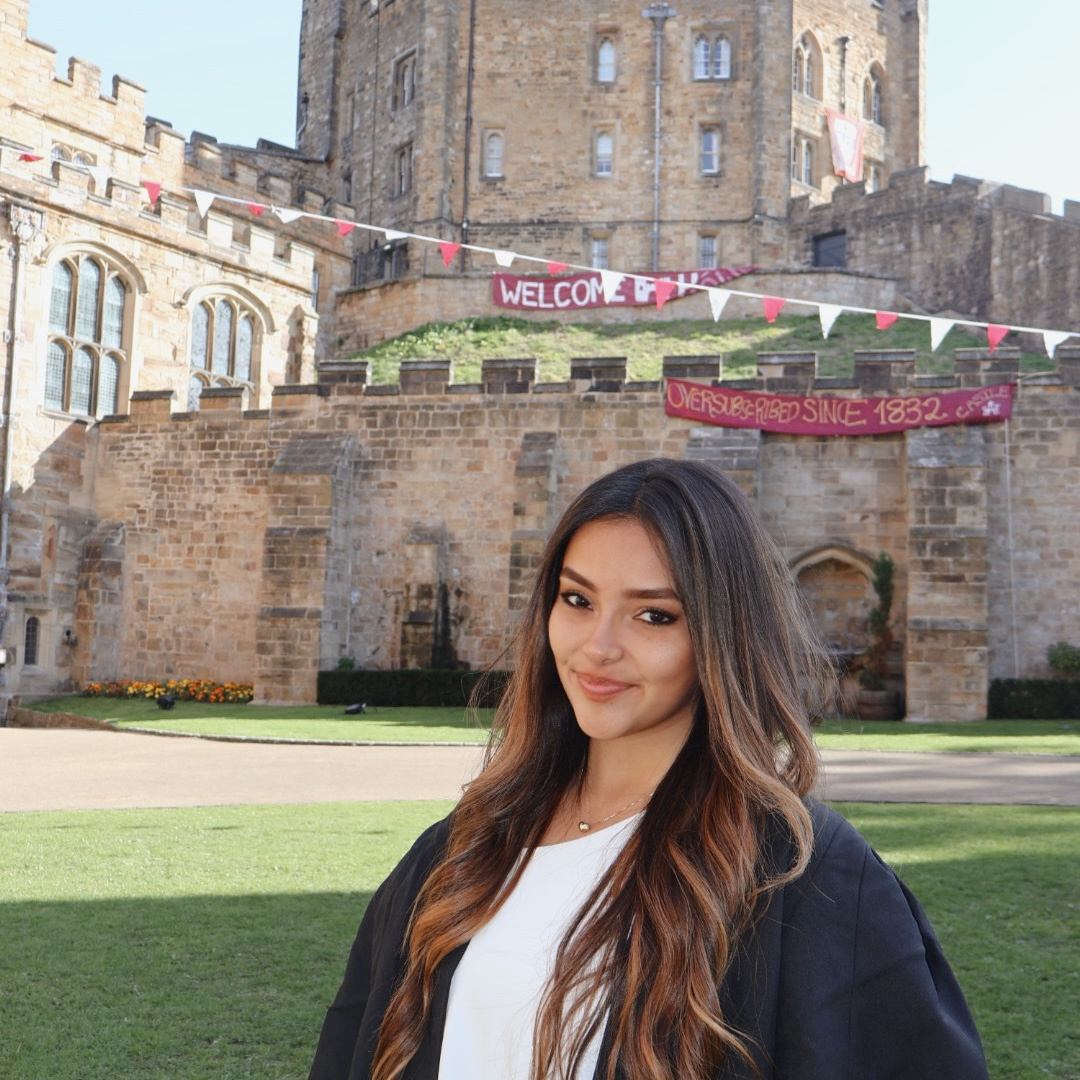
I’m Anette, a PPE student at Durham University and a Laidlaw Scholar from Querétaro, Mexico. I’m passionate about understanding how politics, society and education shape people’s opportunities, particularly questions around inclusion, representation and belonging.
My interest in social impact began through youth-led projects in Mexico, where I worked on initiatives focused on education, sustainability and creating opportunities for young people. I have also been involved in international youth initiatives, including work connected to the United Nations, which exposed me to perspectives and challenges from across the world.
At Durham, I enjoy combining my academic interests with practical action through research, student societies, sport and creative projects. Through Laidlaw, I am researching collaborative learning and how universities can better support students from diverse educational and cultural backgrounds. The experience has pushed me to become more comfortable with uncertainty, question my assumptions and think more critically about how research can translate into meaningful change.
Outside academics, I’m a competitive taekwondo athlete and love creating communities, bringing ideas to life and meeting people with completely different perspectives. I joined Laidlaw not only to develop as a researcher, but to grow as a leader and contribute to a community of curious, ambitious and impact-driven people.
Recommended Content

My Laidlaw Research: Who Does Collaborative Learning Work For? Student Experience, Mental Health, and the Politics of Inclusive Pedagogy in UK Higher Education