Week 3 & 4 - A Streamlined Approach

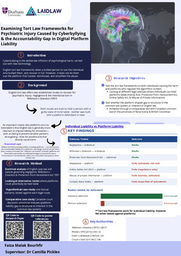
I read Caparo Industries plc v Dickman [1990] and Robinson v Chief Constable of West Yorkshire Police [2018] to better structure the analysis of whether a platform owes a duty to a user harmed by another user's content. My initial assumption was that foreseeability would be the main obstacle to this claim. However, when looking through the cases properly, I now think foreseeability is the easier part, whereas it is the 'fair, just, and reasonable' step where a claim like this would take time, given how reluctant courts have historically been to impose duties for third-party conduct the defendant did not create.
The most significant moment of the week was reading Lorna Woods and William Perrin's 'Online Harm Reduction' report in full rather than through secondary commentary. I had assumed, based on how the proposal is summarised, that it originally gave individuals a right to sue platforms directly and that this was cut before the Online Safety Act 2023 was passed. However, when reading the primary source that turned out not to be correct. Woods and Perrin considered an individual right of action themselves and deliberately rejected it, for reasons including litigation-cost asymmetry and a concern about a 'compensation culture'. I had to go back and correct a claim I had already drafted on my notes.
Such was useful, however slightly humbling. This serves as a prominent example of something I promised myself I would commit to when writing my Laidlaw application: being willing to treat being wrong as information rather than as a threat to the argument I had already built. In this case, the correction actually strengthened my point rather than weakening it: the absence of a private remedy against platforms was a deliberate design choice made by the architects of the duty of care model, not an accident of the legislative process. That is a sharper claim than the one I started with the week before, and I would not have found it if I had not looked through the primary source.

I am Faiza Malak, currently a law student at Durham University. I am excited to be commencing my research this summer and look forward to sharing updates with the network on both the breadth and depth of my work and experiences. Stay tuned!