This week I started my six-week placement with Cambridge Global Health Partnerships (CGHP), where I'm evaluating the organisation's impact over the past year. My role is to bring together evidence from partnership reports, participant reflections, interviews and survey data to understand the impact of CGHP's work for partner organisations, NHS staff and the wider healthcare system.
Before starting the placement, reciprocal learning was a phrase I had heard frequently in discussions about global health. CGHP’s approach helped me understand what it looks like in practice. Rather than bringing predefined solutions, NHS professionals work alongside local partners to address challenges that those communities have identified themselves. Projects are adapted to local contexts, and knowledge exchange happens in both directions. I was particularly struck by the emphasis on building local capacity through a "train the trainer" model, where the aim is to enable local professionals to continue teaching and developing others independently. It is an approach that places sustainability at the centre of the partnership rather than treating individual visits as isolated interventions. Seeing this model in practice has strengthened my appreciation of what ethical global health engagement can look like.
As I worked through reports from previous years, I realised I needed a different way of organising the information to make sense of it. I created my own spreadsheet that brought together details such as partnership locations, projects, dates and supporting reports into a format that was easier for me to navigate. It also helped identify missing documents and broken links that we can now follow up on. Although this wasn't part of my original brief, it should make the next stage of analysis more structured and leave behind a resource that others can refer back to if needed.
Alongside organising the evidence, I also started thinking about how the impact would be best communicated. Previous reports have explored participants' experiences, and I'll be building on that by considering impact from the perspective of partner organisations and the wider value created for the NHS as well as CGHP’s funders. Another task is identifying what information would be useful to collect in the future so that CGHP can better demonstrate its impact while keeping reporting manageable for participants. I've come to understand that impact evaluation is about collecting the right evidence to tell the organisation’s story, not just analysing what’s available.
Personally, this placement already feels different from previous internships. Rather than gradually settling into a role, I've been trusted to take ownership of a defined project from the beginning. I've really appreciated the team's openness and willingness to answer questions. In fact, one of my favourite parts of the week has been that every question seems to uncover another piece of the puzzle. Each conversation or document has helped me build a clearer picture of how the organisation operates and how different partnerships fit together.
Next week, I'll begin working through the partnership reports and participant reflections to identify common themes and prepare for interviews with members. After spending this week understanding the context behind the project, I'm looking forward to exploring the stories behind the data and seeing how they come together to demonstrate the impact of CGHP's work.
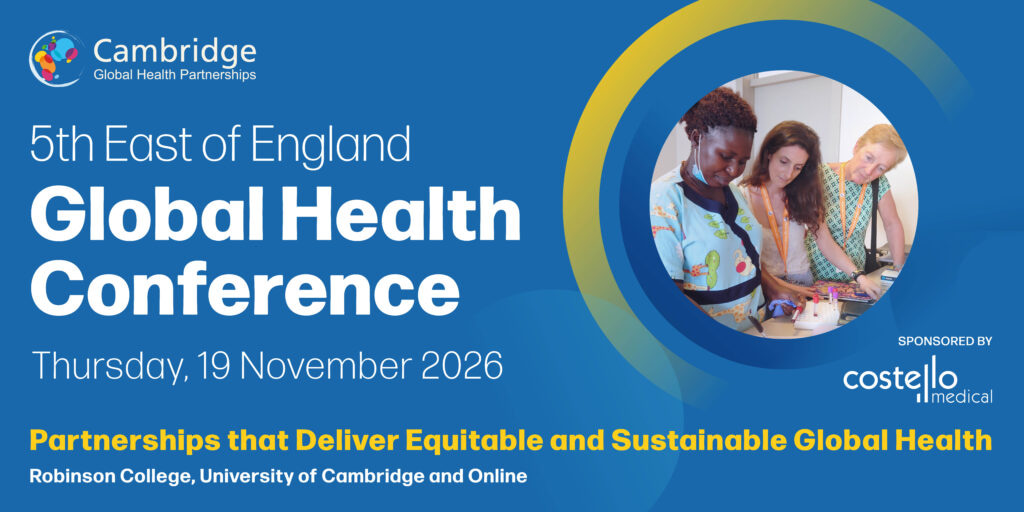
CGHP is hosting an East of England Global Health Conference Nov 19th, 2026, which is open to healthcare professionals, students and researchers. If you are interested, please find more info here: https://cambridgeghp.org/events/5th-east-of-england-global-health-conference/

I’m a third-year undergrad doing psychology! I’m interested in topics of ethics, decision-making, and prosocial development. I hope to work in non-profit in the future, and would love to chat if we have any similar interests!