The Leap was the Lesson: Laidlaw End-of Programme Reflection
Summer I: Geneva, Switzerland | Summer II: Sense about Science, London
I wanted to start this reflection somewhere specific: a Tuesday afternoon in early May, 2026, thirty minutes before I was due to interview Bob McDonald, the CBC's chief science correspondent and the host of Quirks & Quarks, a podcast I've listened to for years, for my own show, The Science Diplomat. The name itself traces back to an offhand conversation with a colleague in Dubai the November before this programme even started, when she first mentioned the term "science diplomacy" to me and, almost as an aside, told me about the Geneva Science and Diplomacy Anticipator. Six months later I was standing in GESDA's building in Geneva doing my Laidlaw research; a year after that, I was interviewing a career science communicator about the same underlying question that has quietly organised both of my Laidlaw summers: how does science actually reach the people who need it? I remember sitting there before that interview, genuinely giddy, thinking: I get to do this as myself now, not just as a research student borrowing the term. That same week, I found out a close friend back home in Toronto had passed away. Those two things sitting side by side, real joy and real grief, in the same seven days, thousands of miles from home, turned out to be the truest preview of what this programme was actually going to teach me: not a tidy lesson, but how to hold more than one true thing at once.
What I Learned About Myself
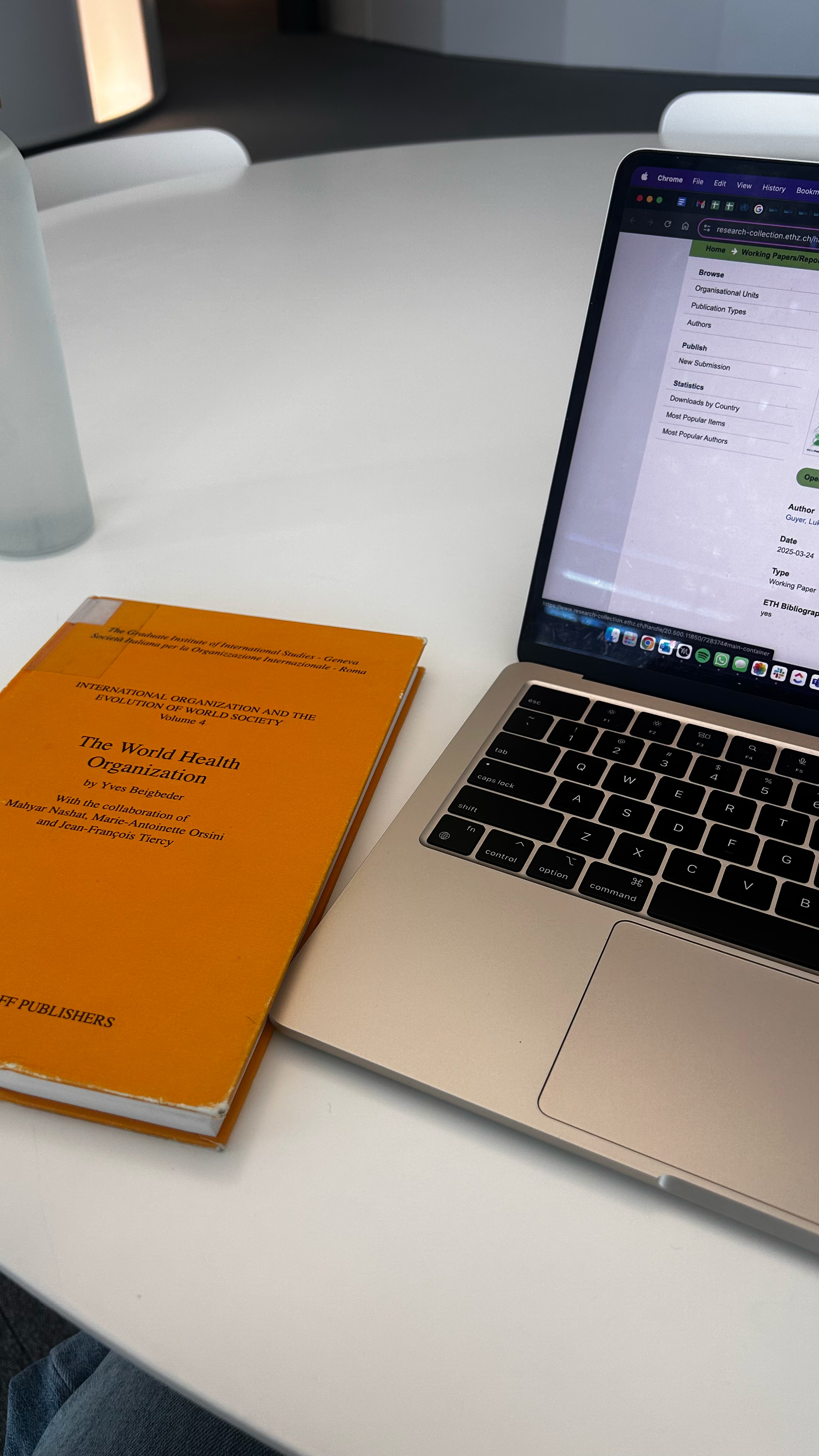
The Laidlaw Scholars Programme gave me two very different summers, and the contrast between them taught me more than either one would have alone. My first summer took me to Geneva, Switzerland, for six weeks of fieldwork on anticipatory science diplomacy and the global cancer burden, under the supervision of Professor Guy Allen, work that grew out of a conversation with a colleague in Dubai the previous November, when I first heard the term "science diplomacy" and had no idea it would become the frame for the next two years. My ethics approval came through only three days before I arrived, which meant re-approaching and rescheduling most of my intended interview participants and pivoting, out of necessity, into fieldwork first: archival research at the UN Library and the Geneva Graduate Institute, conference observation, and eventually five semi-structured interviews with experts from GESDA, the UN, WHO, CERN, and Roche. I applied foresight tools like the Three Horizons and the Futures Triangle to think about how cancer governance could move from reactive to anticipatory, and I still remember sitting at the AI for Good Summit, and later sharing a meal with the former Prime Minister of Greece, thinking: this is what it looks like when science, policy, and diplomacy actually share a room. My second summer, six weeks at Sense about Science in London, put me on the other side of that same coin: translating evidence, not generating it, for audiences who would never read the primary literature themselves. Within days of arriving, I was helping shape recommendations for Evidence Week 2026, learning what All-Party Parliamentary Groups are and building a genuine priority framework for matching partner organisations to the MPs positioned to act on their evidence. None of it, in either summer, went according to a plan I had made in advance; I built the plan as I went, both in Geneva and in London, and it demanded extreme agility, something I didn't know I would get used to until this programme forced it out of me twice.
Who I Got to Work With
Across two summers, I worked with people from different backgrounds and experiences: Professor Guy Allen, my research advisor for the research project, the experts I interviewed, the global cohort of Laidlaw Scholars I connected with in Geneva and London, and the small team at Sense about Science, Tracey, Hayley, Sameh, Katherine, Clare, and Chris, who trusted me with real work almost immediately and, when I needed it most, showed up for me as people rather than just colleagues. I want to also highlight Emily, a fellow intern and PhD student, what started as a run together bloomed into a beautiful friendship by the end of my time in London, exploring the city together. I also leaned heavily on Jane, a friend I'd first met at the UN Summit of the Future in September 2024. By my final week, welcoming me into her family's Eid celebrations, helping me realize that family isn't always just defined by blood. On my last day, the team gave me a card. Emily wrote that I'd been "the best co-intern and friend." Chris called me "a great addition to the office." I don't think I fully believed I belonged there until I read those lines.
My Leadership Strengths and Growth Areas
The version of my leadership strengths I'd have named at the start of this programme was something soft and hard to disprove, "communication," maybe, or "adaptability." Two years later, I can point to something narrower and more useful: I take ambiguous, poorly structured problems and turn them into something with a defensible order to it, and then I do the unglamorous work of holding that order together after the interesting part is over. In Geneva, that meant taking foresight tools like the Three Horizons and the Futures Triangle, frameworks built to organise uncertainty and using them to build a strategic analysis of GESDA's anticipatory practices out of five interviews and a pile of archival notes, work that ultimately proved rigorous enough to be shortlisted for peer-reviewed publication with F1000Research. In London, the same instinct showed up in a far less glamorous form: a constituency-first, APPG-leadership-second, committees-third priority logic behind roughly 370 individual MP recommendations for Evidence Week, and the full appointment-booking infrastructure that made sure every one of those meetings actually happened. Nobody attending Evidence Week will ever know that logic exists. I've stopped assuming leadership has to be visible to be real.
My clearest growth area is the opposite instinct: I default to figuring things out privately before I feel ready to ask for help. I initially tried to handle things alone before letting anyone in, however, things got noticeably better once I stopped doing that. I don't think that instinct has fully gone away, but I'm much more aware of it now, and much quicker to catch myself doing it. I can actually measure some of that shift: in my first Monday team meeting at Sense about Science, I mostly listened, intimidated by how fluently everyone else already spoke about ongoing campaigns; by my last few weeks, I was volunteering ideas unprompted and asking to take on work outside my original scope, including offering to help my colleague Chris scope a new award platform for the John Maddox Prize. Watching myself go from silent to genuinely proactive over six weeks is one of the clearest, most concrete pieces of evidence I have that this kind of growth is trainable, not fixed.
What My Research Taught Me
My research in Geneva sharpened my analytical skills in a very literal, methodological sense, coding and triangulating interview transcripts, reviewing WHO and GESDA policy frameworks, applying foresight tools designed to make sense of uncertainty rather than eliminate it. My LiA placement then taught me a complementary kind of critical thinking: how evidence behaves once it leaves an academic paper or a policy report and enters the world. Building "Thinking Critically About AI Tools" for early-career researchers, structured around five practical questions adapted from the charity's Responsible Handover framework, forced me to think carefully about who gets to ask hard questions of a new tool, and who is expected to simply accept it. Between Geneva's foresight tools and London's responsible-adoption framework, I don't think I'm fully "a wise thinker" by the end of this programme, but I am a considerably more careful one, especially about the gap between what evidence says and what people are actually prepared to hear.
The Oxford Character Project
Running alongside both summers was the Oxford Character Project's leadership programme, the certificate every Laidlaw Scholar is required to complete, built around a set of specific virtues: Transcendence, Humanity, Courage, and Integrity, with Judgment sitting at the centre of the character wheel because it draws on all the others. I went into my LiA with the Oxford Character Project handbook as a shortcut on mt desktop and with each week I realized those seemingly abstract concepts measured against my experiences.
Transcendence, the workbook describes as vision, imagination, and purpose kept balanced and alive, and I felt that most clearly at the AI for Good Summit in Geneva and again, a year later, thirty minutes before interviewing Bob McDonald for The Science Diplomat, the same underlying sense of purpose that first sparked from an offhand conversation in Dubai finally becoming something I got to practise as myself. Humanity, described as the discipline of caring for others without losing balance or boundaries, was the exact shape of my third week in London: letting my new colleagues and Jane's family look after me while I grieved, instead of trying, as I usually would, to handle it quietly on my own. Courage was the measurable distance between the Monday meeting in Week 1 where I mostly listened and the Monday in Week 5 where I shared new ideas, and later, the nerve it took to ask Tracey Brown OBE directly whether she'd be a guest on my podcast. And Integrity, the workbook's language for staying true to your principles when pressures rise, ran underneath the research itself. If Judgment is what the character wheel calls the ability that draws on every other virtue at once, that feels like the most accurate way to describe what two years of this programme actually built in me: not four separate skills I can list off.
The Kind of Leader I Want to Be
If I were describing the value of this programme to a student just starting at university, or to a younger version of myself, I'd say this: Laidlaw doesn't just teach you how to do research or how to lead a project, it puts you in situations where you have to build competence quickly, in public, without a script, and then asks you to reflect honestly on what that revealed about you, including the parts of yourself you'd rather not examine.
One of the clearest external markers of that first summer's rigor came after the programme itself, when I presented my poster on anticipatory science diplomacy at the Laidlaw conference. Editors from Taylor & Francis Group reviewed the poster symposia at both the Durham and Brown conferences and selected just 45 projects, out of everyone who presented across the whole Laidlaw network, to proceed to peer review and open-access publication with F1000Research. Being told that the research I'd built out of a delayed ethics approval and a fieldwork-first scramble in Geneva was rigorous enough to be shortlisted for publication, was one of my proudest moments of this entire programme.
I don't think I'm going to spend my career at a lab bench, and this programme is a large part of why I now feel confident saying that out loud instead of just suspecting it privately. What I want to make, as an ethical leader and a global citizen, is the kind of impact that comes from being a trustworthy bridge.
In the next few years, I want to keep building the specific skills this programme surfaced in me: structuring messy information clearly, communicating evidence honestly even when the honest version is less satisfying than a simpler claim, and doing the patient, often invisible groundwork, researching a community's history, mapping a system before trying to influence it, that has to happen before any communication can be trusted.
I also want to keep practising something else: letting people see me on a hard day, the way my colleagues and Emily saw me in my third week in London, instead of only ever showing the version of myself that has everything under control. I want to keep interviewing people that inspire me, not because of their credentials, but because those conversations keep teaching me, in real time, what it looks like to spend a career in service of public understanding rather than personal recognition.
To continue acting as a global citizen and leading ethically, I plan to keep seeking out work and projects that force me into unfamiliar systems, a foreign Parliament, a coastal community with its own history, a field outside my training, because that discomfort, repeatedly, has been where almost all of my actual growth in life has happened.
Two years ago, I joined the Laidlaw Scholars Programme as a molecular biology student who assumed leadership meant being the expert in the room. I'm finishing it as someone who thinks leadership more often means being the person patient enough, and honest enough, to help everyone else understand what the experts actually found, and humble enough to let other people carry some of the weight along the way.

Hey! I’m Amna, a third-year molecular biology student at the University of Toronto.
I’ve worked in labs studying genetics and nanoimmunoengineering, but I also care a lot about science communication, from writing about microbes to speaking at places like the UN. For my summer research project, I am exploring anticipatory science diplomacy in Geneva. When I’m not deep in research mode, I’m probably planning my next escapade.
Always down to connect, especially if you care about science, systems, or asking big questions.
![[Summer 2] Learning to Translate - LiA Reflection](/cdn-cgi/image/metadata=copyright,fit=scale-down,format=auto,quality=95,width=256,height=256/https://public-storage.zapnito.com/FA3yXx4kRzWF9-Tl-XoxJy7V_pBtCrbNkx0kRvwmBxs)

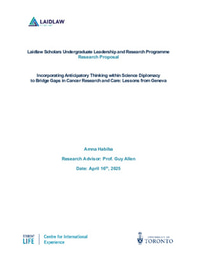
![[Research Report] Anticipatory Science Diplomacy as a Framework for Addressing Inequities in Cancer Research and Care: Insights from Geneva](https://images.zapnito.com/cdn-cgi/image/metadata=copyright,fit=scale-down,format=auto,quality=95,width=256,height=256/https://images.zapnito.com/users/868052/documents/291212/4c0e5abe-b9c6-45f5-ad55-18a4888cb86f-med.jpg)