The Hand Behind the Rabbit
I used to be afraid of my own shadow.
I would watch it distort under the sun’s command, stretching and bending across pavements, walls, and doorways. Yet it was mine. It followed only me. It taunted me as it mirrored my movements, raising its hand with mine while my legs lengthened to three times their length.
Depending on where I stood, the same body could produce an entirely different image.
The sun watched from above, often behind, saying nothing. It did not need to. Without light, I would have nothing that would look at me from below and remind me of my shape.
And yet the shadow was never truly mine.
It emerged from me, but I could never fully determine its final form. The angle of the sun altered it. The ground interrupted it. Walls fractured it. I moved, and it followed, but what appeared on the ground was never mine alone. It belonged to me, certainly, but it was also shaped by forces beyond my control.
What unsettled me was not the distortion itself. Children are given room to be strange. We speak to toys, assign personalities to clouds, and accept that shadows grow taller than the people who cast them. What unsettled me was that the shadow occupied a place I could never reach. However faithfully it followed me, I could never stand where it stood. I could never see what it saw.
It never seemed farther away than when it was directly beneath me.
As a child, I lacked the language to explain why this mattered. I only knew that something attached to me could appear different depending on where it was seen. That it could belong to me without belonging entirely to me. That it could return my own outline altered.
The shadow was only the first thing I learned to mistake for myself.
Eventually, I discovered that shadows were easier to shape than to understand.
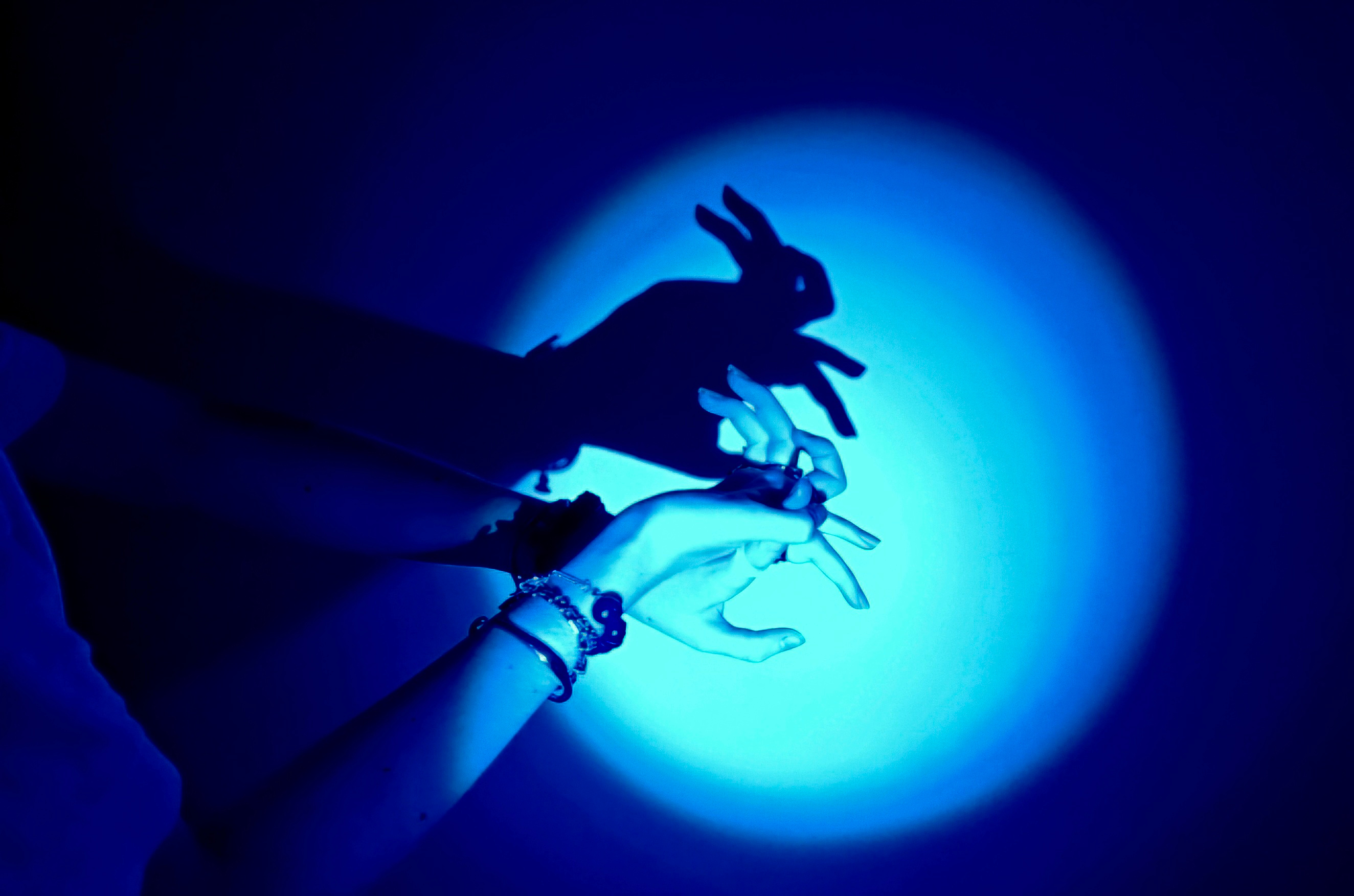
They were not only things that followed me. Given enough patience, they could be persuaded into becoming something else. With two hands and a source of light, a rabbit could emerge from the wall. A pair of ears. A small head. A familiar outline, soft enough to be recognised before it was questioned.
But the rabbit was not where the work happened.
The hand, no longer quite a hand, served the image by severing itself from everything that made it recognisably a hand. One finger disappeared. Another folded back on itself. A third became an ear. Joints bent into positions they were never meant to hold. Tendons tightened. Muscles locked. The hand no longer grasped, pointed, touched, or carried. It surrendered function for the chance of being recognised.
The rabbit appeared natural because the hand did not.
From a distance, the illusion held. Up close, it betrayed itself. Ears returned to fingers. A nose became a thumb. A moment of relief, and the whole animal collapsed. The rabbit survived only for as long as the hand refused to be a hand.
The better the rabbit became, the less visible the hand was. The shadow remained legible. The body producing it became harder to remember.
The rabbit was only the first thing I learned to keep alive by disappearing into it.
The difficulty was that the rabbit rarely remained on the wall.
Eventually, the shape began appearing elsewhere.
Recognition has a way of shifting attention. The rabbit remained visible. The hand did not. I learned to inspect things closely. A loose thread. A scratch in plastic. Dust caught in fur. Imperfections seemed to expand the longer I looked at them, as though attention itself could magnify them into significance.
For years, a stuffed rabbit sat on my desk. Its embroidered daisy promised a certainty that people never could.
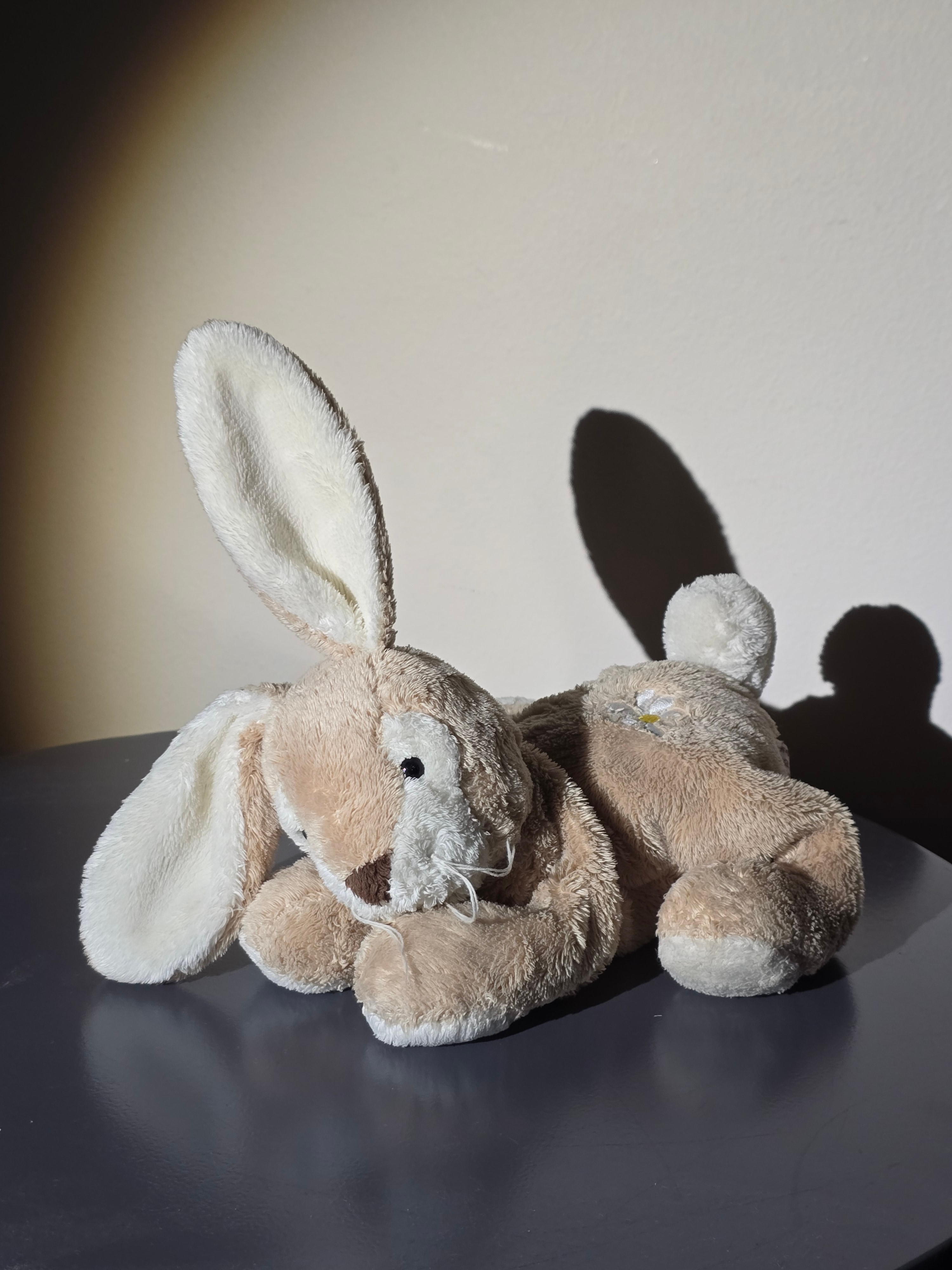
They love me. They love me not.
A relationship reduced to a rule.
I worried over scratches on its glass eyes with a seriousness that now feels disproportionate. I checked for dirt. Smoothed its fur. Preserved it carefully.
Yet the rabbit was never really the point.
The image was.
Eventually, the habit outlived the rabbit.
The more carefully I managed what could be seen, the less certain I became of what remained unseen.
Eventually, the same attention turned inward.
Thoughts were revised before they were spoken. Responses filtered and re-filtered. Silences stretched. Not because I had nothing to say, but because every sentence seemed to arrive carrying multiple possible versions of itself. Some felt safer than others.
A hand can keep a rabbit alive for a while. The rabbit, after all, survives on borrowed anatomy.
Long enough, perhaps, to convince an audience.
Long enough, sometimes, to convince itself.
The question that followed me was never whether the rabbit was real.
It was whether the distinction still mattered.
If a hand remains in the shape of a rabbit for long enough, does it eventually forget that it was ever a hand at all?
The rabbit could work and still fail.
It could be recognised. Welcomed, even. It could enter a room before I did and make the first few moments easier. It could soften the outline, smooth the delay, offer something legible enough to be accepted. Yet acceptance did not always become understanding. The image could arrive successfully while the process that produced it remained unseen.
The rabbit could be spoken to while the hand stayed unnamed.
That was where loneliness began to take shape for me. Not in the absence of people, but in the distance between being recognised and being understood.
Some conversations loosened that distance.
Not because they were effortless, but because they required less translation. Thoughts could arrive unfinished. Silences carried less urgency. Misunderstandings became easier to repair. The rabbit was still present, but it no longer had to stand between every interaction.
For years, I assumed the responsibility was mine. Some rabbits succeeded. Others collapsed. The explanation seemed obvious. Then the shape of the question began to change.
The same hand could produce entirely different shadows depending on where the light fell.
Preparing to begin the Laidlaw research period forced me to look back at the questions that had led me there. The training sessions asked us to consider not only what we wanted to study, but why those questions felt worth asking. I found myself returning to experiences I had long treated as isolated observations and recognising them instead as different shadows cast by the same underlying shape.
Research did not provide the question. It provided a vocabulary for asking it. Thin-slice judgement studies suggest that autistic people can be evaluated less favourably within seconds of social interaction, before meaningful understanding has had time to develop (Sasson et al., 2017). Milton’s (2012) Double Empathy Problem shifts attention away from the individual alone and toward the interaction itself, proposing that misunderstanding can emerge between people whose experiences and ways of communicating differ.
The shadow, it turned out, was never produced by the body alone.
My Laidlaw project begins in that space. It explores loneliness, masking, and authenticity across autistic, ADHD, AuDHD, and participants without autism or ADHD. Alongside established measures, I developed exploratory questions examining social compatibility, perceived misinterpretation, social expectations, failed adaptation, and access to relationships with people whose ways of communicating and understanding the world feel more compatible with one's own.
I am not only interested in whether loneliness differs between groups. I am interested in what remains after adaptation has succeeded: what happens when the rabbit is recognised, yet connection fails to follow; whether some environments require less translation than others; and whether understanding changes when people stop looking only at the image on the wall.
The question is no longer how to make a better rabbit.
It is what becomes possible when someone recognises the hand behind it.
References
Milton, D. E. M. (2012). On the ontological status of autism: The ‘double empathy problem’. Disability & Society, 27(6), 883–887. https://doi.org/10.1080/09687599.2012.710008
Sasson, N. J., Faso, D. J., Nugent, J., Lovell, S., Kennedy, D. P., & Grossman, R. B. (2017). Neurotypical peers are less willing to interact with those with autism based on thin slice judgments. Scientific Reports, 7, Article 40700. https://doi.org/10.1038/srep40700