Research Takeaways
One of the biggest things I learned this summer is that research integrity starts way before the final write-up. I used to think of research integrity mostly in terms of reporting accurate results, citing sources correctly to avoid plagiarism, and not manipulating data. Of course these things still matter, but this project taught me that integrity also means being willing to follow the evidence, even if that means changing your original plans. Although it may sound obvious, it was much harder in practice.
I began the summer with a pretty clear idea of what I wanted my project to become. I thought the main challenge was going to be finding the right evidence, the right datasets, and the right numerical thresholds to make that idea work. Instead, my research forced me to ask whether the structure I had originally planned for was actually supported in the first place. This one shift changed the way I now think about every part of the research process.
One lesson this reframing taught me was that titles and abstracts alone are not enough. Early in the process, it was easy for me to see a paper about deadwood, litter, vegetation or soil microbes and assume relevance. And often it was relevant, just not necessarily in the way I needed. The real answer to a paper’s relevance was usually buried in the methods section. For example, a paper might mention deadwood in the title but measure microbial communities immediately beside individual logs. By contrast, my specific protocol measures total coarse woody debris across a forest plot. These are related questions, but not measured the same. The same issue came up with litter. Litter depth can mean the recognizable leaves and plant material lying on the surface, or it can mean the full forest floor down to mineral soil. Despite the possibility of producing very different values, both measurements may appear in a dataset under a similar label.
Similarly, spatial scale also became just as important. A relationship found at the scale of a few centimeters around a log cannot be treated as evidence for a relationship across a 400-square-meter plot. A tree-diversity experiment planted under controlled conditions is not identical to species richness measured in an established New England forest. A microbial sample taken at a particular point in the soil might not necessarily line up with habitat measurements averaged across an entire stand. These distinctions do not make the studies useless, but they do change what the studies can support, making me much more careful about how I use evidence.
Another major lesson was learning to separate structural reference data from microbial evidence, which became fundamental to the final project. A forest inventory dataset can tell me how much deadwood is typical across a reference population, and a forest census can tell me how many native woody species usually occur within a specific plot area. These are examples of datasets that are useful for establishing structural reference ranges. But by themselves, they do not tell me what a given measurement means for soil microbes. Similarly, a microbial study can tell me that deadwood or litter affects microbial biomass or community composition while still failing to provide the regional reference distribution needed to say whether a field measurement is relatively low or high.
At the beginning of the summer, I was treating all of this evidence as part of one group. By the end, I was much more deliberate in separating different kinds of evidence into their proper roles. This also helped me to become more comfortable with null and inconclusive results. As a part of this project I explored whether the visible habitat measurements showed detectable relationships with soil microbe biomass in an available northeastern forest dataset. The results were pretty tame, with native woody richness and deadwood not showing detectable associations while surface litter produced a suggestive relationship that weakened under additional checks. A few weeks earlier, I would have mainly seen these results as problems. Instead, I have come to see them as useful bits of information. The results did not mean that the structural measurements had no value, but rather that I should not assign them a microbial meaning that the data had not demonstrated.
This distinction helped me understand that a null result is still a result, and just as important. Research is not successful when it only manages to confirm the original expectation. Sometimes, the most useful thing an analysis can do is establish where the evidence stops.
I also learned that there is a point where persistence can turn into confirmation-seeking, one of the most uncomfortable lessons of the summer. Whenever I failed to find a paper supporting a particular threshold or interpretation that I wanted, my first instinct was to keep looking. Although further looking is always recommended (evidence can be difficult to find, important papers are easy to miss, etc.), I eventually had to ask whether I was continuing on because the search was genuinely incomplete, or because I did not like the answers that the existing literature was giving me.
Learning when to stop became part of my research, and so did decision-making more generally. There was rarely a moment where the evidence became perfectly complete, revealing an obvious decision. I still had to choose which datasets were comparable enough to use, which claims were properly supported, and which parts of the original framework should be removed, and not revised. This made me much more comfortable in making decisions in the face of uncertainty.
If I were starting this project again, I would change the order of operations. I would spend less time designing the final tool before looking at what the available evidence could realistically support. I would first define the practical question I wanted the project to answer, and then identify the relevant literature and datasets to decide what form the final project should take. I would also build a stronger evidence-tracking system from the onset. By the middle of the summer, I was juggling papers, datasets, model versions, field protocols, and reference calculations. Eventually I developed a more disciplined way of recording the data from each source I consulted, but it took a couple weeks to sort through the confusion before I found a good system.
The final project is different from the one I imagined when I started, but I no longer see that as evidence that the original plan failed. I see it as evidence that the research actually did its job. The most important thing that I will carry forward is the distinction between being committed to a problem and being attached to a solution. Good research requires persistence, but it also requires the willingness to abandon an appealing answer when the evidence no longer supports it.
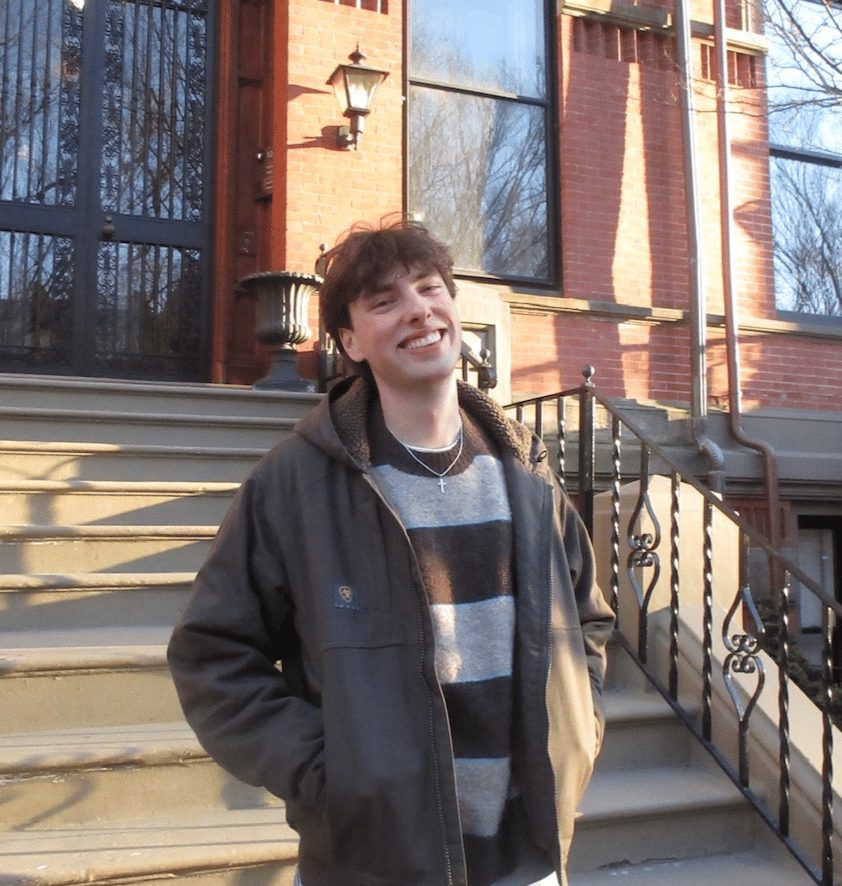
Hello! My name is Harry, and I am a student at Tufts University and part of the 2026 cohort of Laidlaw Scholars.
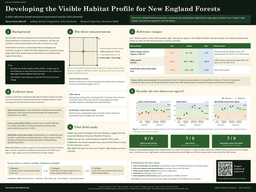
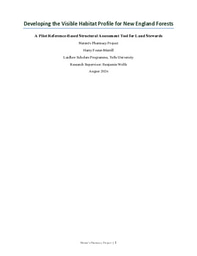
My project develops the Visible Habitat Profile (VHP), a pilot field tool that lets land stewards compare easy-to-measure habitat features (deadwood volume, native woody species richness, and litter depth) against regional reference ranges to judge whether their forest plot is unusual.
Through this research, my overall goal is to reframe rewilding as a public health strategy, not just an environmental one. As antibiotic resistance is increasing, some of the most promising sources of new antibiotics are soil microbes. By identifying which recovering forests have conditions associated with strong microbial communities, I hope to help direct conservation efforts toward the forests most likely to yield tomorrow's medical discoveries.
If you would like to connect or have any questions at all, please feel free to reach out!