Research journey: Beginning with Data

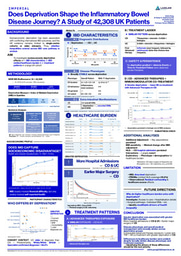
Back in London, I have finally been able to access the UK IBD BioResource and begin exploring its large-scale dataset. Since the data cannot be viewed directly on my own computer, I first had to learn my way around the secure research workspace. Understanding its structure took patience, but it soon became intuitive.
This is my first time using R to analyse a UK dataset of this scale, and the volume of variables and coding schemes was initially disorienting. Working through the IMD quintiles as an exposure measure, for instance, forced me to slow down and think about what deprivation actually captures in this context, rather than treating it as an abstract covariate. Gradually, the structure stopped feeling arbitrary and began to read as a record of patients' actual clinical journeys.
What has struck me most is that analysis is not simply about running the correct test. Every variable represents a real clinical decision or circumstance, and every association I find is a hypothesis about how social factors, disease characteristics, and treatment outcomes interact. This is one that needs to be interrogated, not just reported. Working at this scale has pushed me to think harder about why a given analysis is appropriate before running it, and what a numerical result would actually mean for a patient's care.
Alongside this, working with data at this scale has taught me a great deal about organisation and clarity of thought. Writing simple, clearly labelled code has become essential, not only so that I can retrace my own steps weeks later, but so that my supervisor can follow my logic without needing me to explain every line. I have learned that code does not need to be clever to be good; it needs to be readable. Structuring my scripts logically, rather than adding steps as I think of them, has also saved me from unnecessary repetition and from the kind of errors that creep in when the same operation is written slightly differently in five different places. In particular, I have come to genuinely enjoy using loops, as I can apply a single, well-considered piece of code across dozens of variables rather than repeating myself manually. This has has changed how I think about a task before I even start writing it, prompting me to ask what the underlying pattern is before solving each instance individually.
This way of thinking has started to extend beyond the workspace. Learning to code has changed how I approach problems in daily life more broadly. I try to look for the bigger pattern before getting lost in individual details, planning out steps logically before acting, and favouring the clearest, most direct route to a goal rather than the first solution that comes to mind. It is a small shift, but one that has made me a more deliberate thinker, on and off the page.
This has been a genuinely valuable opportunity, as I am building statistical and computing skills I didn't have three months ago. I have also deepened my understanding of IBD as a disease that plays out differently depending on who a patient is and where they live. If there's one thing this has taught me, it's that good research starts with uncertainty about which question to ask,and that learning to ask a sharper question is itself the skill.