Reflecting on Leadership Training
I was unfortunately unable to attend the training sessions in person, but taking them at my own pace has enabled me to engage with wider reading and dig deeper into some of the ideas presented. The key thing for me has been relating the ideas back to my LiA project, and considering how I can use what I am learning to make my project this summer the most ethical and impactful that it can be.
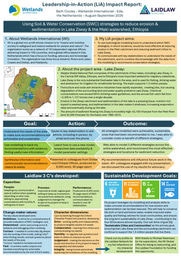
I particularly enjoyed the section from Dr Bruce Malamud (Institute of Hazard, Risk and Resilience, Durham) on communicating risk to foster resilience. In my project, (which is considering the potential effects on flooding and drought of different management systems of interconnected lakes in Ethiopia), I’ll be working with data and communicating the risks and likelihoods associated with different outcomes to key stakeholders, so this is highly relevant to me. I found the information on how to make effective infographics and how structured, ‘serious games’ can be used to simulate the outcomes of different hazards and management options to aid decision-making and education really relevant and helpful. I’m planning on researching these strategies further to consider how I might incorporate them in my project. As an applied mathematician, I’m really interested in how we as humans are notoriously bad at visualizing & understanding very big and very small numbers (a classic example being the public freaking out over a treatment with the side effect of ‘doubling the risk’ of a disease, when actually the risk itself is small so this is irrelevant – double a tiny number is still a tiny number!). This prompted me to read relevant chapters from Jordan Ellenberg’s ‘How not to be wrong’ and to re-read some of the classic ‘The Art of Statistics’ (David Spiegelhalter).
I appreciated the section on White Saviorism and Volunteering vs Voluntourism from Nikki Rutter. Although I have researched these topics before, engaging ethically is of paramount importance, so it was helpful to be reminded to continually and actively reflect on how biases and a western moral superiority complex could affect my judgement on my project. There were some statistics that I hadn’t seen before, including that 80-90% of children in orphanages are not orphans (Shawar & Shiffman, 2023), but removed from their families for financial gain via voluntourism - I was not aware that the figures were so high.
The exercise I found most useful was the SWOT analysis – I took time to consider my strengths & weaknesses and the opportunities & threats presented by my project, and considered how I might utilize my strengths and mitigate against my weaknesses in order to have the most successful and impactful LiA project possible. This was a really transformative process, as I was able to identify key areas to work on and put together a concrete action plan detailing how I will study topics like catchment modelling and the culture & economics of Ethiopia to prepare for my project. I considered how I might utilize my strengths in numerical analysis, networking and information synthesis in report writing, and how I might mitigate issues like loneliness, stagnation and overwhelm. I spent some time journaling and reflecting on these issues and created a personal ‘toolkit’ of activities I could use to support my mental health and nurture my passion and drive during my LiA project. I used the understanding I have gained about my character from regular reflection through the Oxford Character Project in this SWOT analysis – considering how I might utilize elements of my strongest character dimensions (Drive and Transcendence) and planning for how I might support and amplify elements of my weaker dimensions (Temperance and Humanity).
Overall, I found the training really helpful in prompting me to reflect on how I can make my project the most ethical and impactful it can be, and creating a plan to help me prepare for my project in order to achieve this.